Archaeologists from the National Institute of Anthropology and History (INAH) announced Monday the discovery of a cache of ancient Maya beekeeping tools found during construction on a Quintana Roo section of the Maya Train.
The significant discovery appears to support the theory that ancient Maya beekeeping and honey production were practiced not only in the northern part of modern-day Quintana Roo — something which researchers have long known — but also in the southern part.
The discovery of the three limestone jobón lids, plus other artifacts of Maya daily life not related to beekeeping, was made in an area of southern Quintana Roo encompassed by Bacalar and Felipe Carillo, southern Quintana Roo municipalities along the Maya Train’s Section 6, the Tulum-Chetumal route.
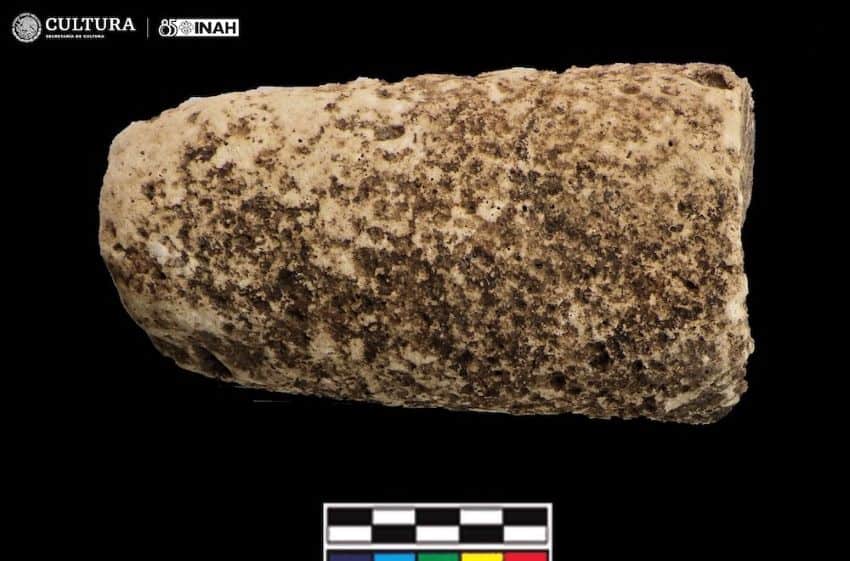
The discovered jobón lids — also known colloquially as panuchos — are round and measure between 20 and 25 centimeters long. They are believed to belong to the Mayan Postclassic Period (A.D. 950–1539), a time during which the peninsula was the central hub of Melipona honey production.
“Only one of the lids is in a good state of conservation,” Carlos Fidel Martínez said in a statement published by INAH, but “the other two [lids] have a high degree of erosion.”
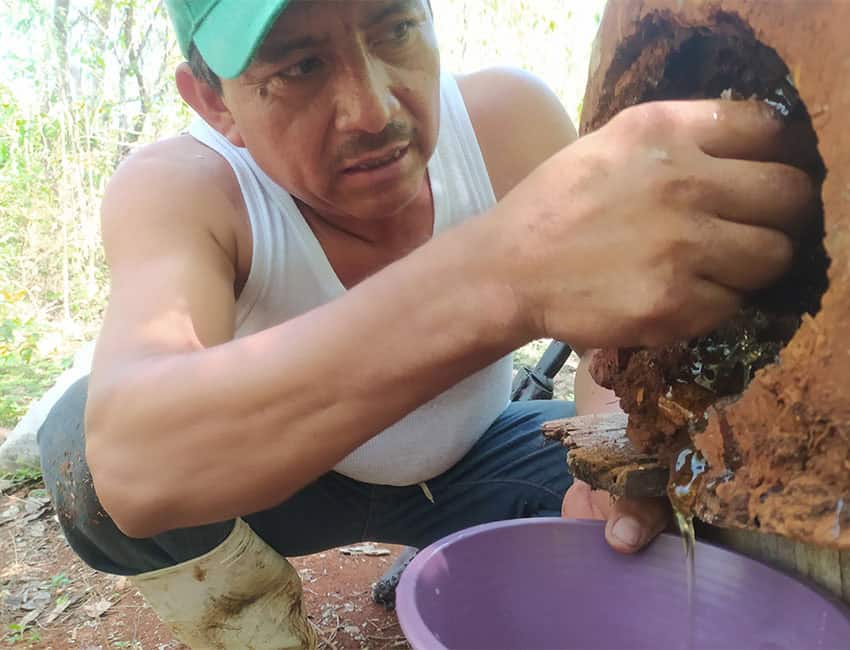
The jobón — a hollow log in which an active hive of melipona bees is housed, according to Maya beekeeping tradition — is still used today by Indigenous Maya on the Yucatán Peninsula. In traditional Maya beekeeping today, lids like the ones discovered by INAH are also still used to plug the opening of a jobón.
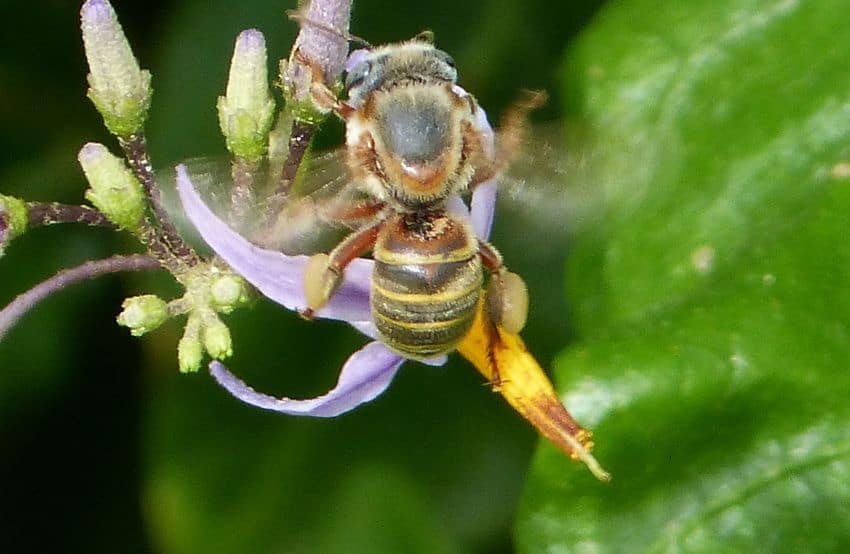
According to Martínez, excavators initially thought that they had bumped into a wall. However, upon discovering the lids, they realized that they had discovered the vestiges of a meliponary, an apiary dedicated to cultivating Melipona beecheii — the Maya’s “sacred bee.”

Melipona honey was important to the ancient Maya in the Yucatán Peninsula: they used it for ceremonial purposes, as food and as a trade commodity.
In addition to the lids, archaeologists unearthed other artifacts made of ceramics, stone and flint, including a cajete, or vase, with red and orange decorations. They also found two limestone metates that are 40 centimeters and 50 centimeters long, an ax, a hammer and a star-shaped shell bead.
The area where archaeologists found the beekeeping tools and the other artifacts is referred to by INAH as Frente 5, archaeologist Raquel Liliana Hernández Estrada said — an area inhabited by ancient Maya communities that did not belong to the elite.
“Most likely, we are in the presence of housing complexes from cities peripheral to ceremonial sites such as the Chacchoben Archaeological Zone and the Los Limones site,” Hernández said.
Since the construction of the Maya Train began in 2021, archaeologists have remarked that the discoveries made along the route could be considered Mexico’s “greatest archaeological treasure” in recent decades.
Mexico News Daily