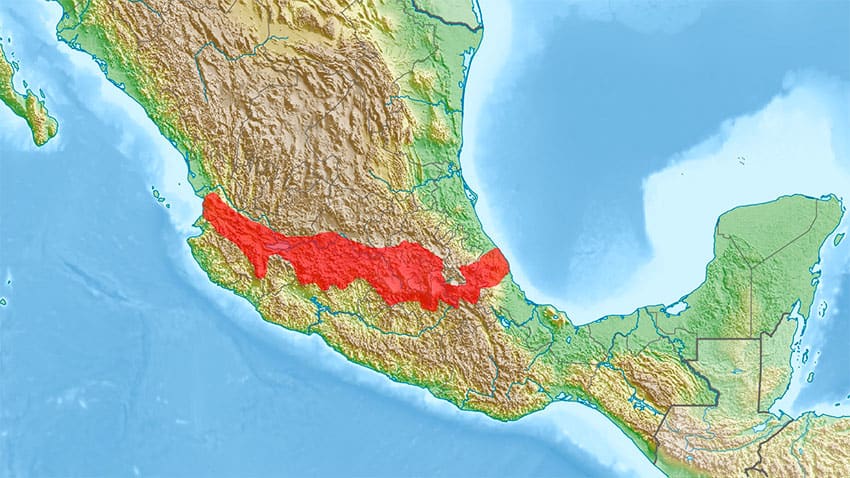
Earthquakes chronicled in Aztec codices and the accounts of Spanish missionaries have led seismologists to believe that Mexico is more seismically active than previously thought.
In a recent issue of the journal Tectonics, scientists offer details about a series of scientifically undocumented earthquakes that occurred in Mexico during the past 450 years.
They looked specifically at quakes that occurred along a 1,000-kilometer-long stretch of volcanoes from the Gulf of Mexico to the Pacific Ocean.
Known as the Trans-Mexican Volcanic Belt, the region is home to 52 million people, or 40% of Mexico’s population.
While only a small number of earthquakes have occurred along the belt since the advent of instrumental seismology in the early 20th century, information uncovered from codices and colonial-era accounts suggest that it is indeed quite susceptible to telluric movements.
One ancient codex, the Anales de Tlatelolco, says that an almost five-kilometer-long crack opened up in central Mexico during a series of earthquakes that lasted up to five days in February 1575.
That seismic event and others recorded in ancient texts were studied over a period of eight years by a team of Mexican seismologists, who attempted to ascertain the magnitude of the earthquakes.

Gerardo Suárez, a researcher at the National Autonomous University (UNAM) and co-author of the report, said that if the earthquake history of a region is compared to a feature film, the era of modern monitoring is just a blip on the screen.
“That hundred years of seismicity is like watching just two or three seconds of the movie,” he said.
Looking at records that pre-date modern earthquake records allows seismologists the opportunity “to see a few more frames,” Suárez added.
Zachary Ross, a geophysicist at the California University of Technology, agreed, telling National Geographic that geologists and seismologists often have to assume the role of a historian in order to get a fuller picture of earthquake activity in any particular region.
Even cave paintings and oral histories that have been passed from one generation to the next over long periods of time can be valuable to seismologists.
However, even more valuable are texts such as the records written by the missionary Fray Antonio Tello.
He chronicled an earthquake on December 27, 1568 that occurred in the western part of the volcanic belt.
Known as the temblor grande, the quake damaged churches and convents, triggered landslides, turned soil into bubbling fluid and opened up cracks in the ground. The UNAM team estimates that it was a 7.2-magnitude earthquake.
F. Ramón Zúñiga, a UNAM seismologist not involved with the study, said the reason why earthquakes are triggered along the volcanic belt is still being debated.
However, he added that it is now clear that earthquakes take place along its entire stretch.
Suárez said that if a moderately powerful crustal earthquake occurs along the belt in an area that is highly populated, such as Guadalajara, there is potential for “a great deal of damage.”
He said he hopes that news of the historical earthquakes, as detailed in Tectonics, will make people living along the volcanic belt more aware of the danger that lurks beneath the ground.
Source: National Geographic (sp)