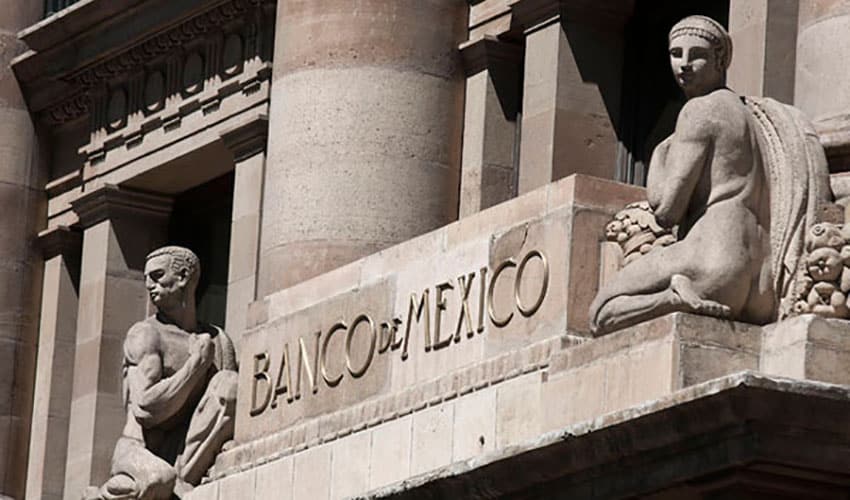
Mexico’s central bank and the Organization for Economic Cooperation and Development (OECD) have delivered more bad news for the Mexican economy.
The Bank of México said on Wednesday that Mexico’s economic and financial outlook amid the coronavirus crisis has worsened.
“The outlook for Mexico’s economy and financial system has deteriorated and become more uncertain,” it said in a financial stability report.
However, Banxico, as the central bank is known, said that financial stress tests indicated that capitalization levels among banks are still above the required minimum levels even in the most unfavorable economic scenarios Mexico could face due to the pandemic and the restrictions put in place to slow the spread of the coronavirus.
But the central bank also said that late corporate payments, especially those from small and medium-sized companies, have increased slightly.
Banxico has cut its benchmark interest rate by 1.5% to 5.5% since the start of the pandemic in Mexico and announced a 750-billion-peso support package for the financial system in April to help Mexico weather the coronavirus storm.
But fiscal support from the federal government amounts to less than 1% of GDP, a figure dwarfed by practically every other country in the region.

With only extremely limited support for business on offer from the federal government, Mexico is widely forecast to suffer a deep recession in 2020.
In a new economic outlook report published on Wednesday, the OECD predicted that Mexico’s economy will contract by 8.6% in 2020 if a second wave of coronavirus infections hits before the end of the year.
If a so-called “double-hit scenario” is avoided, and as a result economic restrictions that have been lifted don’t have to be reimposed, Mexico’s economy would contract by 7.5% with a recovery in the second half of the year led by exports and consumption, the OECD said.
In any case, “the pandemic will push the economy into a severe recession in 2020, driven by the global contraction, the fall in tourism, lower oil prices and the necessary domestic confinement measures taken,” the organization said.
“In both scenarios, the level of GDP would remain lower than [at the end of] 2019, as it will take some time for the tourism and export sectors to return to pre-pandemic levels. The poor and vulnerable, including informal workers, will be particularly hard hit by the recession.”
In that context, the OECD said that additional measures to support the economy are warranted as they would further mitigate hardship and reinvigorate the recovery.
“Such measures should focus on providing affected workers, both in the informal and formal sectors, with income support and avoiding that viable firms disappear. Bolstering private investment will be key to achieve a job-rich recovery and this will require reducing regulatory burden and uncertainty,” it said.
The OECD predicted that the global economy will contract by 6% in a “single-hit scenario” and 7.6% in a “double-hit” one.
“Both scenarios are sobering, as economic activity does not and cannot return to normal under these circumstances,” it said.
Source: Reuters (en), El Financiero (sp)