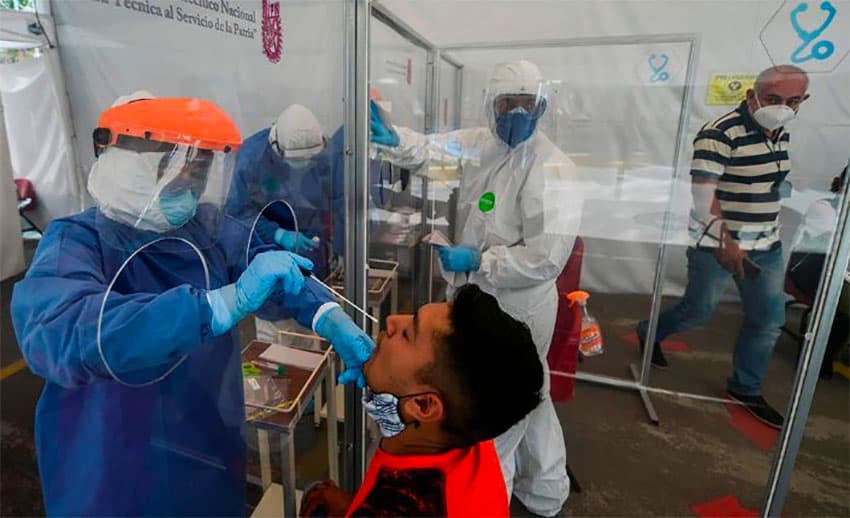
The magnitude of the Covid-19 epidemic in Mexico is being underestimated, warns the World Health Organization (WHO), and one of the main reasons is the lack of testing.
Limited testing and a disproportionate impact on indigenous and impoverished populations have made for a complex situation in Mexico where “the scale of the epidemic is clearly under-recognized,” said Michael Ryan of the WHO’s Health Emergencies Program said on Friday.
Mexico is testing just three of every 100,000 people a day, Ryan said, whereas in the United States the figure is 150 per day.
Tests are also not being done quickly enough to save people, Ryan said. Positivity rates in Mexico hover around 50%, “which means that many people are not well diagnosed or are diagnosed late.”
The WHO has been strongly urging widespread testing since March, but health authorities in Mexico have resisted, claiming that it would be “useless and costly.”
Ryan also said that wealth and class are factors in the spread and mortality of the disease.
“There’s a sharp difference in mortality among the wealthier districts and the poor municipalities,” Ryan said. “People living in impoverished areas are more than twice as likely to die from Covid-19 than those in more affluent areas.”

He also noted a different impact on indigenous populations in Mexico where the fatality rate is one in four to one in five.
Ryan said that Mexico must make efforts to increase access to tests in order to be able to conduct a realistic assessment of the country’s situation.
The WHO said on Friday that it expects the Covid-19 pandemic won’t last as long as the Spanish flu of 1918, which killed an estimated 50 million people by 1920.
“We hope to end this pandemic in less than two years. Above all, if we manage to unite our efforts … and use the available resources to the maximum and hope that we can have supplementary tools such as vaccines, I think we can end it with a shorter timeframe than the 1918 flu,” WHO director general Tedros Adhanom Ghebreyesus told a news conference.
Mexico is the seventh most affected country in the world by the Covid-19 pandemic, with 549,734 reported cases, although the actual number is estimated to be exponentially higher.
Source: El Universal (sp), CBC (sp), Euronews (sp)