50 years later, donkeys continue delivering water in Mexico City villages

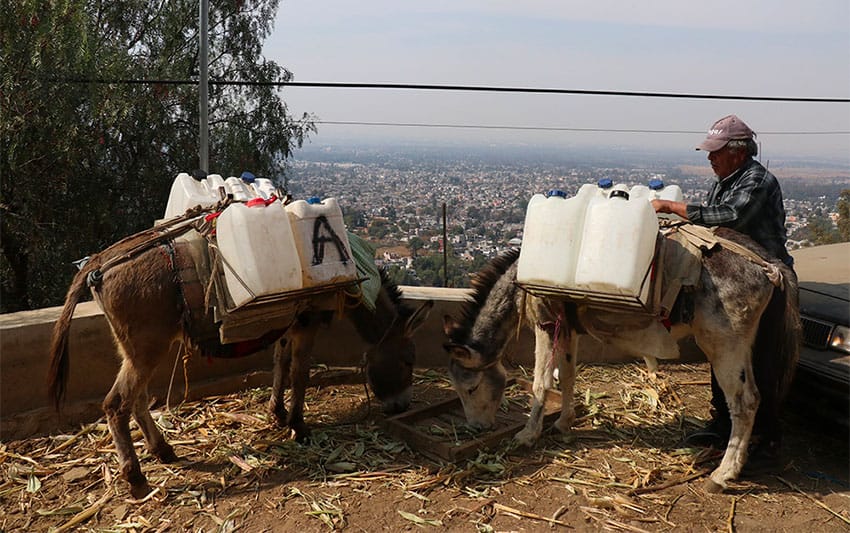
Thirty years ago, Aureliana started delivering water by donkey to hard-to-reach areas in the Mexico City borough of Xochimilco. Today, she carries on doing the same work, taking water to families that still do not have municipal or other water sources.

One such area is Acalpixca, one of the 14 original towns that make up Xochimilco, and still lacks water service.

“Before there were many donkeys. We had 10 or 15 animals, but now they have exchanged donkeys for cars because trucks can get to most places. Or they pay for water trucks and do not need donkeys anymore.”

“This delivery method has been in use for about 50 years. It began in Barrio de las Cruces, which was one of the first populated neighborhoods, and people delivered by donkey because there was no other way to get water,” said Abel Martínez, a local journalist.

Initially, many people worked in water delivery because the area had no public water service. Donkeys abounded to such a degree that the neighborhood was nicknamed “Donkey Town.” As public services grew and improved, fewer and fewer people dedicated themselves to delivering water. Now, customers are limited to roughly 200 families, who buy water due to lack of services or drought.

Eulalia, another delivery worker who still uses donkeys, said that many of her peers have sold their donkeys to buy cars as the roads have improved. But Eulalia carries on with her donkeys.
Donkeys are often loaded with four 20-liter containers. The animals and the delivery people have to travel approximately four kilometers from the water source to reach their remaining clients.

Source: Reforma (sp)

Have something to say? Paid Subscribers get all access to make & read comments.
Manzanillo, Colima, México, 13 de marzo de 2026. La doctora Claudia Sheinbaum Pardo, presidenta Constitucional de los Estados Unidos Mexicanos en conferencia de prensa matutina, “Conferencia del Pueblo” desde Colima. La acompañan Indira Vizcaíno Silva, gobernadora Constitucional del Estado de Colima; Omar García Harfuch, secretario de Seguridad y Protección Ciudadana (SSPC); Raymundo Pedro Morales Ángeles, secretario de Marina (Semar); Bulmaro Juárez Pérez, divulgador de lenguas originarias, presentador de la sección “Suave Patria”; Ricardo Trevilla Trejo, secretario de la Defensa Nacional (Sedena); Jesús Antonio Esteva Medina, secretario de Infraestructura, Comunicaciones y Transportes; Bryant Alejandro García Ramírez, fiscal general del Estado de Colima; Fabián Ricardo Gómez Calcáneo; Rocío Bárcena Molina, subsecretaria de Desarrollo Democrático, Participación Social y Asuntos Religiosos de la Secretaría de Gobernación; Efraín Morales López, director general de la Comisión Nacional del Agua (Conagua); Marcela Figueroa Franco, secretaria ejecutiva del Sistema Nacional de Seguridad Pública (SESNSP) y Guillermo Briseño Lobera, comandante de la Guardia Nacional (GN). Foto: Saúl López / Presidencia

Mexico’s week in review: Congress deals Sheinbaum her first legislative defeat

1
The week of March 9 in Mexico was marked by standoffs between allies in Congress and adversaries at the airport. Here's what you missed.
A soldier displays seized handguns

The US and Mexico, growing together and growing apart: A perspective from our CEO

1
From a historic drop in homicides to opposite bets on electric vehicles, Mexico News Daily's CEO breaks down where the U.S. and Mexico are converging — and where they're not.
Veracruz Gov.

Veracruz governor blames private vessel for 200-kilometer Gulf Coast oil spill

1
The spill, which has spread to over 200 kilometers of Mexico's Gulf Coast beaches, has been traced to a private oil tanker off the coast of Tabasco.
BETA Version - Powered by Perplexity