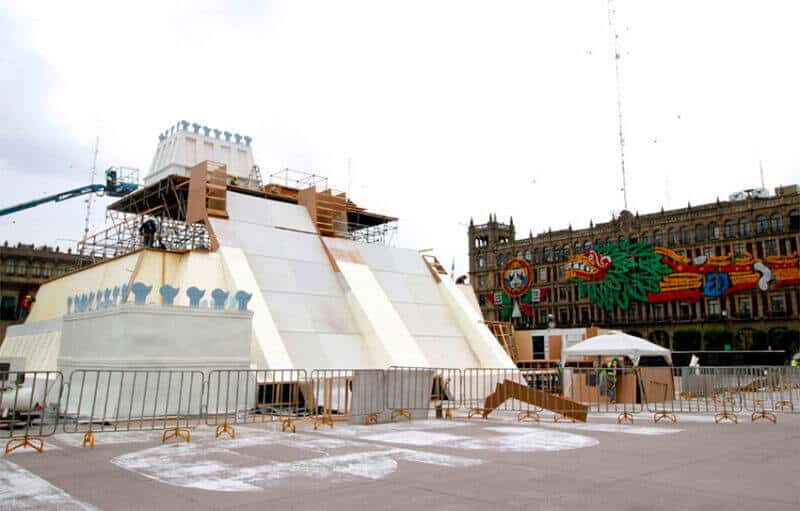
The tallest ever replica of the Aztecs’ Templo Mayor is being erected in Mexico City’s central square, the zócalo, to coincide with the 500-year anniversary of the fall of Tenochtitlán, the capital of the Aztec empire and forbear to Mexico City.
The Templo Mayor was the heart of the Aztec world where two deities were venerated with elaborate pageantry and sacrificial offerings. It was destroyed by Spanish invaders during the Conquest and fall of Tenochtitlán on August 13, 1521, and a Roman Catholic cathedral was built with many of the same stones next to where it once stood.
The 16-meter mostly white, square mock temple, adorned with small red and blue towers, attempts to capture the grandeur of the original, which was as high as a 15-story building, according to archaeologists.
President López Obrador will attend a ceremony in the zócalo on Friday to commemorate five centuries since the fall of the ancient city. The structure will stand in the zócalo until September 1, and a 15-minute film about the foundation of Tenochtitlán will be projected onto each of its four sides every evening.
Mexico City Culture Minister Vannesa Bohórquez López explained the symbolism of the temple’s four platforms and towers. Three of the platforms, she said, represented skulls, snakes and water and the towers on top were chapels dedicated to the rain god Tlaloc and Huitzilopochtli, the patron deity of Tenochtitlán.
Federal Culture Ministry festival director Argel Gómez Concheiro described the significance of the original temple. “For the [Aztecs] it was the center of the universe. It was the point at which one could enter the underworld and the different celestial levels,” he said.
As well as the fall of Tenochtitlán, this year also marks 200 years since independence. However, the government’s decision to plan 15 events this year to celebrate “Seven Centuries of History” have caused controversy. Archaeologists and other academics accused the government of manipulating history for political ends by claiming the foundation of Tenochtitlán was in 1321, 700 years ago, when the academic consensus points to 1325.

Yet in another area, the president has sought to set the historical record straight: he requested an apology from the Spanish monarchy and the Vatican for human rights abuses committed during the Conquest; a request which the government of Spain “vigorously rejected.”
The short film called Memoria Luminosa will be projected three times each evening from August 13 to September 1 at 8:30 p.m., 9:00 p.m. and 9:30 p.m.
With reports from Reuters