They called him “the journalist.” When I first saw Joel Rondón sitting in a quiet corner of the “21st Century” detention center in Tapachula, Chiapas, he was thinking intensely. It didn’t seem worth asking what was on his mind: getting out was everyone’s priority.
The Venezuelan, 32, didn’t look like the typical refugee. He wore a shirt and glasses, and had piles of documents; Mexican law and human rights law among them. The idealism was hard to ignore: we’d all been imprisoned without any legal process, but his faith wasn’t wavering.
He’d been trapped 27 days, and his patience had worn thin. The last time I saw him in “21st Century” was through the tiny window of the metal door which kept us confined. He was on the other side, being wrestled to the ground by police officers.
That resistance effort took him to a solitary cell. However, the next day word spread that he’d been released.
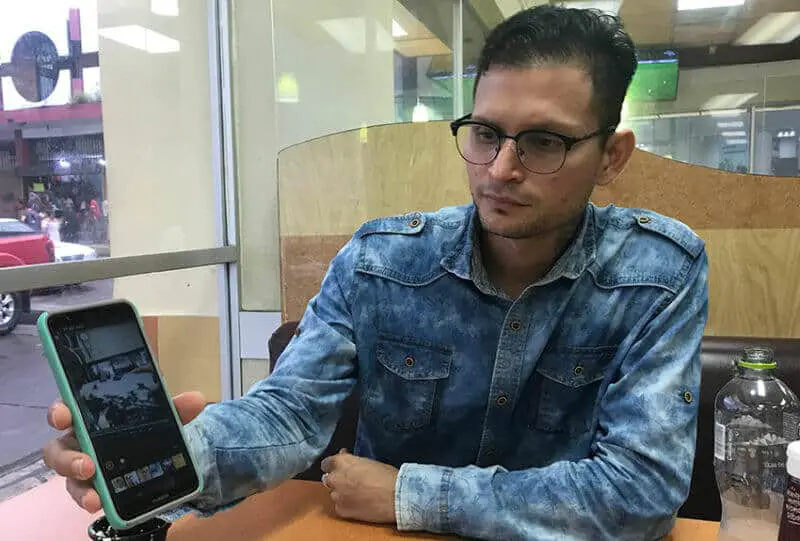
I met up with Joel in the Pollo Campero fried chicken restaurant in Tapachula later in October. He told me about the 10,000-kilometer road he and his wife had traveled.
“I left because of the political situation, I was pressured by the government. The dictatorship.” Joel had been working as a radio journalist for Bolivar FM, 104.5, in Maracaibo until 2017, when he left the country. His radio show became increasingly critical of the Nicolás Maduro regime, and started taking public legal accusations through an on-air phone-in.
Federal investigators took exception to the reporting. Not so subtle hints came that the broadcaster should keep a low profile, accompanied by demands for dollar bribes. “It brought us problems,” he said, in understated fashion.

“I left Venezuela and I went to Peru. I started doing the same reporting, live, from my cellphone … I was covering the plebiscite of [opposition politician Juan] Guaidó in 2017. That generated more problems for me in Peru. They’re criminals. They get your number … they threaten you … they wrote to me on WhatsApp: ‘We know you’re in Peru. You have family here in Venezuela.’ My whole family had to flee,” he said.
Chile was his next attempt at freedom. After setting up a cellphone repair business in Santiago de Chile, things were going well. Then one day an unwelcome visitor arrived. “We know you fled Peru, we know you fled Venezuela. We don’t want you here; leave this business,” Joel was told.
Back in Pollo Campero, slabs of fried chicken were disappearing when Joel reached for a video on his phone. CCTV footage showed a parking lot, and a thin individual riding a scooter. A car approached from behind, and made straight for the scooter, intentionally hitting the front wheel and knocking the rider off.
Someone was after Joel. Clearly Chile wasn’t safe either.
“From Chile I had to go through Bolivia, back through Peru, Ecuador, Colombia, the jungle,” he said referring to the Darién Gap, the inhospitable no man’s land which separates Colombia from Central America.
“I saw 11 bodies [in Darién]. It’s like entering a different dimension.”
After a hellish journey, the couple reached Panama, and were met with some unorthodox border policies: they were given US $40 to head north to the border with Costa Rica. A border officer told a crowd of migrants that he was about to turn his back, and the rest was their prerogative.
In Costa Rica there was no detainment. They crossed Nicaragua unimpeded: Venezuelan passport holders had free transit due to the political alignment of the two governments.
In Honduras, that changed drastically. Bribes were demanded at every police checkpoint. Guatemala, Joel said, was even more expensive: “They stop your taxi and demand $50 each.”
The pair crossed into Mexico in July. They had a meeting with refugee agency COMAR for September 6. That was canceled by the agency. The following day they decided to head north for Tuxtla Gutiérrez, the state capital, and were caught.
“The immigration official said I would be there for two days,” he said of the prison-like detention center he was sent to. There the facility overflowed with migrants sleeping in squalid conditions on the floor. Medical attention and phone calls were hard to come by; legal information and representation were inaccessible.
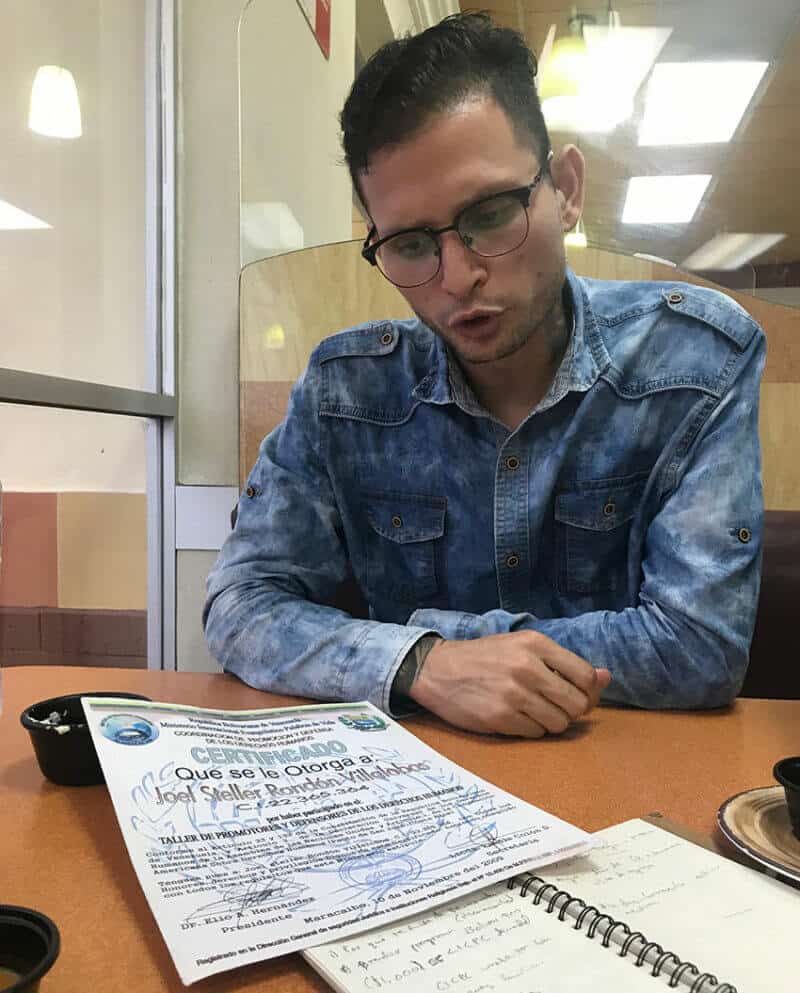
“I arrived at night and in the morning I was organizing a protest,” he explained proudly, before presenting his certificate as a human rights defender, awarded back in Venezuela. “They are violating human rights,” he said with conviction.
The protests continued, and they worked. He secured private meetings with the center’s director, which are not available to other inmates.
However, it didn’t seem to speed up the process. The days and weeks dragged on, and Joel found himself losing track of time. Eventually, from that solitary cell, his name was called and he tasted freedom once more.
Now, free of cells, bad meals and abusive officials, he and his wife feel little affection for Mexico. They hope to find their way to a place where their rights can be protected, and dollars can be earned.
Just one last border remains, before asylum in the U.S.A.
Mexico News Daily