A magnitude 2.4 earthquake usually comes and goes unnoticed, but that wasn’t the case Tuesday afternoon in the state of Jalisco about 60 kilometers south of Lake Chapala.
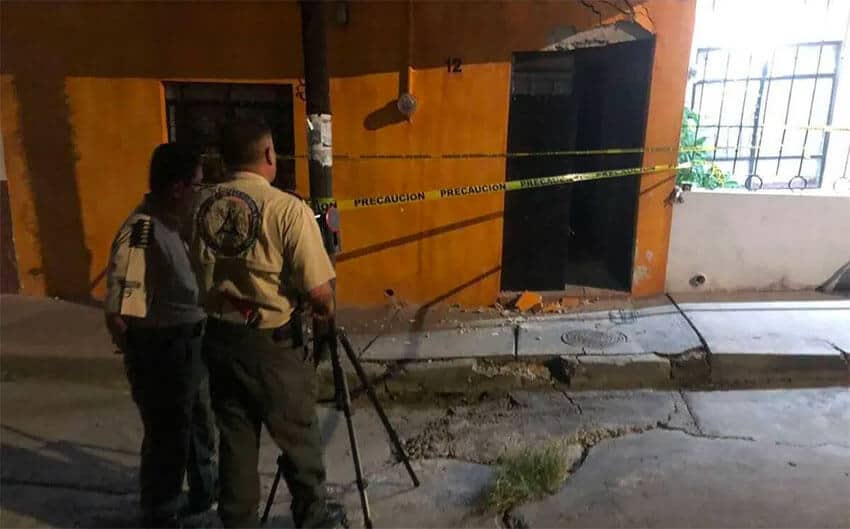
Up to 10 houses had to be evacuated, the water system had to be temporarily shut down and repaired, and several streets with cracks in the asphalt had to be closed to traffic in the municipality of Zapotlán El Grande after an earthquake described as “weak” by one geological service struck 1 kilometer west of downtown.
The damage occurred in several neighborhoods that sit atop a fault line, which for years has been a cause for concern. The neighborhood hit the hardest was Santa Rosa, but Magisterial and Centro also were affected.
“A little more than 70 homes have some type of damage, but only six are uninhabitable, and that number, unfortunately, could continue to rise,” said the municipality’s mayor, Alejandro Barragán. An initial report in the newspaper Milenio stated that at least 10 houses had to be evacuated.
Approximately 25 people spent the night in a shelter that had been set up in the San José neighborhood. The mayor said authorities, including the army, would be monitoring the evacuated houses to prevent theft.
The temblor struck at 3:58 p.m. Tuesday, and was followed by a 2.1 aftershock 41 minutes later, according to the National Seismological Service of UNAM’s Institute of Geophysics. Approximately 125 kilometers south of Guadalajara, Zapotlán El Grande is also known as Ciudad Guzmán.
State Civil Protection was called in to help inspect the affected areas and search for any further damage. Meanwhile, other agencies carried out topographical surveys to evaluate why there was so much displacement of soil and pavement.

Civil Protection director Víctor Hugo Roldán pointed out that the displacement of pavement and structural foundations has been monitored since 2002 and, in some cases, significant displacement has indeed been measured.
Added Barragán: “We must recognize that we have had studies for 15 years. What we do not have is the forecast of when things are going to happen. It is very difficult to carry out an investigation to say what type of infrastructure we should do.”
Several sources reminded Milenio that Zapotlán El Grande is a seismic zone atop a fault and that as long as the area remains inhabited, people are going to have to continue living with the danger.
With reports from Milenio