There are conflicting reasons as to why large numbers of dead fish have recently washed up on the Nayarit coast: a biologist says that toxic algae is to blame, but a Civil Protection official believes that a lunar eclipse is the culprit.
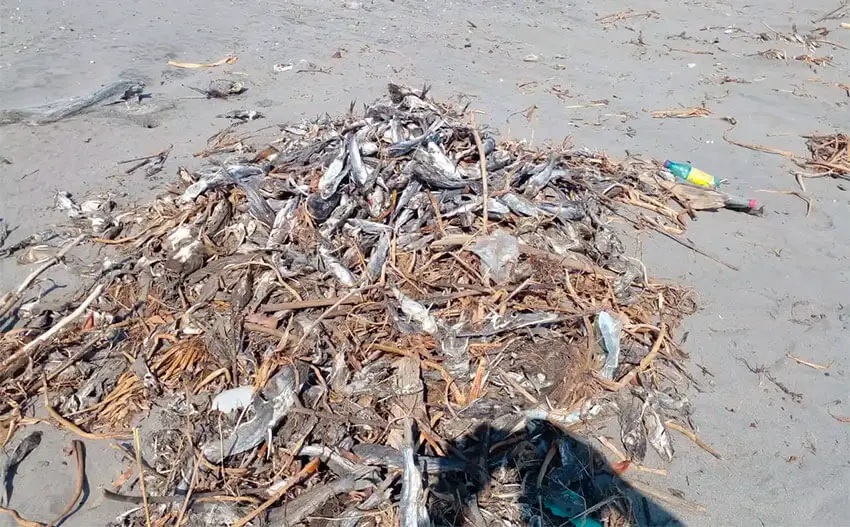
Dead fish have appeared this week on beaches in municipalities such as Santiago Ixcuintla and San Blas.
Mario Alberto Ortiz Jiménez, an academic at the Technological Institute of Tepic, said on social media that the decomposition of toxic microalgae is causing the fish to die.
“The [U.S.] National Oceanic and Atmospheric Administration has reported high levels of chlorophyll … off the northern coast of Nayarit since June 28. The high concentration of chlorophyll corresponds to a high proliferation of microalgae. Microalgae are often toxic and upon dying they decrease the concentration of oxygen in the water, causing fish to die, as occurred … on Playa El Colorado,” he wrote, referring to a beach on the Santiago Ixcuintla coast.
Peces muertos tapizan playa #ElColorado en Santiago Ixcuintla, en Nayarit; ninguna autoridad ha informado a qué se deba este fenómeno. Desde enero se han visto peces muertos en playas de Compostela, Bahía de Banderas y Puerto Vallarta, situación que achacan a la #MareaRoja pic.twitter.com/qz5p35cEJe
— Puerto Vallarta (@VivirVallarta) July 6, 2022

Ortiz said that rain is causing excess fertilizer from agricultural fields to flow into the ocean, “where it fertilizes the microalgae.”
“If that wasn’t enough, discharges of wastewater from Tepic … provide more nutrients for the microalgae, aggravating the problem. Earth is a system that is very sensitive to human activity. Anything we do will end up affecting our Earth’s ecosystem,” he added.
But Santiago Ixcuintla Civil Protection director David Estrada Mariscal reached a different conclusion, saying that the appearance of dead fish on beaches was due to a recent lunar eclipse. He indicated that the eclipse caused the fish to die and to wash up on the beach, an opinion that he formed after discussions with local fishermen.
“Due to the effect of the eclipse … dead fish began to wash up on the beach,” Estrada said.
According to a report by NTV Noticias, he was unable to say exactly when the eclipse occurred. The most recent total lunar eclipse occurred in mid-May.
Estrada conceded that a red tide, or harmful algal bloom, could have caused the fish to die, but said there was no record of such a phenomenon having occurred, indicating that he was oblivious to Ortiz’s explanation.
With reports from NTV Noticias