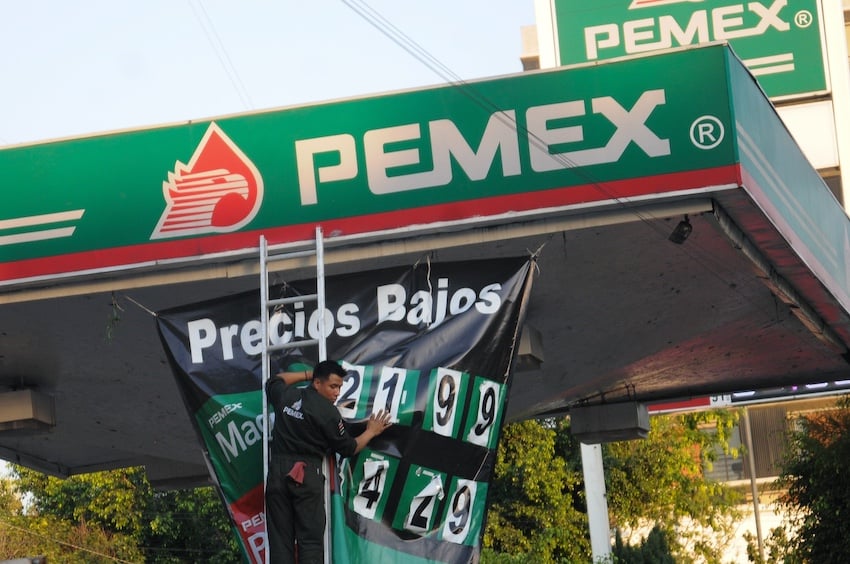
Taxes on gasoline in Mexico are five times higher than in the United States, making fuel at least 60% more expensive, according to an analysis by newspaper El Economista.
By comparing data from the consulting firm PETROIntelligence and the U.S. Energy Information Administration (EIA), El Economista calculated that 46% of what consumers currently pay for a liter of gasoline in Mexico goes to taxes, compared to 15% in the U.S.
As a result, the average price of a liter of gasoline in Mexico was 22.13 pesos per liter (US $1.28) on Monday, while gasoline in the U.S. sold for $3.058 per gallon, or $0.81 per liter.
The taxes on a liter of regular Magna gasoline in Mexico comprise 6.18 pesos in the federal Special Tax on Production and Services (IEPS), 0.55 pesos in state IEPS and about 3.54 pesos in value-added tax. This adds up to 10.27 pesos of taxes (US $0.60) on each liter, compared to 2.06 pesos (US $0.12) on an average liter in the U.S. — although the final price paid by U.S. consumers varies depending on local state taxes.
The fuel tax in the U.S. is updated every six months, while in Mexico, fuel prices are controlled through the IEPS, which varies each week depending on the fiscal stimulus applied by the Ministry of Finance and Public Credit (SHCP).
In times of hardship, such as the oil price spike following Russia’s 2022 invasion of Ukraine, the SHCP can cushion the blow to consumers by reducing IEPS or even applying an additional subsidy. It can later use the IEPS to recoup these subsidies, helping to reduce the impacts of fuel price volatility over time.

As global oil supply chains adapted during 2023, Mexico steadily restored IEPS and reduced fuel subsidies. This pushed fuel prices up 3.21% over the year, while they fell by 2.37% in the US and in many other countries around the world.

“The collection of the IEPS did not allow the low prices seen internationally to be observed in 2023, because the government had to recover the revenues used to prevent the price from reaching levels of 30 pesos per liter (US $1.74) last year [2022],” Alejandro Montúfar, director of gasoline market research firm PETROIntelligence, told El Economista.
These comparatively high fuel prices have presented challenges for Mexican businesses. For instance, low-cost airline Volaris and transportation firms such as Grupo México Transportes and Traxión all reported struggling with higher costs.
For Volaris, this was one factor leading to a 25% fall in share price over the first nine months of 2023, as fuel represents about 35% of its operating costs.
With reports from El Economista