Twenty months after a federal judge suspended bullfights in Mexico City, the world’s largest bullring was back in action Sunday — with approximately 40,000 spectators inside the stadium and a few hundred protesters outside.
The bullfights at Plaza México resumed a month after the Mexican Supreme Court (SCJN) overruled a lower court judge’s May 2022 injunction that sided with animal rights defenders.

Sunday’s event was a win for bullfighting enthusiasts in their protracted battle against those who argue that the practice violates animal welfare and affects people’s rights to a healthy environment.
Bullfighting is still allowed in much of Mexico, but the legal fight in the capital has gone back and forth.
On Sunday, the ring was emblazoned with the word libertad (freedom) and the mood was festive. Several media reports said there was a full house inside Plaza México, which has capacity for 41,262 spectators.
The first bullfighter to enter the ring was renowned Mexican matador Joselito Adame. In all, six bulls fought and all were killed.
Outside, a crowd of protesters estimated at 200 to 300 people yelled “Murderers!” and held signs reading “Sadism disguised as culture, sport and tradition” and “Torture is not art, it is not culture.”

Some had gathered near the Angel of Independence and marched to the venue.
“Why were the bullfights allowed to return when there is so much evidence of all the damage they do to a living being?” said Guillermo Sánchez, one of the activists.
Though police with shields were on alert, the protest was reportedly peaceful despite some activists throwing stones and plastic bottles.
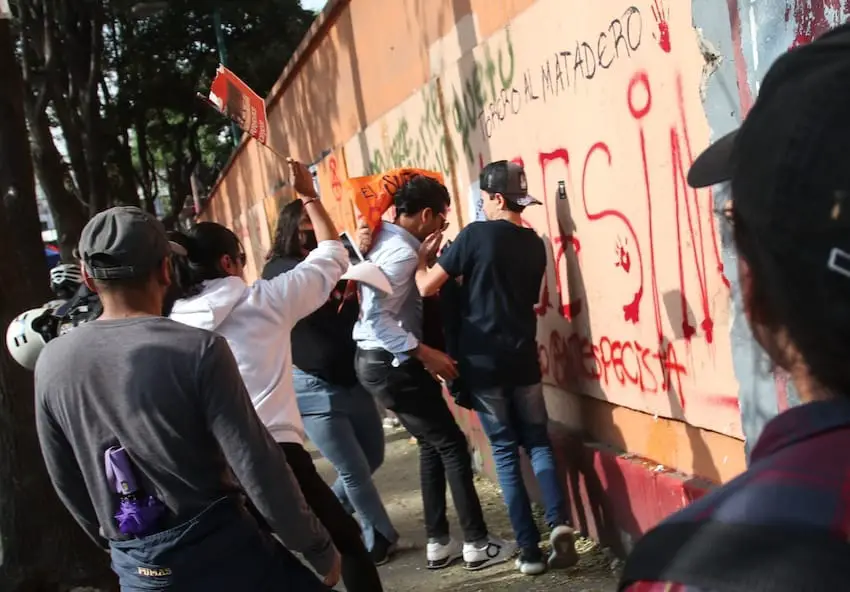
In May 2022, a local court ordered a provisional ban on bullfighting at Plaza México after civil organization Justicia Justa filed an injunction, citing the violation of human rights. The provisional ban became definitive in June 2022.
The suspension applied only to Plaza México, but as the only functional venue in Mexico City, the ban was effectively citywide. Also known as Monumental Plaza de Toros, the venue has been hosting bullfights since 1946.
The Supreme Court last month revoked the suspension while the merits of the case are being discussed and a decision is reached on whether bullfights affect animal welfare.
There are eight more bullfights on the early 2024 schedule at Plaza México, concluding on March 24.
The National Association of Fighting Bull Breeders in Mexico estimates that bullfighting is responsible for 80,000 direct jobs and 146,000 indirect jobs, and generates about US $400 million in Mexico.
Members of animal rights groups that have been gaining ground in Mexico in recent years say they are now attempting to collect 35,000 signatures to send to the Supreme Court in support of their stance.
Bullfighting is currently prohibited in five states: Sonora, Guerrero, Sinaloa, Coahuila and Quintana Roo. Meanwhile, it is considered as an intangible part of cultural heritage in Aguascalientes, Tlaxcala, Hidalgo, Querétaro, Zacatecas, Michoacán, Nayarit and Guanajuato.
With reports from El Universal, Aristegui Noticias, La Jornada and AP