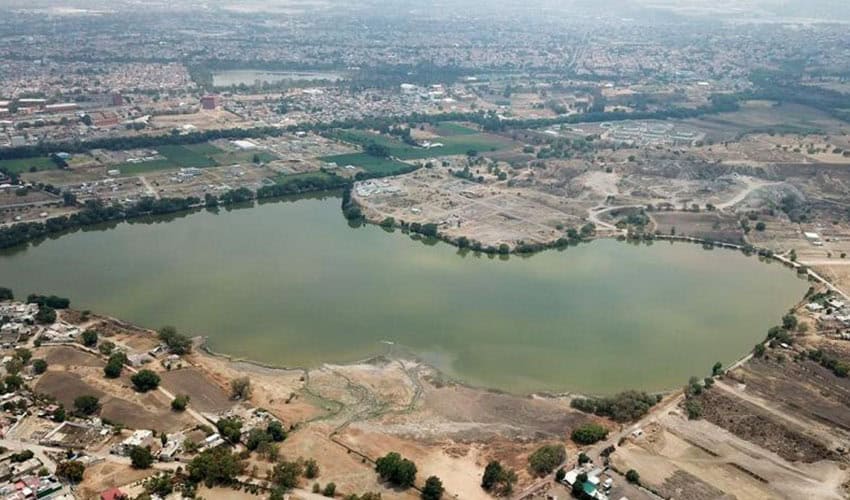
Authorities in México state have intensified their efforts to capture a crocodile seen in a lagoon, Laguna de la Piedad, located within the city limits of the Cuautitlán Izcalli municipality, considered a suburb of Mexico City.
Residents of La Piedad neighborhood, north of the lagoon, say they’ve seen at least two crocs, each of which is an estimated 3 meters (nearly 10 feet) in length. Locals told the newspaper El Heraldo that there could be up to four in the lagoon.
Roberto Romano lives along the lakeshore. He told El Heraldo that he has been seeing crocodiles in the early morning for about four years.
“There is one that is about 3 meters long … and a second that must have been about 1 meter 20 [less than 4 feet long],” he said.
The smaller crocodile has not been seen for some time and is presumed dead.
Although the Laguna de la Piedad is considered an important feature of Cuautitlán, it has been contaminated with effluent discharge for years and is often used as a dumping ground. The newspaper Record published a photo of the crocodile sitting on what appeared to be a refrigerator dumped in the lagoon.
The presence of crocodiles in the lagoon has been an urban legend for years, especially as the condition of the lagoon and its location in the middle of urban sprawl makes it an unlikely spot for a crocodile to settle. But recent sightings have been supported by photographs and drone videos that have circulated on social media and in newspapers.

Mexico is home to several species of crocodiles, but none is native to México state. A Cuautitlán environment official told Record that the animals in the lagoon had allegedly been dropped off there by a man in a trailer some years back. The community has since been feeding the crocodiles, the official said.
Elementos de protección civil, bomberos y personal de la PROFEPA montan operativo para capturar a cocodrilo que se encuentra en la laguna de la Piedad en Cuautitlán, Izcalli, Estado de México.
Con una lancha y redes, personal especializado buscará acercarse y capturarlo para… pic.twitter.com/6EdqKXK4fV— Uno TV (@UnoNoticias) April 29, 2024
These two short videos give a close-up look at the crocodile, sunning itself on a sofa dumped in the lake as firemen and other authorities attempt to get close enough to capture it.
Agents from the Federal Attorney for Environmental Protection (Profepa), México state Civil Protection units, members of local fire departments, and officials from the Environment Ministry (Semarnat) and the Cuautitlán Police Department began a concerted effort on Monday to capture the crocodile — or crocodiles.
Crocodiles are protected species in Mexico, so the authorities are intent on capturing and relocating the animals instead of killing them.
A Profepa team was paddling around the lake, nets were in abundant supply and officials set up several bait traps along the shore of the 39-hectare lagoon in hopes of capturing the reptiles.
With reports from El Universal, Heraldo de Mexico and Record