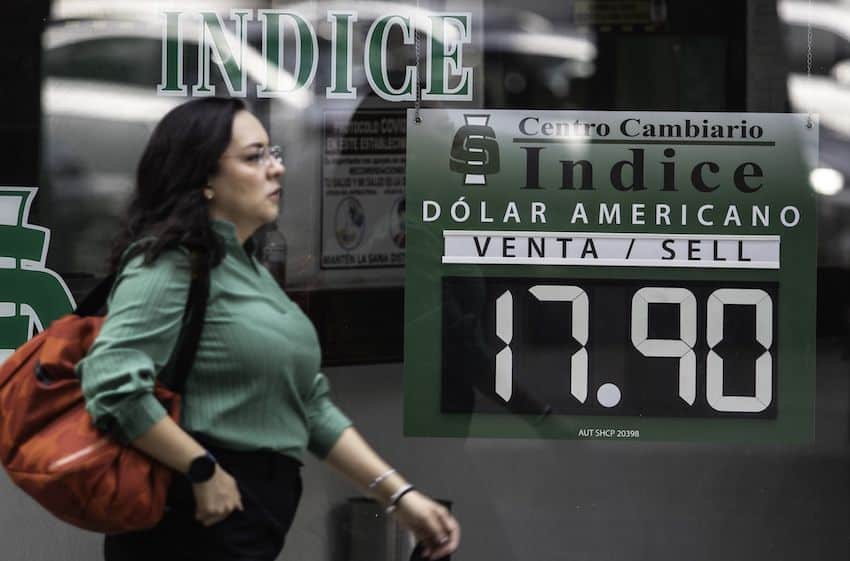
The Mexican peso weakened further on Tuesday morning, depreciating to above 18 to the US dollar due to concern over election results that could allow the ruling Morena party and its allies to approve constitutional reform proposals with little or no negotiation with opposition parties.
Bloomberg data shows that the peso reached a low of 18.15 to the greenback early Tuesday, while Reuters data shows it dropped to as low as 18.20.
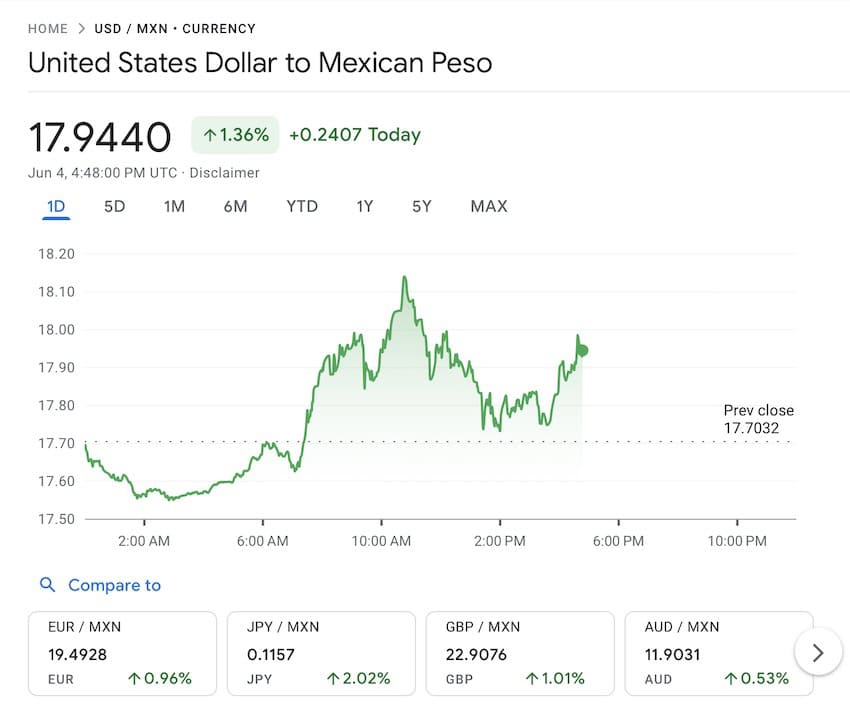
Compared to its closing position on Friday, the peso declined more than 6% to reach 18.15. The last time the currency traded at a weaker position was in October 2023.
At 10 a.m. Mexico City time, the peso had recovered to 17.83, a level slightly weaker than its closing position on Monday. But the currency had depreciated again to 17.96 to the dollar at 10:40 a.m, rounding slightly down to 17.94 just before 11 a.m.
The depreciation on Tuesday morning followed a significant weakening of the peso on Monday after election results showed that Claudia Sheinbaum was elected president of Mexico and Morena and its allies were on track to win large majorities in both houses of federal Congress.
“Quick count” results announced by the National Electoral Institute (INE) show that Morena, the Labor Party and the Ecological Green Party of Mexico easily won a two-thirds majority in the lower house of Congress, and could also reach a supermajority in the Senate.
A two-thirds majority in both houses would allow Morena and its allies to approve constitutional reform proposals without the support of opposition parties.

If the Morena-led coalition falls just short of a supermajority in the Senate — as some analysts and the federal government expect — it will only have to get the support of a few opposition senators to approve changes to the constitution.
Sheinbaum, who won the presidency in a landslide, will have immense power if her congressional allies pull off a supermajority in both houses of Congress.
President Andrés Manuel López Obrador would also benefit from such a situation for a brief period as the newly elected lawmakers will assume their positions in September, and the president doesn’t leave office until Oct. 1. López Obrador submitted a package of constitutional reform proposals to Congress in February.
The Monex financial group said Tuesday that the peso had depreciated further as markets continued to assess the implications of the election results for the economy.
Mexican bank Banco Base said that “risk aversion about Mexico” was persisting due to the election results.
“Risk aversion about Mexico continues after Morena candidate Claudia Sheinbaum won 59% of the vote in the presidential election” and the Morena-led coalition “won a qualified majority in the Chamber of Deputies and a large simple majority in the Senate, strengthening its position compared to the current legislature and increasing the probability of it being able to approve changes to the constitution,” Banco Base said.
The bank said that the news that Finance Minister Rogelio Ramírez de la O will remain in his current position when Sheinbaum takes office “has not been sufficient to calm the aversion to risk.”
Buoyed by a large differential between interest rates in Mexico and those in the United States, as well as strong incoming flows of remittances and foreign investment, the peso has performed well against the dollar for an extended period.
In April, the peso reached 16.30 to the dollar, its strongest position in almost nine years.
The low of 18.15 on Monday morning represents a depreciation of more than 10% for the peso compared to that level.
Mexican stock exchange also down
The Mexican Stock Exchange’s benchmark index fell more than 6% on Monday after the announcement of the election results. It was the worst single-day drop for the S&P/BMV index since the early days of the COVID-19 pandemic.
The index gained 1.6% shortly after the stock market opened on Tuesday.
President López Obrador asserted Tuesday morning that the market situation will soon “normalize.”
“There is a lot of responsibility in the management of public finances … and the Mexican economy is solid,” he said.
“The economic policy that we’ve been applying, and which has yielded very good results, won’t change,” López Obrador added.
With reports from Expansión and Aristegui Noticias