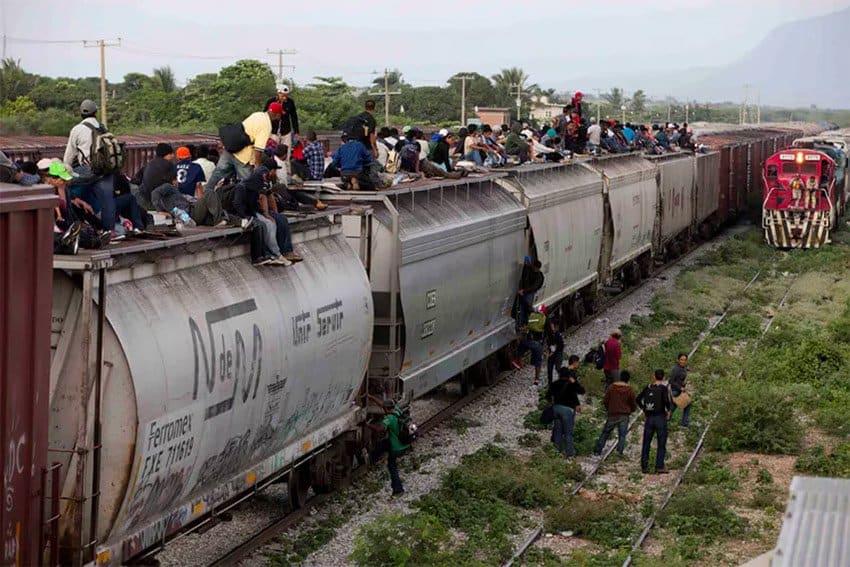
Mexico is often considered a transit country for migrants. It’s the territory Central Americans must cross to get to the United States.
But many generations of migrants have made Mexico their home. From 1930s-era Spanish Civil War exiles and Jewish World War II refugees to South Americans escaping military dictatorships throughout the 20th century, Mexico has welcomed successive waves of immigrants.
In 1948, during the drafting of the Universal Declaration of Human Rights – the founding document of the international human rights system – Mexican delegate Pablo Campos Ortíz advocated for a “very broad conception” of asylum.
Seconding a Lebanese proposal, Campos Ortíz said the world should recognize “not only the right of seeking asylum but also the right to be granted asylum.”
Mexico and Lebanon lost that debate.
The 1951 Convention for Refugees and subsequent agreements require that signatory countries offer asylum to migrants who can prove they have a “credible fear” of certain kinds of persecution. As demonstrated by U.S. Attorney General Jeff Sessions’ recent exclusion of domestic abuse as grounds for asylum, they are not obliged to accept all applications.
Mexico provides an exception to that rule – in law, if not in practice. It took almost 60 years, but in August 2016 a Campos Ortíz-inspired amendment to the Mexican Constitution recognized migrants’ right to seek and be granted asylum. The amendment proposal called Mexico a “country of refuge.”

The next year, Mexico City approved a local constitution declaring itself a sanctuary city where authorities will “prevent, investigate, sanction and offer reparations for human rights violations.”
As a human rights scholar and immigrant, I have watched Mexico’s 2018 presidential election season closely. Would any candidates take a page out of Donald Trump’s playbook and demonize Central American migrants for political gain?
Despite an official commitment to the rights of migrants, Mexico has recently followed the U.S.’s punitive lead on immigration.
Between 2007 and March 2017, the U.S. government invested US $1.5 billion in the Mérida Initiative, a U.S.-Mexico partnership officially intended “to fight organized crime and associated violence while furthering respect for human rights and the rule of law.”
In recent years, however, Mérida Initiative funds have gone toward enhancing Mexican immigration enforcement. At the urging of the Obama administration, in 2014 President Enrique Peña Nieto launched an aggressive arrest and deportation program along its southern border.
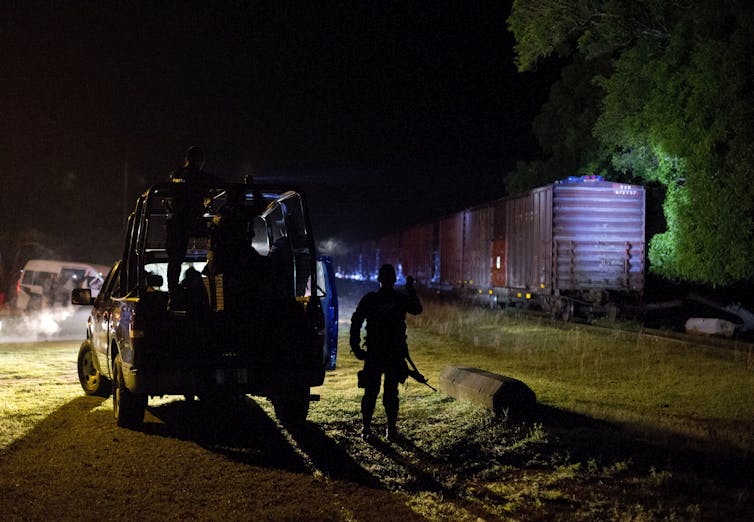
The Programa Frontera Sur targets Central American migrants attempting to cross Mexico. U.S.-trained Mexican immigration officials use American-funded surveillance towers and biometric data equipment to control the southern Mexican states of Chiapas, Oaxaca and Tabasco.
Nearly 40% of Central American migrants entering Mexico are fleeing violent attacks or threats back home, according to Doctors Without Borders.
But Mexican authorities still routinely force people to return to dangerous conditions, Amnesty International reports. This practice, known as refoulement, is illegal under domestic and international law.
Despite Trump’s Twitter claims that Mexico has done “nothing at stopping people” from coming to the U.S., the Frontera Sur program has proven effective. Between 2014 and 2015, Mexican deportations of Central American migrants – primarily Guatemalans, Hondurans and Salvadorans – more than doubled, from 78,733 in 2013 to 176,726 in 2015.
During the same period, detentions of Central Americans along the U.S. border fell by half.
From restrictions on asylum claims to mass deportations, the Trump administration’s draconian immigration policies may actually push Mexico closer to becoming the “refuge country” it claims to be.
According to a 2017 study by the country’s National Human Rights Commission, around 20% of 1,000 Central American migrants surveyed while passing through Mexican territory have now decided to stay in the country. The U.S. Border Patrol detained some 351,000 people attempting to cross illegally into the U.S. in 2017, down from 600,000 in 2016.
That has made migrants a hot topic in the lead-up to Mexico’s July 1 general election – but not in the way that might be expected. Presidential candidates have largely been largely sympathetic to their plight.
During the second presidential debate, which aired on May 21, an audience member from the border city of Tijuana asked the four candidates how they would improve Mexico’s “outrageous” treatment of undocumented Central Americans.
Frontrunner Andres Manuel López Obrador, from the Morena party, answered that he would stop doing the U.S.’s “dirty work” on immigration if elected.
López Obrador proposed instead an “alliance for progress” between the U.S., Mexico, Canada and Central America to foster regional job creation, economic development and security, thus reducing the need to migrate. He did not explain how he would persuade Trump to join.
Candidate Ricardo Anaya, who heads an unusual left-right alliance between the progressive Democratic Revolution Party and the conservative National Action Party, said Mexico must be the “moral authority” on immigration. It should treat Central American migrants the way Mexicans would like to be treated in the U.S.: justly and humanely.
Even José Antonio Meade, from President Peña Nieto’s Institutional Revolutionary Party, acknowledged that criminals, economic migrants and victims of violence are different groups of people and should treated as such.
In a rebuke to a Trump administration policy of separating migrant children from their parents, Meade added that unaccompanied minor migrants should be offered special health services and legal protection.
Not even independent Jaime Rodríguez, a political renegade who once suggested that Mexico could fight crime by chopping off drug traffickers’ hands, has taken a hard line on immigration. He proposed making the southern state of Chiapas a “Mexican California” – evidently meaning a place where low-paid migrant workers would help drive the local economy.
None of the candidates attacked migrants in a populist bid to win votes.
But none addressed the gap between Mexico’s treatment of Central American migrants and its “refuge country” status, either.
 For the next president, complying with Mexico’s new humanitarian law will mean passing policies that truly take migrants’ rights seriously.
Luis Gómez Romero is a senior lecturer in human rights, constitutional law and legal theory at the University of Wollongong. This article was originally published on The Conversation.