With only a few days remaining in the school year, teachers in Oaxaca and Chiapas have decided to return to their classrooms and end a month-long strike.
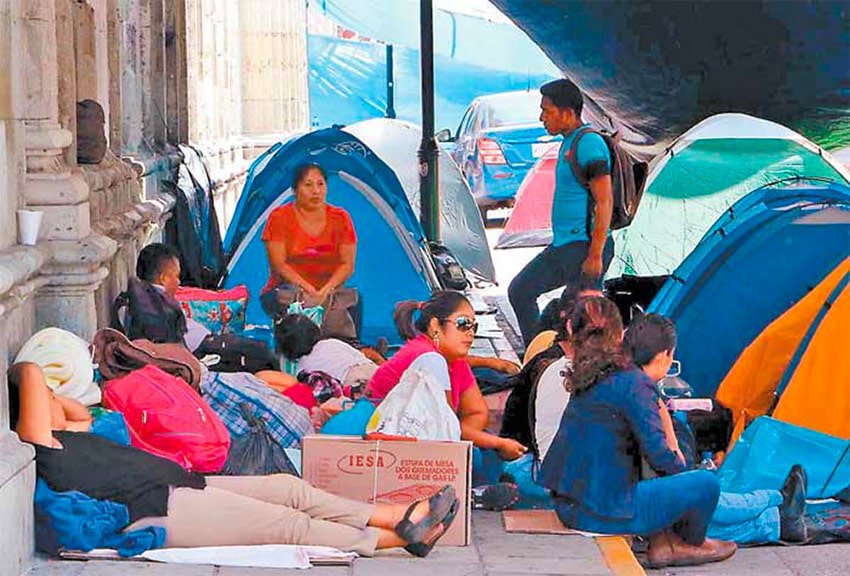
Members of the CNTE teachers’ union decided to abandon their protest camps in Tuxtla Gutiérrez, Chiapas, and in the streets of Oaxaca city. An encampment will remain, however, in the latter city’s central square, the zócalo.
Oaxaca teachers said they will return to work tomorrow while those in Chiapas have not indicated when they will go back.
A vote taken among some 20,000 of the union’s Oaxaca members revealed that 2,255 wished to continue the strike, 8,084 wanted to maintain a representative protest in which 20% of the membership would participate and 7,828 wished to withdraw the protests and end the strike.
This morning, teachers withdrew from the streets in the city center after a 17-day occupation, leaving only the camp in the main square.
Although according to education officials fewer than 5% of Oaxaca teachers actually participated in the strike, the protest camp caused significant economic damage to the city, a business leader said yesterday.
Carlos Guzmán Gardeazabal, head of the Oaxaca chapter of Canacintra, the National Chamber for Industrial Transformation, estimated losses of 100 million pesos (US $4.88 million) and that some businesses were forced to close.

Guzmán said the willingness shown by Governor Alejandro Murat Hinojosa to encourage economic development is lost through the destabilizing actions carried out by the CNTE.
“We’ve made many calls, and we’re fed up. There’s no will among the teachers to modify their conduct and protest methods,” he said, adding that teachers should consider the fact that they’re affecting the city’s business sector, whose taxes are needed to pay teachers their salaries.
The governor said the state had met all the union’s demand that fell within its jurisdiction.
The union agreed that the state had provided answers to the demands but observed that 62% of them fall within the responsibility of the federal government.
Source: NVI Noticias (sp), Milenio (sp)