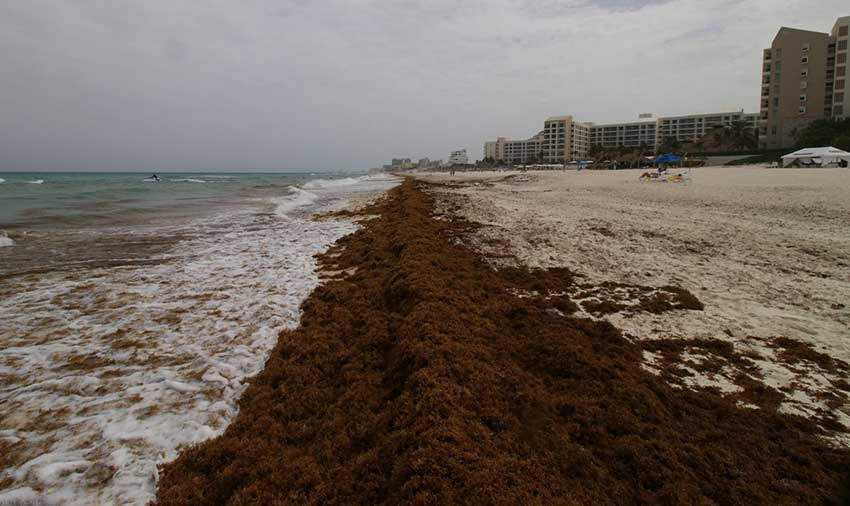
The mass arrival of sargassum on Mexico’s Caribbean coast beaches could cause a serious environmental disaster, researchers from the National Autonomous University (UNAM) have warned.
Brigitta Ine van Tussenbroek, a scientist at the university’s Institute of Marine Sciences and Limnology, said that since 2015 the presence of the brown, smelly seaweed on beaches in Quintana Roo has doubled.
She explained that apart from being an annoyance for tourists, sargassum also affects oxygen levels in the water, brings contaminants and other microorganisms to the beach, changes the ecological balance of coral and causes beach erosion.
“There could be an ecological disaster in the short term and by extension also a socioeconomic disaster because all the industry here in Quintana Roo depends on tourism,” Ine van Tussenbroek said.
She said that climate change and pollution are possible causes of the growing quantities of sargassum washing up on beaches in the state, adding that changing ocean currents were also a factor.
Subtropical Storm Alberto left tonnes of sargassum on beaches in seven Quintana Roo municipalities in late May but since then the seaweed has continued to arrive on the state’s coastline, affecting popular tourist destinations such as Cancún, Playa del Carmen and Tulum.
Martha García, also a UNAM researcher, said that no studies have been done about the effect of sargassum on human health but she explained that jellyfish sometimes hitch a ride with the seaweed and that they can inflict painful stings.

The sargassum also discolors the turquoise waters and white sand beaches that attract many tourists to Quintana Roo.
Both researchers agreed that academia, the private sector and government need to work together to address the problem.
“The sargassum problem that we’re experiencing at the moment in the state has already exceeded the individual response capacity of the municipalities or hotel owners. We need a coordinated effort to be able to mitigate it,” Ine van Tussenbroek said.
She added that studies completed by the Institute of Marine Sciences indicated that the owners of large hotels in Quintana Roo spend around 1 million pesos (US $54,000) per month to keep the beaches clean.
Source: El Financiero (sp)