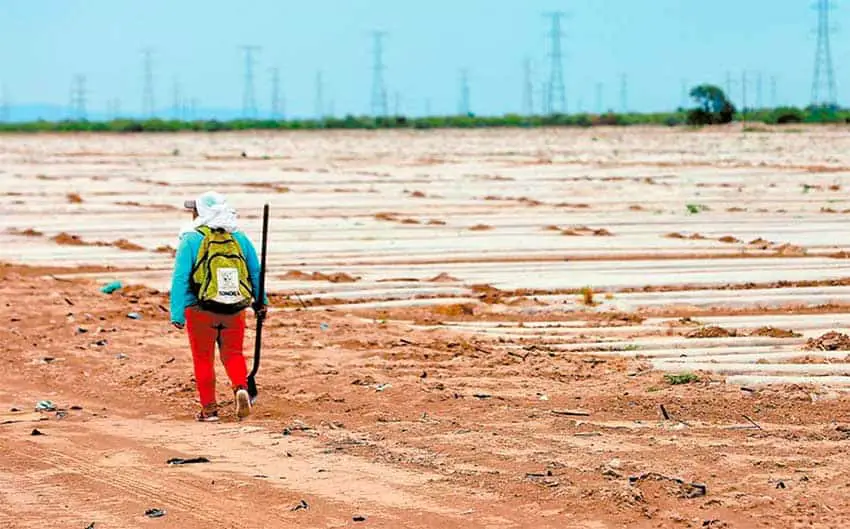
The heat wave in Sonora is continuing to take a heavy toll, causing the deaths of at least six people and making life close to unbearable for many.
Two jornaleros, or day laborers, three elderly people and one migrant have died due to heat-related illnesses and authorities have declared emergency situations in 64 of the state’s 72 municipalities.
For those living in poor-quality housing in informal settlements, the situation is even more dire.
One such community is Tres Reinas in the state capital of Hermosillo, where 600 families live without the basic services that many take for granted.
Homes are not connected to the city’s water service, forcing residents to rely on a once-a-week delivery from a pipa, or municipal water truck.
But each tanker only brings 1,500 liters of water, meaning that each family only receives a meager ration that doesn’t even come close to meeting its needs.
Electricity supply is also unreliable, which makes coping with the sweltering heat even more difficult.

Some residents don’t have refrigerators and instead purchase ice to try to keep food cool, while others who do sell popsicles to children who play barefoot outside on the hard, sun-baked earth.
In addition to the six deaths, the Sonora Secretariat of Health has reported 115 cases of heat stroke and other heat-related illnesses. Seventy per cent of those affected live in the municipalities of Hermosillo and Guaymas.
About 50 kilometers southwest of the capital, the community of Miguel Alemán is also suffering through the dog days of summer.
Up to 40,000 jornaleros arrive each year to work the agricultural fields of the area and other coastal regions of the state.
Although it is not currently planting season, some workers remain to water and guard the crops in July and August, meaning that they are also exposed to the fierce heat and direct sunlight.
Measures are taken to prevent the workers from falling ill — such as restricting work hours and ensuring that proper hydration is maintained — but they haven’t been completely foolproof and a small, under-resourced medical clinic has struggled to cope with the extra demand for its services.
Rosalba Rodríguez, supervisor of a team of women working at a Sonora vineyard, told the newspaper Milenio that when a worker suffers from heat stroke, the first thing she does is make sure that she rehydrates and rests until she recovers.
However, convincing a jornalero to miss a day of work, whether due to illness or excessive heat, is easier said than done.
“[Working in the fields] is hard but we have to do it because that’s how we live. If we don’t work one day because it’s really hot, we miss out on a day’s pay,” said Juan Narciso Urías, jornalero and secretary of a local workers’ union.
Source: Milenio (sp)