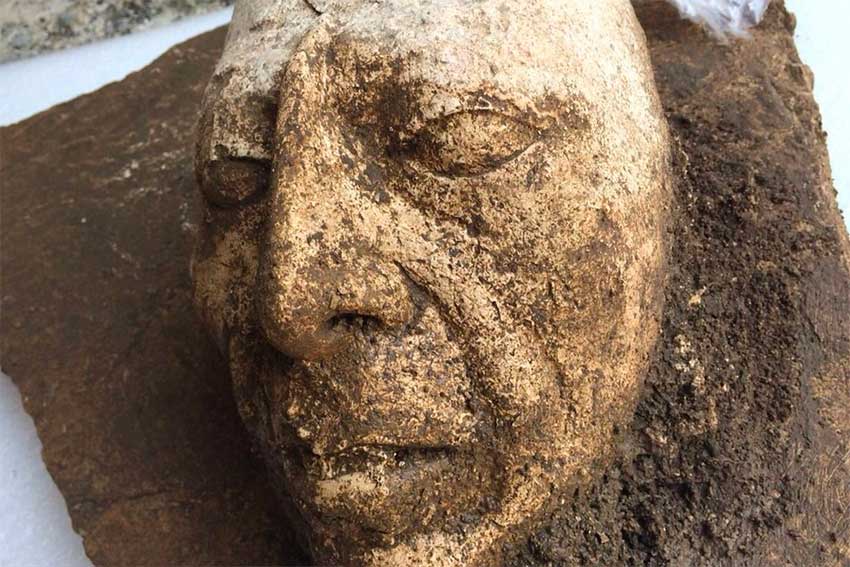
Routine conservation work in the Mayan city of Palenque, Chiapas, led to the discovery this week of a trove of archaeological treasures, including a mask believed to depict the Mayan ruler Pakal in his old age.
A team of specialists from INAH, the National Institute of Anthropology and History, led by Arnoldo González Cruz, was working on the foundations of House E of the site’s central complex, The Palace, when they discovered a ritual offering.
Small objects including ceramic figurines and flower pots, carved bones, jadeite, flint, mother of pearl and obsidian fragments and bone fragments belonging to several animal species were found along the prize discovery, a stucco mask thought to represent King Pakal.
Given the wrinkled facial features, including a prominent lower lip, the archaeologists believe that the face represents the likeness of the Mayan ruler.
If proven true, “it would be the first representation we have of an old Pakal,” said González.
Offerings like this “are normally related to the end of a period, an architectural renovation or the building of a new edifice,” said the chief archaeologist. “In this case, it looks like it was a renovation.”
The House E discovery had a second remarkable object, an ornamental nose plug the likes of which had not been discovered “either in the Mayan area or in Mesoamerica. It is unique,” said González. He added that while the object did not belong to Pakal, it does belong to the epoch in which he lived, the Mayan late classic.

González and his team started a three-year-long conservation and restoration project at Palenque in January, funded by a US $500,000 donation by the U.S. Ambassador’s Fund for Cultural Preservation.
Born in 603, Pakal became king at the age of 12 and ruled until his death in 683.
Source: El Universal (sp), Milenio (sp)