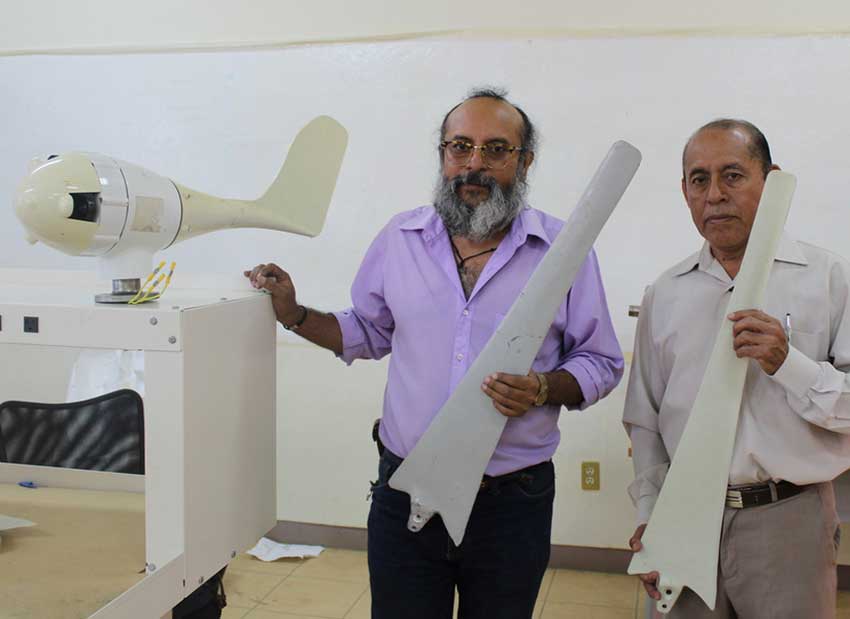
A new use has been found for the maguey plant, a symbol of Mexico and the base ingredient of tequila and mezcal. Researchers in Oaxaca have found it can also be used to produce blades for wind turbines.
Professors and students at the Technological University of the Central Valleys of Oaxaca (UTVCO) are currently conducting tests on prototypes of the blades made out of maguey bagasse, the residue of mezcal production in the state.
Results to date have shown that the material is even stronger than fiberglass, which most wind turbine blades are made of.
“Wind wears down fiberglass [causing it to detach] and what we’re trying to do . . . is avoid that harmful material spreading out into the environment as well as offer an alternative which recycles and uses the maguey residue,” said UTVCO professor Alejandro Alderete Nava.
More than 122,000 tonnes of maguey residue are produced annually in Oaxaca, Mexico’s main mezcal-producing state, and much of it ends up being illegally dumped in rivers or incinerated and generating air contamination, according to the National Council for Science and Technology (Conacyt).
Alderete explained that the blade prototypes made by renewable energy engineering students at UTVCO are for low-power wind turbines with a capacity of up to 600 watts.
He also said that environmentally-friendly wind turbine blades made out of coconut fiber were planned for a later development phase.

Oaxaca’s Isthmus of Tehuantepec region is Mexico’s wind power capital, with 26 of the country’s 45 wind farms located there.
Around 5.5% of all energy generated in Mexico currently comes from wind but according to an estimate by the Secretariat of Energy, that figure will increase to 16% by 2029.
Mexico is the 18th largest producer of wind energy in the world and the second biggest in Latin America behind Brazil.
Fidel Sánchez Maqueo, director of the renewable energy degree program at UTCVO, said that a “dual education” model will be introduced in September that will allow students to complement their university study with real world practice.
He said the university has reached agreements with wind power companies in the Isthmus of Tehuantepec, which will enable students to conduct fieldwork and gain valuable experience.
He also said that UTCVO has developed relationships with the Federal Electricity Commission and energy companies in other states, which will also serve to provide opportunities to students to gain experience and increase their chances of obtaining employment in the sector after they graduate.
Mexico News Daily