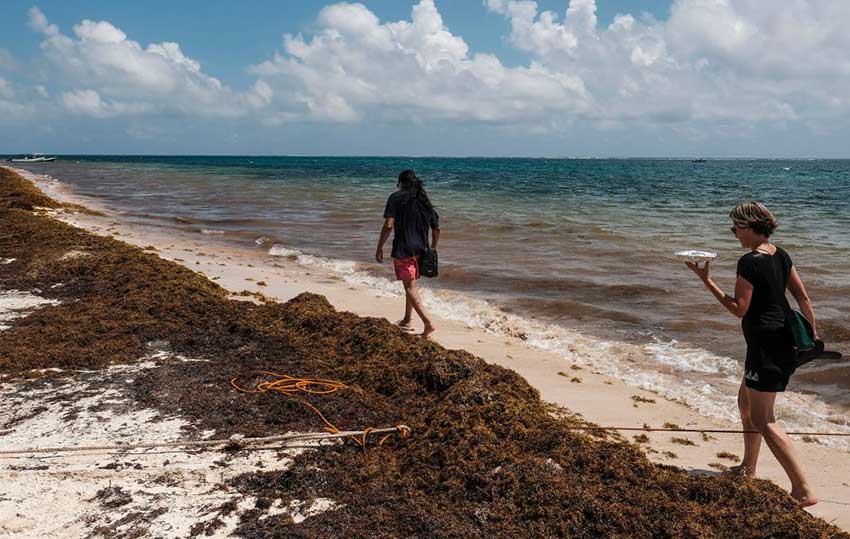
Large quantities of sargassum are again likely to wash up on the beaches of Mexico’s Caribbean coast in 2019, according to an ocean researcher from the National Autonomous University (UNAM).
Brigitta Ine van Tussenbroek, a scientist at the university’s Institute of Marine Sciences and Limnology, said that satellite images from the University of Florida show that there are currently large floating masses of the brown seaweed in the Atlantic Ocean between southern Africa and Brazil.
The coast of Quintana Roo at Chetumal, Tulum or Cancún could all be affected, van Tussenbroek said, although she explained that more detailed monitoring and modeling is needed to say with confidence which beaches would see large amounts of sargassum.
“If it’s in open ocean, the possibility of it arriving on the Mexican coast is very high although it depends on local atmospheric conditions, like trade winds, that carry sargassum to our beaches,” she said.
Van Tussenbroek warned that if the seaweed arrives in quantities similar to those seen last year, the impact on local ecosystems and tourism will be severe.
In 2018, tourism declined in some parts of coastal Quintana Roo due to the presence of unsightly and smelly sargassum on beaches that draw visitors because of their usually pristine white sand.
Van Tussenbroek said that authorities at all levels of government need to work together to establish efficient and environmentally-friendly methods with which to collect sargassum before it reaches the coastline.

“In Quintana Roo, the tourism sector is extremely worried and actively participates . . in the mitigation [of the problem] but [the response] should reach another level, go beyond local action,” she said.
The scientist added that her suggestion is to “establish a state or national coordinating body, [that is] specifically dedicated to effective [sargassum] mitigation.”
Floating sargassum barriers were installed off some sections of Quintana Roo’s coast last year to prevent the seaweed from arriving on shore but authorities and citizens were still required to dedicate thousands of hours to clean the state’s beaches.
Source: El Financiero (sp)