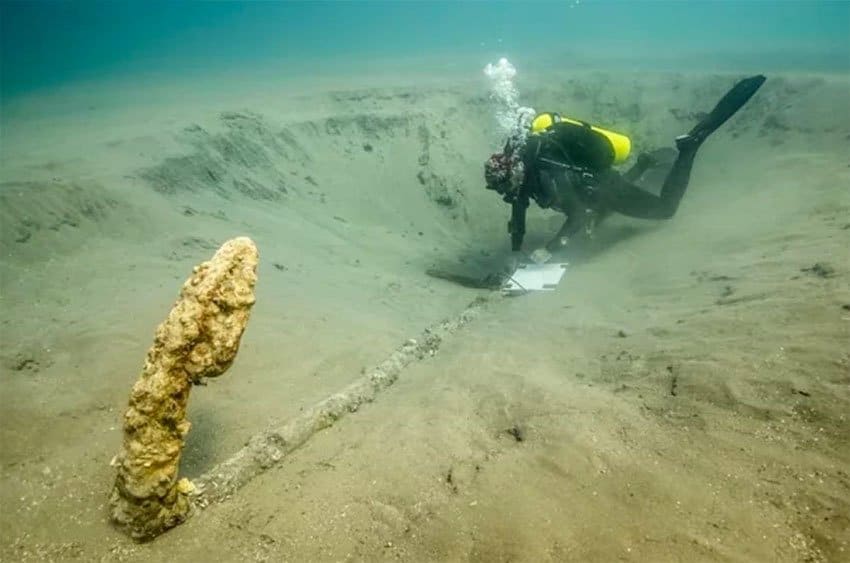
Search for Cortés’ ships turns up 15th-century anchor off Veracruz

Could an anchor half buried in the ocean floor off Veracruz be part of the wreckage of one of the scuttled ships of conquistador Hernán Cortés?

The Spanish adventurer had two options in 1519: face mutiny or quell a rebellion by scuttling 10 of his 11 ships, which would give the crews no option but to move inland with him toward the heart of the Mexica empire.

He chose the latter option, which has led to a project whose goal is to locate the remains of Cortes’ fleet.

This week, that project, headed by archaeologist Roberto Junco Sánchez and anthropologist Chris Horrell, made its first significant find — an anchor dating back to the 15th century with wood still attached to it, identified as being a type of oak found only in northern Spain.

Junco, head of the Underwater Archaeology Project at the National Institute of Anthropology and History (INAH), explained that the anchor was found just 12 meters below the surface, all but covered by sediment that helped keep the piece in good condition.

Preliminary analyses of the wood have been used to date it, narrowing it down to two periods of time, either from 1417 to 1492 or from 1450 to 1530.

The data is still not enough to link the anchor to one of Cortés’ ships, explained Junco, or with the ships of other Spanish explorers.

The anchor remains where it was found, but experts continue to analyze it using a three-dimensional reconstruction. The plan is to remove and stabilize it in order to guarantee its conservation.

The researchers’ work continues as they prepare a proposal for a second season of exploration season.

The search employs a magnetometer and sonar among other technologies to locate possible parts of the ships.

“The project is in its initial stages. We have before us many more hours of diving and visiting the sites marked by magnetic anomalies, and determining if those correspond to historical or contemporary objects,” said Junco.

The area under exploration is off Playa Villa Roca, about 75 kilometers north of the city of Veracruz.

Source: Notimex (sp)

Have something to say? Paid Subscribers get all access to make & read comments.
Manzanillo, Colima, México, 13 de marzo de 2026. La doctora Claudia Sheinbaum Pardo, presidenta Constitucional de los Estados Unidos Mexicanos en conferencia de prensa matutina, “Conferencia del Pueblo” desde Colima. La acompañan Indira Vizcaíno Silva, gobernadora Constitucional del Estado de Colima; Omar García Harfuch, secretario de Seguridad y Protección Ciudadana (SSPC); Raymundo Pedro Morales Ángeles, secretario de Marina (Semar); Bulmaro Juárez Pérez, divulgador de lenguas originarias, presentador de la sección “Suave Patria”; Ricardo Trevilla Trejo, secretario de la Defensa Nacional (Sedena); Jesús Antonio Esteva Medina, secretario de Infraestructura, Comunicaciones y Transportes; Bryant Alejandro García Ramírez, fiscal general del Estado de Colima; Fabián Ricardo Gómez Calcáneo; Rocío Bárcena Molina, subsecretaria de Desarrollo Democrático, Participación Social y Asuntos Religiosos de la Secretaría de Gobernación; Efraín Morales López, director general de la Comisión Nacional del Agua (Conagua); Marcela Figueroa Franco, secretaria ejecutiva del Sistema Nacional de Seguridad Pública (SESNSP) y Guillermo Briseño Lobera, comandante de la Guardia Nacional (GN). Foto: Saúl López / Presidencia

Mexico’s week in review: Congress deals Sheinbaum her first legislative defeat

0
The week of March 9 in Mexico was marked by standoffs between allies in Congress and adversaries at the airport. Here's what you missed.
A soldier displays seized handguns

The US and Mexico, growing together and growing apart: A perspective from our CEO

1
From a historic drop in homicides to opposite bets on electric vehicles, Mexico News Daily's CEO breaks down where the U.S. and Mexico are converging — and where they're not.
Veracruz Gov.

Veracruz governor blames private vessel for 200-kilometer Gulf Coast oil spill

1
The spill, which has spread to over 200 kilometers of Mexico's Gulf Coast beaches, has been traced to a private oil tanker off the coast of Tabasco.
BETA Version - Powered by Perplexity