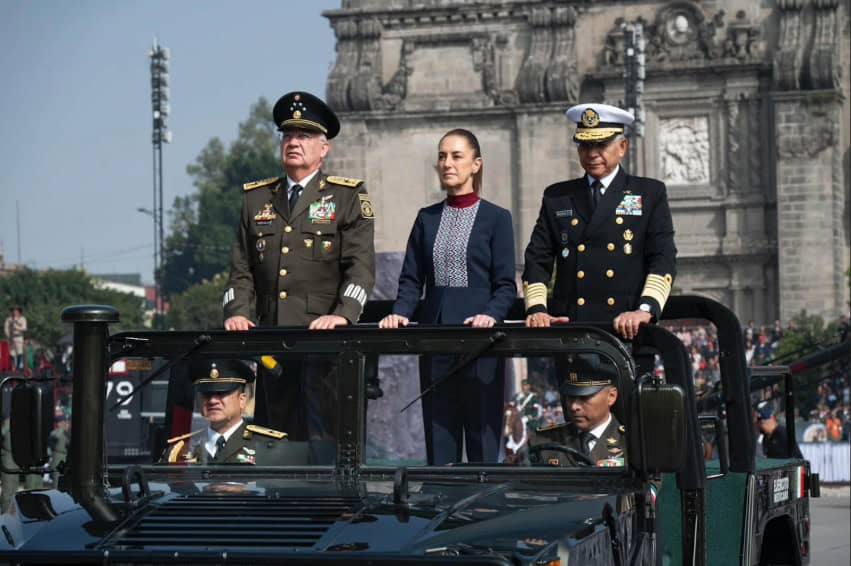
Hours after arriving home from a five-day trip to China, President Claudia Sheinbaum on Friday presided over the military-civic parade commemorating the 116th anniversary of the start of the Mexican Revolution.
At 10 a.m. local time, Sheinbaum walked across the Zócalo flanked by Defense Minister General Ricardo Trevilla and Navy Minister Admiral Raymundo Pedro Morales for a ceremonial flag-raising.
116 Aniversario de la Revolución Mexicana. Ciudad de México https://t.co/luurZLWDR4
— Claudia Sheinbaum Pardo (@Claudiashein) November 20, 2026
They then returned to a podium erected in front of the National Palace for a brief tribute to the military, followed by a series of speeches, culminating with the president.
Sheinbaum invoked the 1917 Constitution (a direct result of the Revolution) — describing it as the world’s most advanced charter for social justice at its time — issued a defense of democratic freedoms and expressed her administration’s rejection of elite privilege.

She also hearkened back to the violence and foreign interference that led to the turmoil of the Decena Trágica (a 10-day coup in February 1913 that ousted President Francisco Madero during the Revolution), accusing political opponents and foreign interests of attempting to weaken her administration and delegitimize the 2027 midterm elections.
During his comments, Gen. Trevilla praised Sheinbaum — Mexico’s first female commander-in-chief — reaffirmed the armed forces’ loyalty to the Constitution and civilian leadership, and claimed that the military draws its strength and social character directly from the working-class and campesino origins of the Revolution.
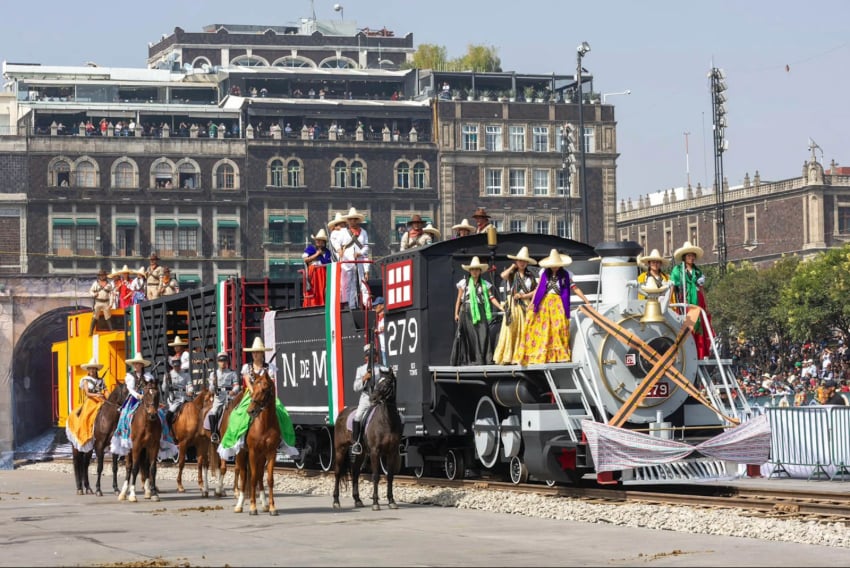
Following the speeches, performers in period costumes vacated the Zócalo to prepare for the parade. Before the floats appeared, actors narrated the meaning of the Revolution and its celebrations, soldaderas danced and sang corridos.
Then came the pageant floats depicting historical events such as the 1908 Creelman interview (in which President Porfirio Díaz hinted at democratic liberty after 34 years of dictatorial rule), Madero’s 1910 Plan de San Luis (a political manifesto urging an armed uprising), the 1913 Plan de Guadalupe (which rejected the coup after the Decena Trágica), the 1914 Aguascalientes Convention (which sought to unite rival revolutionary factions) and the 1917 Constitution.
The parade continued with military contingents marching through the Centro Histórico and along Paseo de la Reforma to the Monument to the Revolution while the Defense Ministry’s mariachi band entertained the dignitaries in the Zócalo.
Spectators lined the parade route, cheering on the participants throughout, while many lingered afterward in the shadow of the Monument to the Revolution where military vehicles were on display.
With reports from El Economista, La Razón, Milenio