Planning to use Mexico City International Airport (AICM) during the next two decades? Be prepared to help pay off government debt.
Over the next 19 years, taxes paid by passengers flying into or out of the airport will be used to pay back debt associated with the cancelation of the previous government’s signature infrastructure project, the new Mexico City airport.
It will be no mean feat. According to the Secretariat of Communications and Transportation, cancelation of the partially-built Texcoco project left a US $6-billion bond debt and a 30-billion-peso (US $1.56-billion) liability associated with the issuance of securities known as Fibra E shares.
In that context, the airport tax for both domestic and international passengers at the AICM rose on January 1.
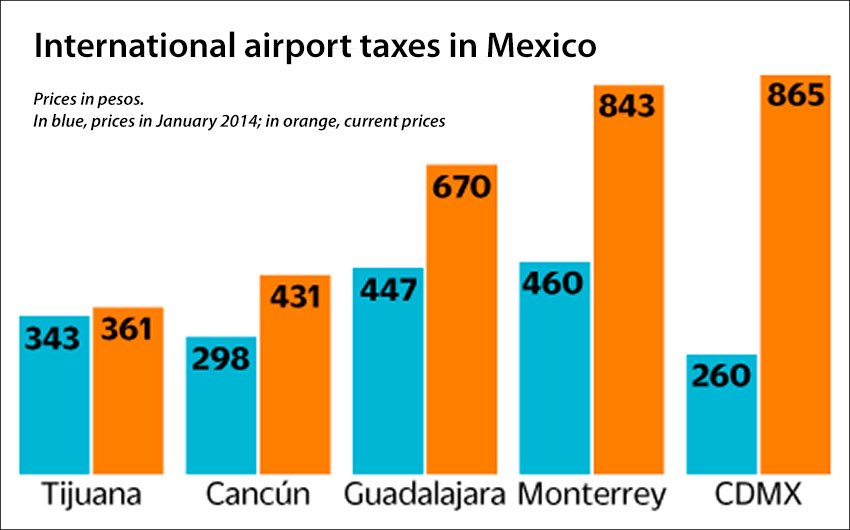
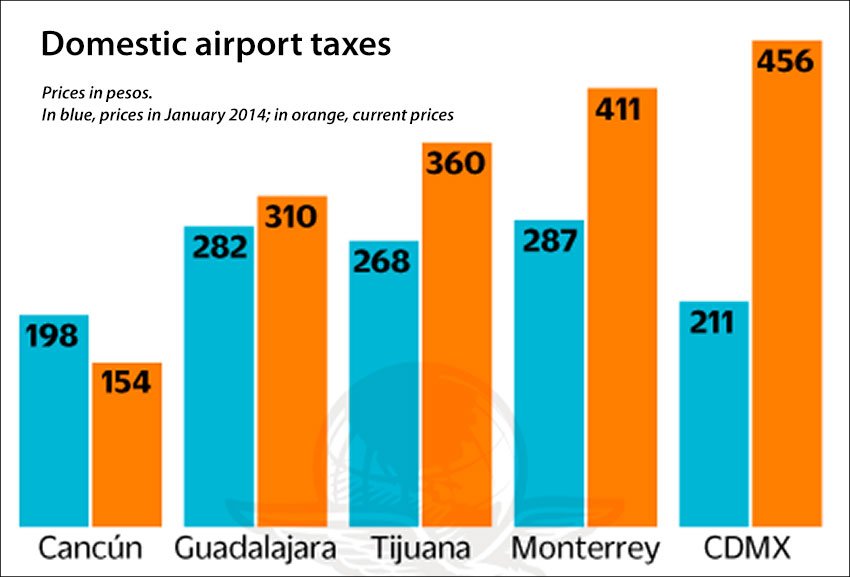
The former now pay US $23.79 to use the airport, a 116% increase compared to 2014, while the latter pay $45.18, a 232% hike.
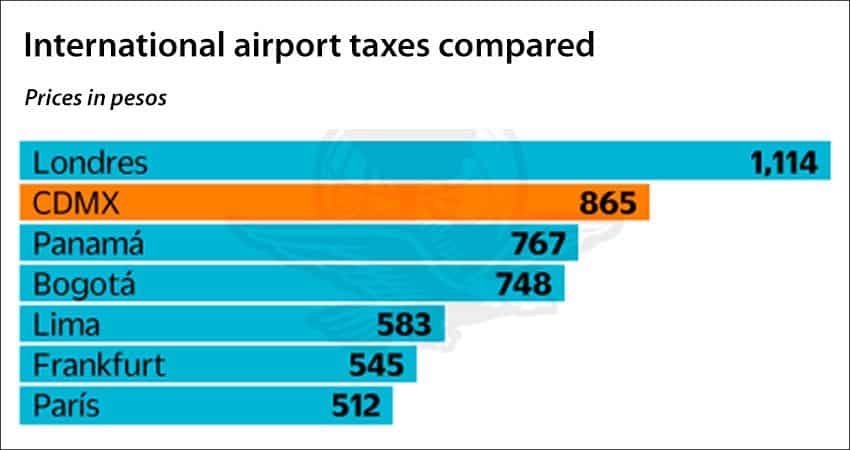
The newspaper El Universal reported that the new international passenger rate makes the Mexico City airport the second most expensive in the world after Heathrow in London, England.
The use of an airport tax to repay debt is unconventional – resources raised by the duty are most commonly spent on airport maintenance and improvement projects.

“We’re facing an unusual situation in which this charge is being used for something that isn’t maintenance, improvement, refitting or the construction of more runways that can increase the number of planes per hour,” said Rafael Camacho, an aviation analyst for the financial company Ve Por Más.
Rogelio Rodríguez, an attorney who specializes in aviation law, agreed with Camacho’s assessment.
“Mexico is a unique case in the world because airport taxes are always paid to improve an airport . . . but we’re paying to finance the debt of a government decision that in a sense threw away all the investment [of the abandoned airport] and took on the debt,” he said.
Under the current arrangement, none of the airport tax funds can be used for either the construction of the Santa Lucía airport or for the upgrading of the AICM, Rogelio explained
The lawyer said that those projects – including the construction of a third terminal and the installation of new technology at the existing airport – will have to be paid for out of the federal budget.
However, as a result of the decision to direct airport tax funds to pay off debt at Texcoco, a trust associated with that project paid the operator of the existing airport almost 57 billion pesos (US $3 billion) in compensation in April 2018.
The previous government planned for the abandonment of the AICM in 2021, the year when the Texcoco airport was to begin operations.
But based on the results of a controversial and legally-questionable referendum, President López Obrador decided to cancel the new airport project and instead build a new one at the Santa Lucía Air Force Base in México state and upgrade existing facilities in the capital and Toluca.
The plan, however, is not currently running as smoothly as the government would like.
The Santa Lucía project is currently facing legal challenges from a collective opposed to government waste that believes that reviving the abandoned airport is “legally possible,” while earlier this month the Environment Secretariat suspended assessment of the environmental impact statement until it receives more information.
Source: El Universal (sp)