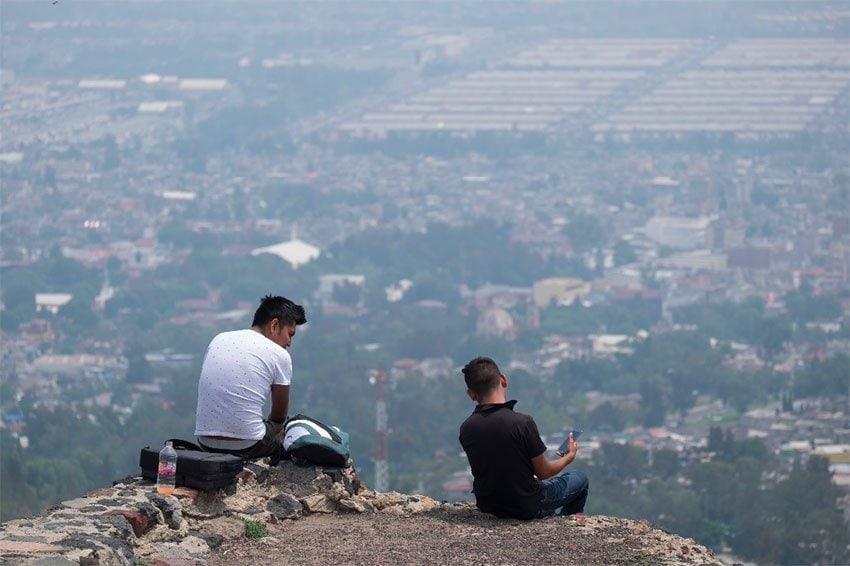
Authorities in Mexico City and México state have announced that they won’t comply with a court order to issue an environmental warning when pollution exceeds 100 points on the air quality index because it would cause “economic and social stress.”
Greenpeace was granted a definitive injunction on Monday dictating that contingency measures must be activated when the Imeca index, which measures the quantity of fine particulate contaminants in the air, hits 101.
Under the Mexico City government’s environmental contingency program, a contingency is declared when the Imeca index reaches 150.
While Greenpeace’s stricter pollution standard was endorsed by a judge, the non-governmental organization explained that the ruling allows authorities not to declare a contingency at the lower pollution threshold if doing so would adversely affect the economy, education, public and private transportation and the public in general.
But Greenpeace said that prioritizing the economy over people’s health would be irresponsible, highlighting that 17,000 people per year die in the Mexico City metropolitan area from illnesses related to air pollution.
However, the Environmental Commission of the Megalopolis (CAMe) and the environment secretariats in both Mexico City and México state say that is exactly what they will do.
Had the stricter standard applied since January 1, an environmental contingency would have been declared on all but 19 days so far this year, said CAMe chief Víctor Hugo Páramo.

He explained that around 200 gas stations and 11 LP gas plants would be forced to close on any given day when a warning is in effect.
In addition, more than 2,000 factories would have to reduce their production by 40%, Páramo said.
The CAMe chief also said that declaring a contingency at a lower pollution threshold doesn’t reduce air contamination, adding that people’s health is already protected by the dissemination of information about the risks of exposure to smog.
Mexico City Environment Secretary Marina Robles pointed out that a lot of the measures in Greenpeace’s more stringent standards, such as recommendations not to smoke on high-pollution days and for certain segments of the population to avoid going outdoors, are also set out in the government’s contingency program.
Source: El Universal (sp), La Jornada (sp)