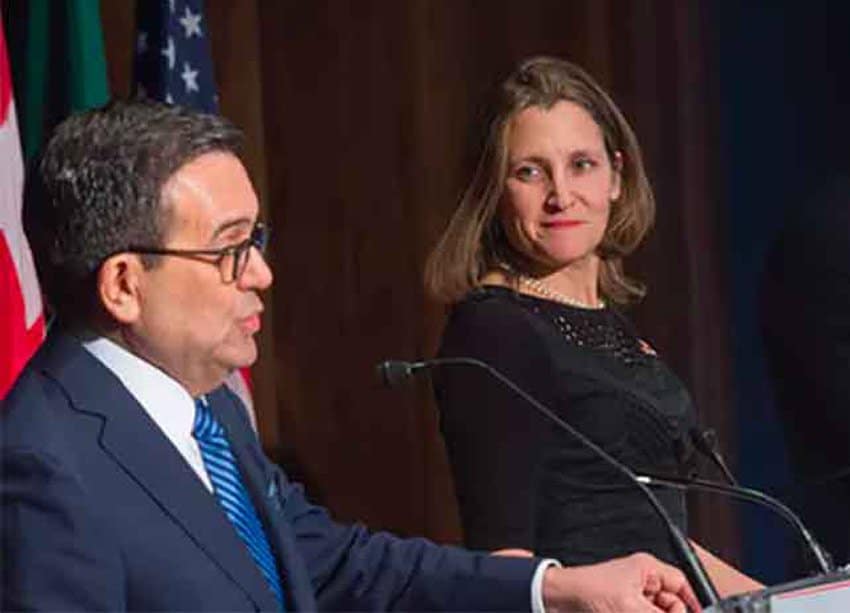
The process to renegotiate the North American Free Trade Agreement (NAFTA) will resume over the summer, Canadian Foreign Affairs Minister Chrystia Freeland said this week.
“We decided to continue our work in an intensive way over the summer,” Freeland told reporters Thursday after meeting with United States Trade Representative Robert Lighthizer.
“We didn’t set specific dates today [Thursday]. We talked about following up on setting up specific dates for meetings and that is what we are going to do,” she explained.
“All three countries are clear that meaningful progress has been made to date and we need to keep working hard to get to a deal on a modernized NAFTA.”
Canadian media reported that Freeland received the support of several United States senators during the meeting with Lighthizer, including two Republicans.
Republican Senator Bob Corker, who is the chair of the Senate Foreign Relations Committee, later confirmed that the majority of U.S. senators are in favor of renewing NAFTA.
For her part, the minister said the meeting with Lighthizer was “constructive” and explained that its main aims were to set a path towards reaching a deal to continue the 24-year-old trade pact and to discuss and reconcile differences about the United States metal tariffs that were imposed on Canada and Mexico June 1.

Both countries imposed retaliatory tariffs on their neighbor in response.
Freeland also said that she had spoken with Mexico Economy Secretary Ildefonso Guajardo and they had agreed to continue working to reach an agreement regardless of the outcome of the July 1 presidential election.
Following Freeland’s remarks, the president of Mexico’s influential Business Coordinating Council, Juan Pablo Castañón, said the three countries’ technical teams were continuing to work to reach a deal and that only the political will to achieve a deal was stagnant.
United States President Donald Trump has made repeated threats to terminate the agreement and more recently suggested that the U.S. could seek to negotiate separate trade deals with both Mexico and Canada.
However, Castañón said he was hopeful that “internal dialogue in the United States” would lead the Trump administration to reconsider its position and that the three chief negotiators —Guajardo, Freeland and Lighthizer — would sit down to new talks soon.
Following the United States’ decision to impose tariffs on steel and aluminum imports, Mexican President Enrique Peña Nieto and Canadian Prime Minister Justin Trudeau both condemned the move but also reaffirmed their commitment to reaching a new NAFTA deal.
While the announcement of the new metal tariffs and Mexico and Canada’s retaliatory tit-for-tat measures didn’t deliver a knockout blow to an updated agreement, the trade tensions have further complicated a process that was already strained by differences on issues such as rules of origin for the auto industry and the so-called sunset clause.
According to former United States Commerce Secretary Carlos Gutiérrez, the United States’ decision to impose tariffs on its neighbors and allies effectively killed the possibility of reaching a new NAFTA in 2018.
Source: El Financiero (sp)