A week after the Mexican federal government published an agreement to support the national semiconductor sector, industry participants and government officials from both Mexico and the United States gathered in Tijuana to formulate strategies to discuss the Mexican semiconductor industry’s competitiveness.
The second of four quarterly forums aimed at promoting the development of semiconductor supply chains in North America was co-hosted by Baja California Governor Marina del Pilar Ávila and Mexico’s National Chamber of Electronics, Telecommunications and Information Technology (Canieti). U.S. Embassy Deputy Chief of Mission Mark Johnson led the U.S. delegation.
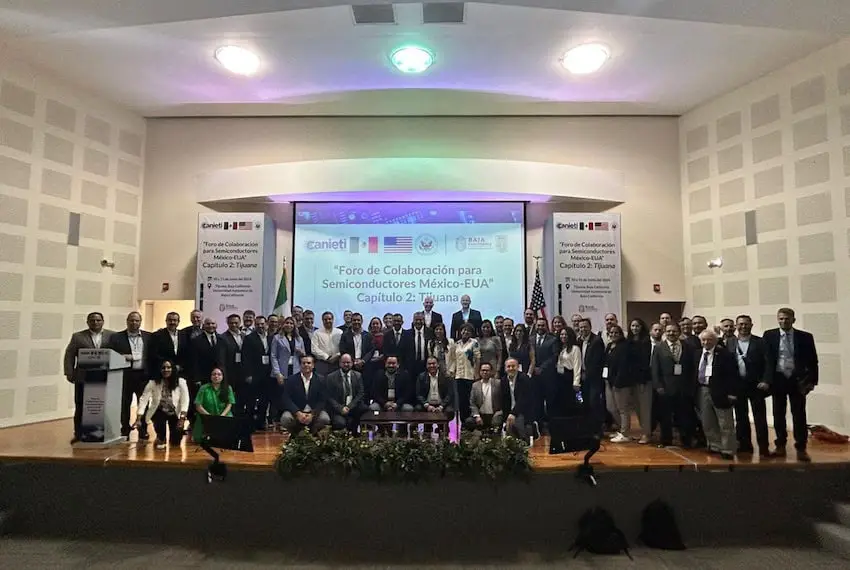
The forums aim to catalyze dialogue among the U.S. and Mexican federal governments, Mexican local governments and the private sector in order to make Mexico’s part of the global semiconductor supply chain.
“Studies presented to the forum indicate that Mexico has the potential to develop design, assembly, packaging and integration to complement the U.S. chip manufacturing industry,” said Canieti president Enrique Yamuni.
“The importance of semiconductors is massive,” said Pedro Casas Alatriste, the CEO of the American Chamber of Commerce in Mexico and a participant in the forum. “Just as we’ve talked about oil in recent decades, this is how we should talk about and act on this technology as a key differentiator for North America.”
In late March, the U.S. State Department announced a partnership with the Mexican government to “explore opportunities to grow and diversify the global semiconductor ecosystem.”

The partnership is developed under the umbrella of the multi-billion dollar CHIPS Act of 2022, a U.S. federal statute that aims to develop semiconductor research and manufacturing in the U.S., and also to strengthen supply chain resilience in North America.

Mexico’s government further solidified its commitments to the industry with the June 5 decree, which establishes the formal commitment by several federal agencies to collaborate on promoting the semiconductor industry in Mexico.
Armando Cortés, the director of the National Autoparts Industry association (INA), applauded the publication of the decree.
“The development of the semiconductor industry is essential to guarantee inventory for key sectors, particularly the automotive industry,” Cortés said, according to the magazine Fortuna y Poder. “Furthermore, global market conditions indicate that sufficient demand exists such that Mexico can position itself as a competitive supplier.”

The decree authorizes the Finance Ministry (SHCP), the Economy Ministry (SE) and the Environment Ministry (Semarnat) to coordinate the promotion of the semiconductor industry in the country via identifying the best areas for development, ensuring adequate energy supply and also providing tax incentives to attract investors.
The new program is designed to help Mexico keep pace with the fast-evolving global industry, one of the most critical elements of the global economy and especially attractive to investors, especially as Canada and the United States have taken significant steps to develop their position in the front end (chip design and manufacture) of production.
Cortés and forum participants point to Mexico’s potential to play a critical role in the back end of the value chain. This would have Mexico specializing in validating processors in semiconductor assembly and focusing on semiconductor packaging.
With reports from Fortuna y Poder, Expansión and El Economista