
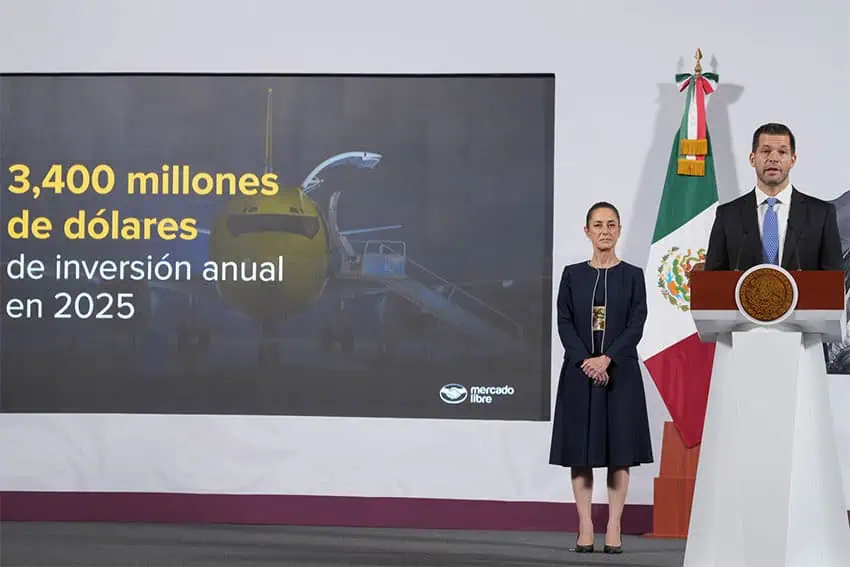
Latin American e-commerce giant Mercado Libre announced it will invest US $3.4 billion in Mexico this year, a 38% increase over investment plans announced last year.
The announcement came during President Claudia Sheinbaum’s Friday press conference a day after U.S. President Donald Trump granted a tariff reprieve to Mexico, following what Sheinbaum described as an “excellent and respectful” phone chat between the two presidents.
The investment will focus on tech products and financial services, a Mercado Libre executive said while standing alongside Sheinbaum. The company plans to hire 10,000 more people this year to work in logistics, financial technology, administration and other areas.
“We have decided to privilege Mexico, which today is our second largest market in the entire region,” David Geisen, Mercado Libre’s country manager for Mexico, said.
With the investment, Mercado Libre will have invested a total of US $35 billion in Mexico in the last five years, Geisen said, adding that with the new hires the company’s total workforce in Mexico will reach 35,000.
Geisen explained that the resources aim to boost the company’s innovation with technology and artificial intelligence. This will include improvements to its e-commerce platform and financial solutions, as well as in the expansion of the company’s logistics capacity.
The announcement comes just two months after Mexico imposed a 19% tax on imports via courier services from countries with which it does not have a free-trade agreement. This tax will impact Mercado Libre’s Chinese competitors, such as Temu and Shein.

This week’s investment announcement by Mercado Libre — Mexico’s largest online retailer with a 15.4% market share in 2023 — surpasses by nearly US $1 billion the 2024 investment plans the company had announced in November.
Economy Minister Marcelo Ebrard lauded the continued arrival of investments in Mexico in the midst of the uncertainty posed by the latent threat of U.S. tariffs, calling it a sign of Mexico’s good economic prospects, despite Trump’s protectionist offensive.
As if to illustrate this, energy infrastructure company Sempra confirmed at the same press conference that it is developing two new projects in Baja California at a cost of US $3.5 billion.
Sempra president Tania Ortiz said the ongoing projects — an expansion at a liquid gas terminal in Ensenada and a wind farm in Tecate, both of which are expected to be operational in 2026 — have resulted in nearly 19,000 new jobs.
Over the past 28 years, Sempra has invested US $13.6 billion in energy infrastructure in Mexico, Ortiz said.
With reports from El Universal, Mexico Now and Reuters