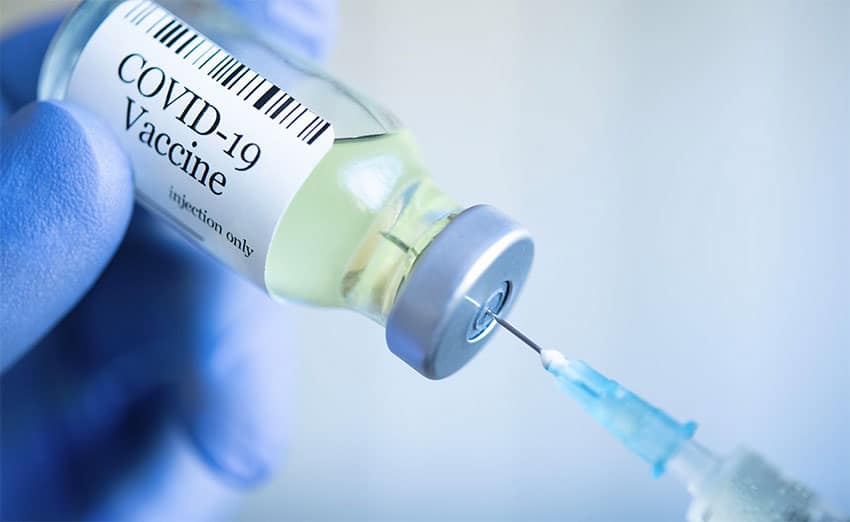
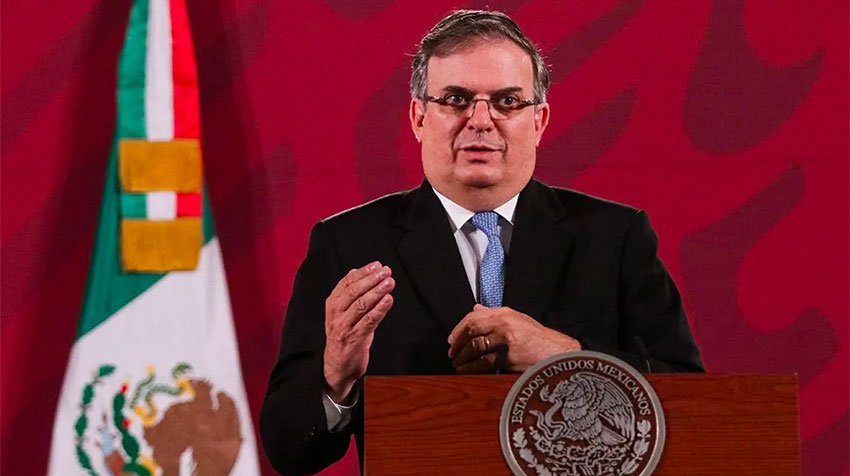
A coronavirus vaccine will be available by the end of March in a worst-case scenario, Foreign Minister Marcelo Ebrard said Tuesday.
“What is the worst-case scenario? That there is not a safe vaccine until the month of March. What is the best-case scenario? That there is a vaccine that works at the end of December,” he told President López Obrador’s regular news conference.
Ebrard said the best and worst-case scenario predictions come from the European Union,“especially the Health Ministry of Germany, which sent us their own information.”
“Why the huge global investment and beyond the obvious why are they preparing all this? What is wanted is to limit the impact of the [northern hemisphere] winter, having the vaccine at some time in winter will mean an enormous change in the course this pandemic will follow,” he said.
Ebrard said that authorities in Mexico also hope to be able to start vaccinating people against the coronavirus before the end of winter, and provided an update on the progress of vaccine trials by companies with which Mexico has entered into purchase agreements.
The foreign minister noted that AstraZeneca, which has an agreement with Oxford University to supply its vaccine, has successfully restarted phase 3 trials that were paused due to a serious adverse reaction in a participant.
Those trials are now on the verge of being completed in Brazil, the United Kingdom and South Africa, he said.

Ebrard also said that Mexico is making progress in preparing to produce the AstraZeneca vaccine here.
(The charitable foundation of Carlos Slim, a telecommunications mogul and Mexico’s richest person, announced in August that it would fund production of the AstraZeneca vaccine in Mexico and Argentina should it pass phase 3 trials.)
“Mexico has already made progress in the transfer of technology, which is very complex,” Ebrard said. “The goal is to have production ready [to go] in Mexico and Argentina so that we can have the vaccine ready … in March.”
The vaccine developed by the United States company Pfizer in collaboration with two other companies is also nearing the end of phase 3 trials. Ebrard said reports about the efficacy and safety of the vaccine will be published in the United States by the third week of November.
The foreign minister said Mexico would finalize its supply agreement with Pfizer by November 12 and stressed that there will be enough funds to purchase its vaccine should it prove to be effective and safe.
Ebrard noted that a vaccine developed in China has been approved by the Chinese military and shown positive results. It will be tested in Mexico starting in the first half of November, he said, adding that the government would finalize its agreement with the Chinese firm by November 12.
Russia announced last month that it had reached an agreement with Mexican pharmaceutical company Landsteiner Scientific to supply 32 million doses of its Sputnik V coronavirus vaccine but its use in Mexico has not yet been approved by health sector regulator Cofepris.
President López Obrador has pledged to make vaccines available for all Mexicans free of charge and offered to be the first person to be inoculated no matter where the vaccine comes from.
Source: El Universal (sp)