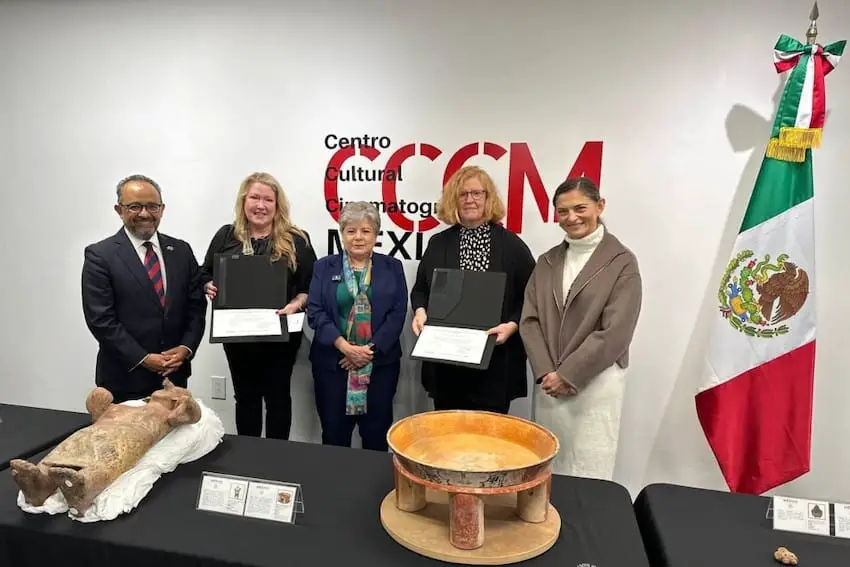
Thirty archaeological pieces have been repatriated to Mexico through the Mexican Consulate in Los Angeles, California, as part of the Mexican government’s international campaign to recover Mexican artifacts from abroad.
The repatriation ceremony was led by Foreign Affairs Minister Alicia Bárcena, who was accompanied by the Deputy Minister of Cultural Development, Marina Núñez.

The collection of artifacts includes anthropomorphic figures, vessels, necklace beads and ceramic fragments that vary in style and are associated with pre-Columbian cultures in Mexico’s West, Central Highlands, and Gulf Coast regions. Some artifacts – several of which are Maya and Mixtec – date back to periods ranging from the Classic period (0-650 A.D.) to the Mesoamerican Postclassic period (1200-1521 A.D.).
Speaking at the ceremony, Bárcena announced that the process of recovering Mexican artifacts will no longer be referred to as “repatriation,” but rather as “rematriation,” since the pieces will be returned to the “mother earth” and their “mother communities.”
Throughout the administration of President Andrés Manuel López Obrador and under the slogan #MiPatrimonioNoSeVende (“My Heritage is Not for Sale”), Mexican embassies and consulates have recovered over 13,500 cultural pieces globally.
This campaign, which began in 2019, has also managed to prevent auctions of stolen objects or objects that belong to Mexico’s heritage in cities like New York, Paris and Rome.
To showcase the government’s efforts to recover stolen artifacts from abroad, the Chancery Museum of the Matías Romero Institute in Mexico City’s Historical Center is currently showing the exhibition “A Halo of Splendor: Repatriation of Archaeological Pieces from the Cultures of Mexico.”

With a display of 200 artifacts recovered through diplomatic efforts, the exhibition aims to promote an understanding of Mexico’s rich cultural heritage and how it has been recovered.
The exhibition will run through March and is free to the public.
With reports from Forbes México