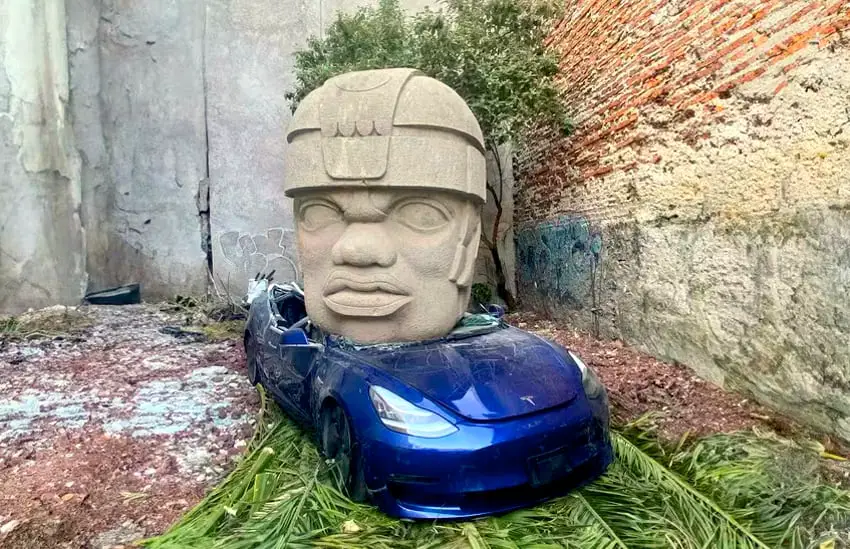
Images of a Tesla car crushed by an Olmec colossal head in Mexico City recently went viral this week, giving way to all kinds of theories on social media.
The unusual scene was discovered in the Roma Norte neighborhood between Mérida and Colima streets. While some thought it was an AI-generated image, others suggested aliens had dropped the Olmec head onto the Tesla.
But neither artificial nor extraterrestrial intelligence was involved: it’s actually an art installation by Mexican artist Chavis Mármol.
Known for his “Neo-Ta-Memes” series, Mármol offers a unique view of Mexico’s pre-Columbian past.
“This is the last in a series of sculptures in which I return to the Olmec heads to talk about specific topics,” Mármol wrote on an Instagram post. In a previous part of the series, the artist imitated Mexico’s ubiquitous app delivery workers, distributing food from an Olmec head-shaped delivery bag.
The name of the series alludes to tamemes, porters who carried loads on their backs in pre-Columbian times. The word tameme comes from the Nahuatl verb “tlamama,” meaning “to carry.” Colossal stone heads are the best-known material legacy of the Olmecs, Mesoamerica’s first major civilization, whose culture flourished on the Gulf coast beginning in 1200 B.C. 17 of the heads have been found so far.
Ver esta publicación en Instagram

In this video, Mármol explains more about his work
The sculpture combines humor and criticism, emphasizing the importance of conserving and valuing one’s roots.
“The Olmec head imposes itself over the technological object, bursting and crushing it,” the artist explained in an accompanying video. The Tesla vehicle, he said, “is just a product of a capitalist system.”
“What matters is where we came from, who we are, and who we have been for generations,” Mármol added. In a later Instagram post, the artist also mentioned that his intention was to “troll Elon Musk and his new car plant in Mexico.”
The art piece was installed in collaboration with Colima 71 Art Community Hotel and, according to El Universal newspaper, its installation required a crane to lift the 9–tonne Olmec head replica and drop it onto the blue Tesla Model 3.
Originally from Hidalgo, Chavis Mármol studied Visual Arts at the Autonomous University of the State of Hidalgo (UAEH) and the National Autonomous University of Mexico (UNAM).
Just over a decade into his career, he has participated in various national and international exhibitions and has received multiple grants and awards.
With reports from El Universal and Infobae