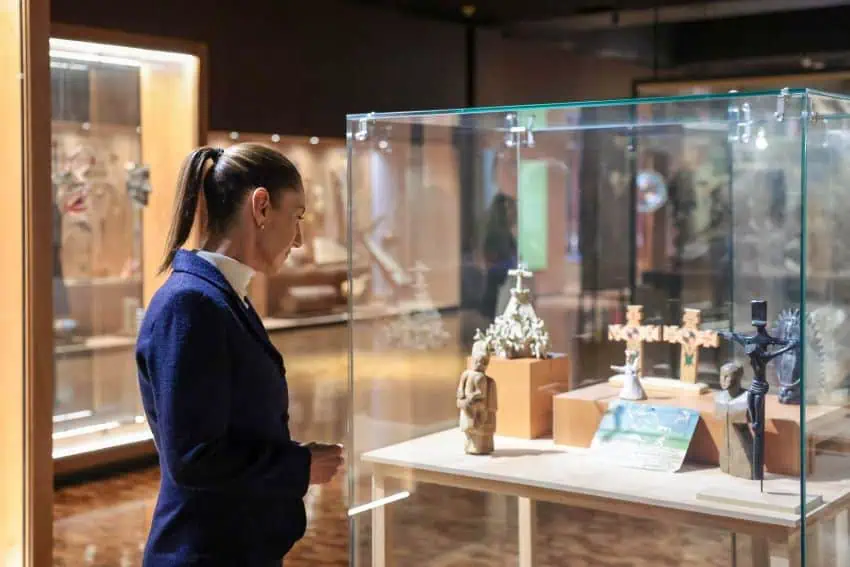
President Claudia Sheinbaum inaugurated a new section of the National Museum of Anthropology Monday, as part of the reopening of its second floor.
The second floor had been closed for two years for renovations, the first in about 20 years.
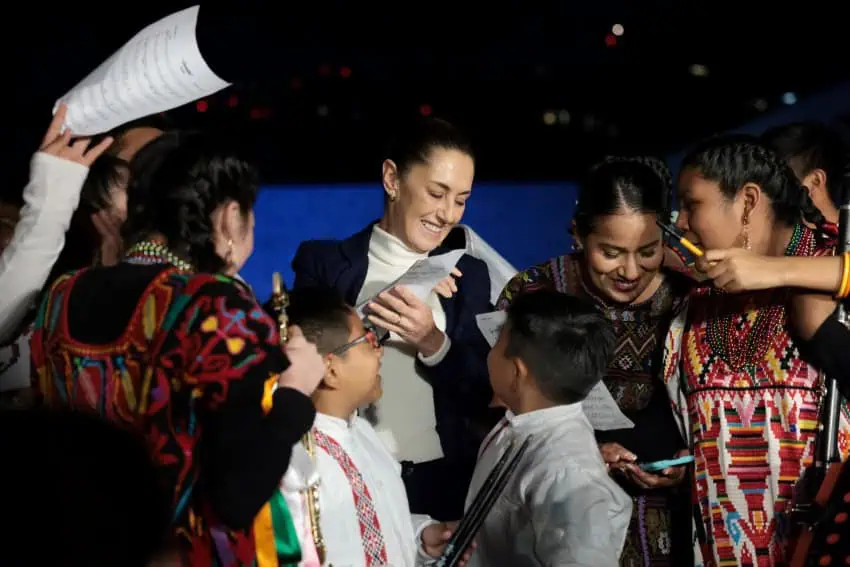
With an investment of 45 million pesos (US $2.2 million), the new section is dedicated “to the recognition of Indigenous peoples, who continue to represent the country’s cultural diversity,” announced Sheinbaum at the opening ceremony, to which several Indigenous women and children were invited as guests.
The museum was opened in 1964 to preserve Mexico’s Indigenous culture and is now Mexico City’s most-visited museum, attracting 3.7 million visitors in 2024.
The new section consists of five rooms housing almost 6,000 archaeological, ethnographic and artisanal pieces and offers a transition from the pre-conquest section of the museum to an area showcasing Mexico’s contemporary cultural traditions.
Mexico City Mayor Clara Brugada also attended the ceremony, alongside federal Culture Secretary Claudia Curiel de Icaza, Tourism Secretary Josefina Rodríguez and several other officials.
“The recovery, preservation, research and dissemination of our historical legacy is an essential task for the present and future of our nation,” Brugada said at the event. The new section, she said, provides “a unique opportunity for us to learn not only about pre-Hispanic history, but also about the artistic and cultural production of contemporary Indigenous peoples.”

Both Sheinbaum and Brugada emphasized the importance of recognizing Indigenous women and Afro-Mexican communities. Sheinbaum referenced Mexico’s constitutional reform passed late last year that recognizes the rights of Indigenous peoples and provides them with an autonomous annual budget, which stands this year at 13 billion pesos ($638 million).
During the event, Sheinbaum also announced plans for the consolidation of the Culture Ministry with the National Fund for the Support of Artisans (Fonart), the Museum of Popular Culture and various museums associated with Indigenous culture.
“In this way, the National Institute of Anthropology and History (INAH), as well as the National Institute of Fine Arts and Literature (INBAL) and… everything related to the cultures of Indigenous and Afro-Mexican peoples are incorporated under a single system,” Sheinbaum stated.
With reports from Excelsior, Quadratín México, Infobae and LatinUS