Remember the article about corn where I listed numerous dishes that can be made from it? I mentioned corundas as one of my absolute favorites. As I’m writing this article, I’m feeling abundant and blessed, with the power of manifestation within me, because a very good friend of mine just arrived at my house with a bag full of corundas.
What are corundas?
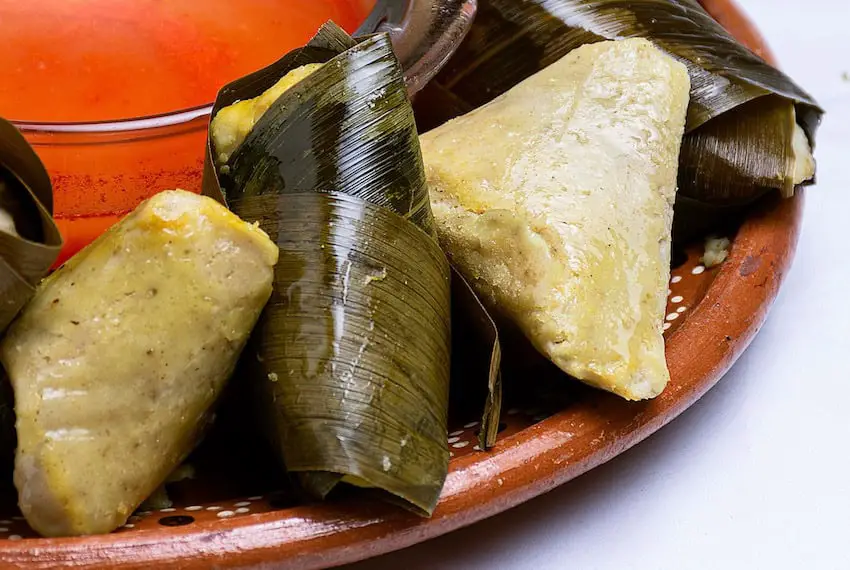
Corundas are a dish with pre-Columbian origins that consists of corn masa (dough) wrapped in (more) corn — or reed — leaves and steamed. They can be either triangles or thin rectangles in shape. The texture of corundas is distinct and differs greatly from the more common tamal, which is often fluffier, like bread. Corundas are denser and more tender, with a more intense flavor.
This dish originates from the center-west state of Michoacán, a region native to the Purépecha. For them, corundas were an everyday dish available all year round. With the arrival of the Spanish and new sources of protein, corundas began to be made with pork or chicken meat.
Types of corundas
Ash* corundas: These are made with a dough of reed ash mixed with corn flour, lard and salt. Ash corundas are wrapped in reed leaves and have a flat shape.
*If you get health and sanitary concerns as soon as you read the word ash, you are not alone. I never really thought about how safe it is to eat the ashes of a plant. I mean, we’ve been eating it for centuries without any known consequence, but still.
Regular corundas: These are the most well-known type and have a triangular shape. The dough is made from corn flour, lard, salt and water if necessary. Sometimes, they are filled with cheese, pork, bean dough, fava beans or chickpeas. I personally prefer them unfilled, and served with pork in red sauce on the side.
View this post on Instagram

Where to eat corundas?
If you visit Michoacán or a Michoacán-style restaurant, you will find corundas on the menu as they are the most typical dish of the area. Alternatively, you could find yourself a Michoacán “ambassador” in your city who can bring you corundas.
But if you feel like cooking them, here is my family recipe:
LA RECETA (25 corundas)
- 250 grams of pork lard
- 250 grams of vegetable shortening
- 800 grams of corn masa (for tortillas)
- 1 teaspoon of baking soda
- 1 teaspoon of baking powder
- 3 cups of warm water with a pinch of salt
- 25-30 long and thin corn husks (from the plant, not the cob)
- Begin by preparing the dough. Mix the corn masa with the baking soda and baking powder, along with three cups of warm water. Once the dough is ready, set it aside for a moment.
- Next, beat the lard until it reaches a creamy consistency. Gradually incorporate the dough into the whipped lard. If your dough becomes a little dry or stiff, add more warm salted water.
- Once your dough is ready, take one of the corn husks. Grab a small ball of dough and place it at one end. Begin to “close” the dough ball, and naturally, the triangular shape will form. Repeat this process until you finish the dough. To fill the corundas, use your finger to make a hole in the dough and add cheese or a small piece of cooked pork.
- In a large steamer, place all of your corundas and let them cook for about an hour.
THE “CALDILLO”
- 6 tomatoes
- 1 chile serrano (I like it better with 2)
- 1 clove of garlic
- 1 quarter of an onion
- Salt to taste
While the corundas are cooking, you can prepare the typical red sauce that goes with them. Boil the tomatoes with the serrano chile. Once they are ready, blend them with a clove of garlic and a piece of onion until you have a sauce, using the water from the boiling process. After blending, you’ll have a “caldillo” (similar to a broth).
If you want to prepare it Michoacán style, add small cubes of pork to cook in the “caldillo.” If you’re vegetarian or vegan, the caldillo on its own will be delicious.
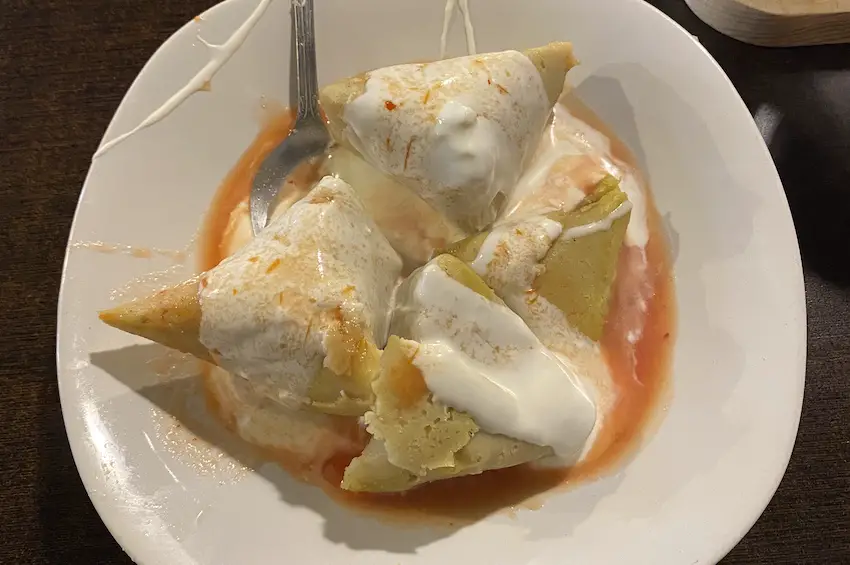
Now, unwrap a couple of your steamed corundas, place them on a plate and drizzle them with the caldillo. Add a spoonful of crema on top and sprinkle some grated cotija cheese or queso fresco.
Isn’t that the most glorious thing you’ve ever tasted?
María Meléndez is a Mexico City food blogger and influencer.