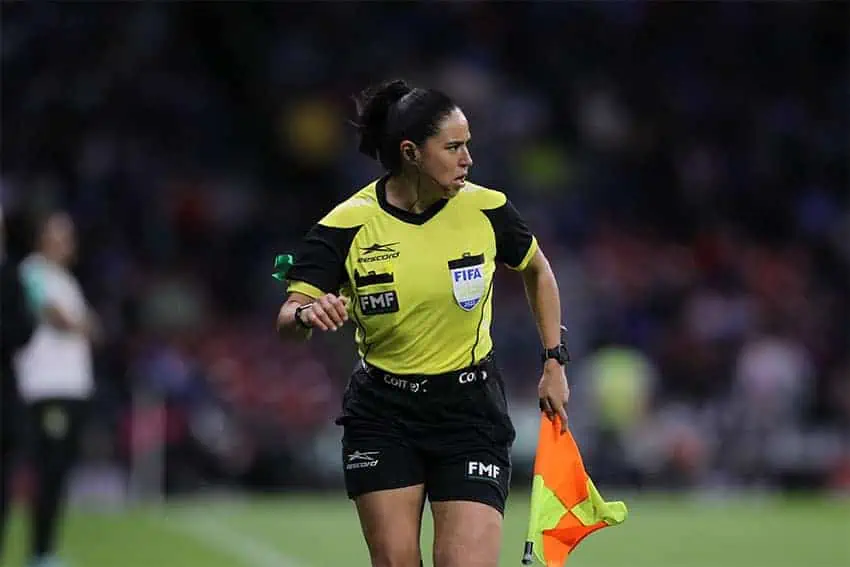
Karen Díaz Medina of Mexico has made history at the World Cup, participating as a reserve assistant referee in Morocco’s 0-0 tie against Croatia on Wednesday at Al Bayt Stadium in Qatar.
For the first time ever, FIFA, world soccer’s governing body, chose women referees to participate in this year’s men’s World Cup, and among the six selected was Díaz, a 38-year-old native of the city of Aguascalientes.
“They deserve to be at the FIFA World Cup because their performance is consistently excellent, and that is the determining factor for us,” said Pierluigi Collina, chairman of the FIFA Referees Committee.
The six women are among a total of 36 referees, 69 assistant referees and 24 members of the video review team. Díaz was selected as an assistant referee, the person on the sidelines whose duties include holding up a flag when a player is offside (previously known as a linesman or lineswoman).
As a reserve assistant in the Morocco-Croatia match — and also in Portugal’s 3-2 victory over Ghana on Thursday — Díaz was tasked with maintaining order on both benches and announcing player substitutions and the added time at the end of each half. She also would have replaced an assistant referee if one of them was unable to continue due an injury or medical reason.
Díaz has a university degree in agro-industrial engineering, but before that, she became interested in soccer officiating when she was working at the snack shack at a youth sports center.
“The designated referee did not show up for the game,” she recalled in a 2020 interview. “The league administrator asked me if I wanted to referee the game, and I said yes. I liked it and I enjoyed the experience … From then on, I was assigned more games every week and with the money earned I was able to pay for college.”

Díaz has 12 years of experience and has been an official in Liga MX matches since 2016. In 2020, she became the first female to officiate in a Liga MX final when she was an assistant referee for the second leg of Pumas vs. León.
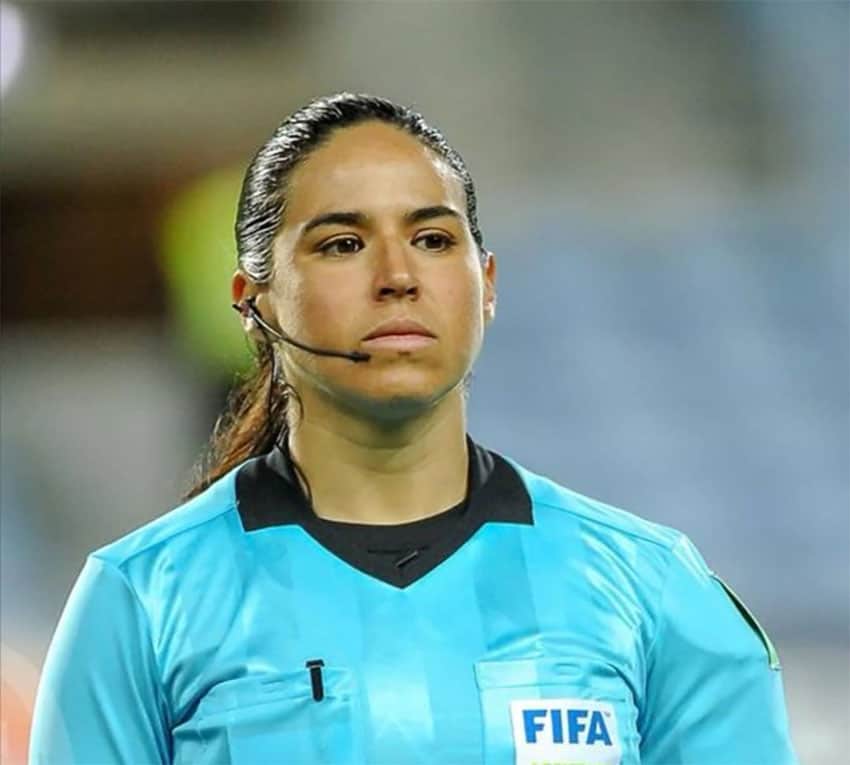
Asked why she is so passionate about officiating, Díaz replied, “First of all, because I love soccer. This is a profession that makes you fall more in love with it each day, since each day you can face a new challenge. It is a fantastic experience that involves all your senses in each game.”
Certified as a FIFA assistant referee in 2018, Díaz was then given a number high-profile assignments at which FIFA officials could observe her, including the Concacaf under-17 women’s championships in Nicaragua in 2018, the Concacaf under-20 men’s championships in Florida the same year and the Scotiabank Concacaf League in 2020. Concacaf stands for the Confederation of North, Central America and Caribbean Association Football, and it is one FIFA’s six regional governing bodies.
The six female referees in Qatar for the 2022 World Cup are Stephanie Frappart (France), Salima Mukansanga (Rwanda) and Yoshimi Yamashita (Japan) as referees and Neuza Back (Brazil), Kathryn Nesbitt (U.S.) and Díaz as assistant referees.
Frappart, 38, became the first woman to referee at a men’s World Cup when she was the reserve assistant for Tuesday’s Mexico-Poland match, which ended in a 0-0 tie. On Thursday, she was the fourth official in the same Portugal-Ghana match in which Díaz was the reserve assistant.
Mexico’s national team returns to Group C action in a highly anticipated match against Argentina and superstar Lionel Messi on Saturday at 1 p.m. CST. The match is drawing even more focus in the wake of Argentina’s stunning 2-1 loss to Saudi Arabia on Tuesday.
Each team has three group games, after which the top two teams in each of the eight groups will advance to the knockout round. Mexico, which has one point after its 0-0 tie against Poland, has made it to the knockout round in seven straight World Cups, but has failed to advance to a “quinto partido” (fifth game) each time.
The World Cup started Nov. 21 and will conclude Dec. 18.
With reports from Animal MX, ESPN and Concacaf.com