Why more Americans are crossing the border for healthcare

15
3873
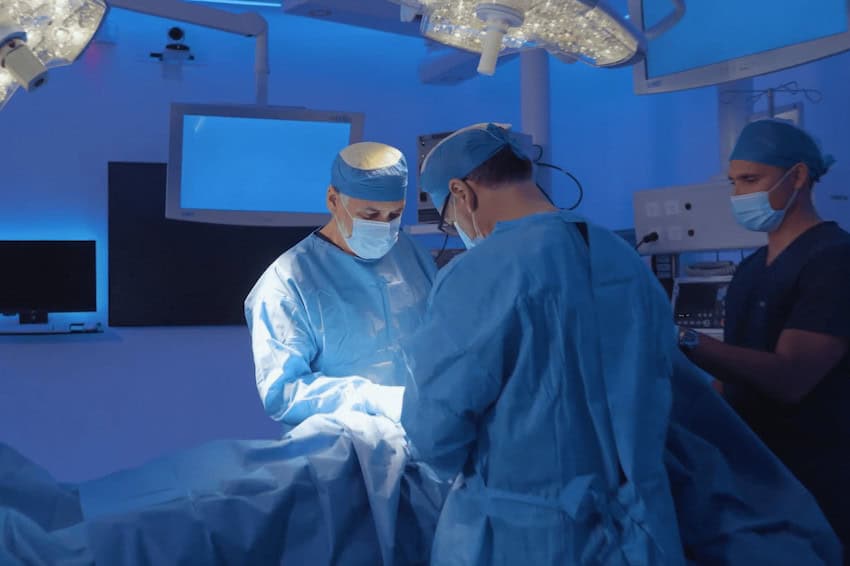
Two doctors perform a medical operation
Baja California is fast becoming an international medical hotspot. What's drawing Americans to the border in search of healthcare? (Obesity Control Centre)

I’ve spent a lot of time in hospitals over the years — usually as a visitor, sometimes as a patient and increasingly as a journalist. But I wasn’t expecting to be floored by the level of luxury, innovation and hospitality I saw on a recent tour through some of Tijuana’s leading medical tourism and healthcare facilities.

As I walked through a private recovery suite, sampled gourmet snacks from an on-site kitchen and took a peek at a hyper-efficient technology system that incorporates 21st-century tools like the Cloud and AI, one thing became crystal clear: Tijuana is raising the bar for global medical care. And patients from around the world, especially the United States, are taking notice.

Tijuana's New Medical Plaza
With new developments across the city, Tijuana is embracing demand for medical facilities. (Bellphoria)

A growing industry

Medical tourism isn’t new to Mexico, but it’s never looked quite like this.

According to the Global Wellness Institute, the global wellness economy hit US $4.4 trillion in 2020, and wellness tourism accounted for $436 billion of that. On the U.S. side of the border, the healthcare industry alone was valued at $808 billion in 2021, based on data from the International Institute of Market Metrics (IIMM). So it’s no surprise that Americans are increasingly seeking more affordable alternatives — and often, better service — just a short flight or drive away.

Mexico is the second most popular destination for medical tourism globally, drawing in an estimated 1.4 to 3 million international patients in 2020, according to Patients Beyond Borders. Their analysis found that Americans can save between 40% and 60% on major procedures here, from dental implants and bariatric surgery to fertility treatments and stem cell therapy.

And for many patients, that journey starts in Tijuana.

Located just across the U.S. border from San Diego, Tijuana has emerged as one of the most visited cities in the world for medical tourism. Its proximity to California, coupled with modern facilities and significantly lower costs, has made it a viable option for everything from dental implants and bariatric surgery to fertility treatments and cosmetic procedures.

Cyntar: Integrating technology with recovery
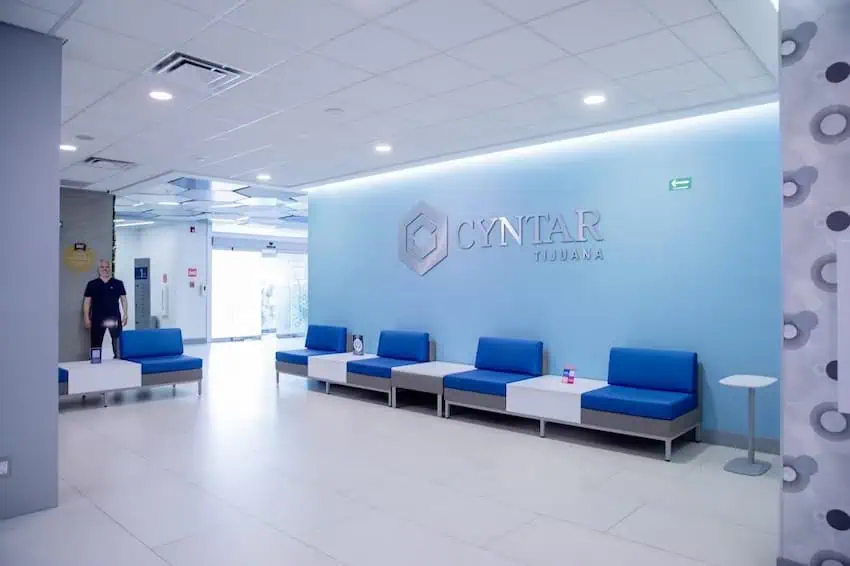
A hospital waiting room
(Cyntar Tijuana)

Among the more specialized facilities in Tijuana is Cyntar Hospital. This facility emphasizes technological integration with patient care and recovery, providing a series of 360° Recovery Rooms.

These rooms are equipped with customizable environmental controls and in-room monitoring technology that allows for continuous tracking of vital signs. According to Dr. Ariel Ortíz, CEO and Founder of the Hospital Center Tijuana, most patients go home within a day of their procedure and are monitored from the comfort of their own home via a digital, remote monitoring device. This allows doctors to keep a check on their patients in real-time, while their patients are recovering in their own beds.

The hospital also features designated areas designed to allow for more private interaction between patients and medical professionals — a shift away from more traditional open-ward systems. Cyntar offers a range of specialties, including minimally invasive general surgery, interventional cardiology, gynecology, orthopedics, urology, ENT and gastrointestinal diagnostics.

The hospital is also accredited by Joint Commission International, similar to U.S. medical centers like Princeton University Healthcare, New York University, University of California, San Diego, UCLA, Washington University, Mount Sinai Hospital and George Washington University. 

NewCity Medical Plaza
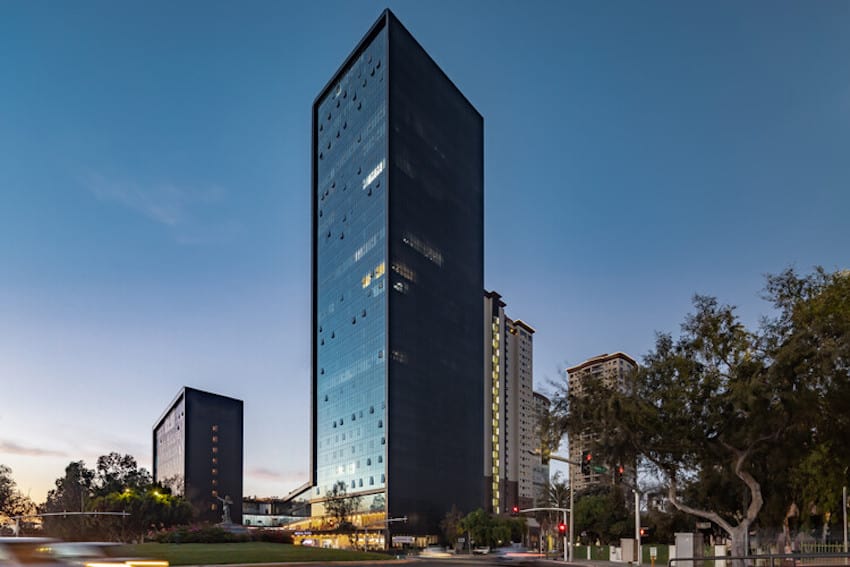
New City Medical Plaza, Tijuana
(archdaily.mx)

Another prominent complex is NewCity Medical Plaza, a multi-use development that combines healthcare services with hospitality, dining and retail. The concept is designed around providing all-in-one access for patients and their companions, from surgery to post-op recovery and leisure.

Located about three minutes from the San Diego border, NewCity includes a full-service hospital, radiology and lab services, more than 30 medical specialties and what it markets as Tijuana’s only five-star wellness hotel. Patients undergoing outpatient or elective procedures can recover in the hotel while remaining close to medical support.

Among its four flagship clinics are: 

  • Hairfax, specializing in hair restoration;
  • ProgenCell, offering stem cell therapies;
  • The Fertility Center by IMI, which focuses on reproductive health and IVF;
  • The Dental District offers general and cosmetic dental care.

The complex also includes a dining plaza featuring local cuisine and wines from Baja California’s Valle de Guadalupe, a beauty salon, clothing retailers and family-friendly events. While these amenities are not part of the medical services themselves, they aim to make the experience more appealing for both patients and their families.

Considerations for medical travelers
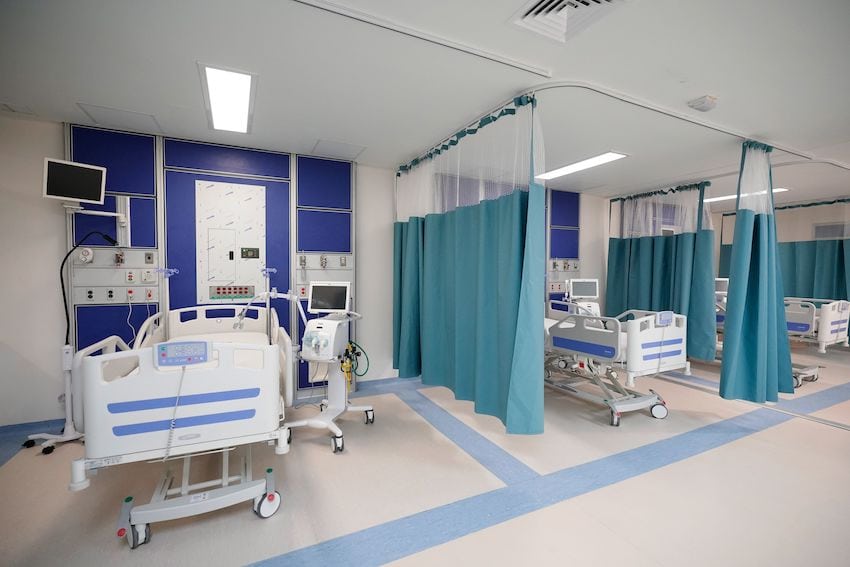
IMSS hospital ward in Juchitan, Oaxaca, with three empty stalls with hospital beds and medical equipment.
(Cuartoscuro)

Tijuana’s expanding medical tourism offerings are not without scrutiny. While many clinics cater specifically to international patients and many doctors are certified or trained abroad, standards can vary. Most reputable facilities will provide information about physician licensing, success rates and international affiliations. 

For travelers coming from the U.S., logistics are relatively simple. Tijuana is accessible by car, with medical facilities often providing medical transportation services to and from San Diego. The Cross Border Xpress (CBX) terminal allows foot traffic directly from the Tijuana airport into Southern California.

As healthcare costs remain a barrier for many Americans, Tijuana continues to position itself as a competitive alternative for a wide range of medical and wellness needs. Its hospitals and clinics have responded by investing in infrastructure, expanding specialties and combining healthcare with hospitality.

The cost savings are significant, and for those who do their homework, Tijuana offers a practical, nearby and sophisticated option for medical care.

Meagan Drillinger is a New York native who has spent the past 15 years traveling around and writing about Mexico. While she’s on the road for assignments most of the time, Puerto Vallarta is her home base. Follow her travels on Instagram at @drillinjourneys or through her blog at drillinjourneys.com.

15 COMMENTS

  1. My family has gotten extremely good healthcare in Mexico. Two years ago I had heart stint surgery in Colima. It cost less than 10k USD for 1 stint plus two nights in a quality, clean, professional hospital. In the US that same procedure was 150k plus. We were told by many US doctors of that fact. WITH insurance in the US we would have been out over 20k. TWICE what the surgery cost in Mexico. As it was our insurance paid 5k. We saved 15k plus by having one 45 minute surgery in Mexico. Now if we hadn’t have been paying for US insurance to pay for obscenely high priced medical care in the US we’d be up 10k more at LEAST.

    One year later I unfortunately dumped our motorcycle in Texas breaking my wife’s ankle when she hit the ground. We got X-rays and the opinion of a specialist. He quoted us 75k for the surgery. He couldn’t perform the surgery for a week. We called the same hospital in Colima and we were quoted 4k. AND they told us they would be waiting. I drove 20 hours straight from Texas to Colima Mexico. She had the surgery that day, about 24 hours after we first notified them. One night in the hospital and a 75k operation for what turned out to be $4,500 USD. And done 5 days sooner.

    And it’s not just cost. The top manager of Hospital Colima gave us his WhatsApp. We can communicate with him at anytime. And similarly we have WhatsApp contacts for four other doctors at that facility. And yes, they get back to us. They spend time with us. They are very professional. Their bedside manner is full of empathy, concern, and compassion.

    I don’t know where our healthcare industry went off the rails, but it has. I’m a staunch capitalist but what’s happening to the cost of healthcare, and the declining quality of said care, is quite frankly criminal. My wife and I are self employed. We own a business in the US. We just dropped our healthcare insurance in the US and will self insure. We will use our considerable savings on healthcare care and insurance to further boost our savings and our ability to self insure. In many ways the US, and the west, is a legacy country. It’s lost its way. It isn’t in fact the land of liberty. It’s quite the opposite.

    • “our country” went off the rails when Hedge Funds and other invertors took over ownership of medical care. I practiced in the United states from 1970-2005. In the 70s, we (physicians), usually in small group practices, enjoyed a very strong loby in congress and we made out like bandits. We were greedy, but not as greedy as the corporations that soon came along to buy up the system (United Healt Care, and many, many others). I’ve now lived in and received healtcare in Mexico for 15 years. Down here in Mexico, probaly 95% of medical needs are cared for just as well here as in the United States at a fraction of the cost. A big part of that is because the revenue from healthcare is distibuted to the health care workers, not the “owners” (who claim they are more effecient than “the Government”,but which, by the way, ther is little evidence.) What do you call this system of medical care in Mexico? Socialism, which I thought was a dirty word until I came to Mexico and lived the Mexican life with a Mexican family. Affordable healthcare is just one of many measurments used to place Mexico in the top ten countries on the Happiness index (USA? number 24)

      • My wife and I have received care in private hospitals in Mexico. Not gov ones. Not socialist ones.

  2. I had brain surgery in CDMX. I have no complaints. The surgeon was excellent and I’m here to talk about and have had no side effects. One of the best hospitals ABC Hospital here have an emergency room with private rooms with sliding doors and an area for visitors in your own private emergency room suite. But the #1 hospital is Medica Sur, who accepts most USA insurance plans.

  3. Every time I see articles like these I cringe. I happen to be a Board=Certified Internal Medicine doctor, both trained and educated in the United States. During my career working with underserved Mexican immigrants coming to the United States, and even helping poor people in Mexico, I have encountered numerous erroneous diagnoses. From misdiagnosing people with Systemic Lupus Erythematosus ( when in fact the patient had tuberculosis of the bone); to a young man being misdiagnosed with Rheumatoid Arthritis.

    While I am sure that there are some very good doctors in Mexico, I would say that a lot of the time, when It comes to more complicated symptomatology, I would recommend people seek care in the United States as you run the risk of getting mediocre care in Mexico.

    • I am sure that is your experience, but this article is about the private medical system in Mexico, which I doubt if many Mexican immigrants have experienced here in Mexico. Just my opinion. Definitely the US system has extraordinarily excellent physicians, nurses, hospitals, technology at the highest level.

    • You are no doubt seeing the downside of Mexico’s public medical system IMSS, which is chronically underfunded and oversubscribed. The private medical system in Mexico (as described in the article) is entirely separate from this. The private system attracts a highly skilled work force for far better pay. Besides U.S. tourists, it also serves wealthy Mexicans who can afford to pay out of pocket for better care. It may not be a just situation, but it’s the reality in Mexico.

    • Many immigrants to the US come from very rural communities. The health care in the rural areas in Mexico, and in the US, is not comparable to the care in the urban areas. In the rural clinics you have GP’s – not specialists. And it is very expensive for people in rural areas to go to the city hospitals/clinics where hotels, food, transportation is out of their price range.

    • flying from tijuana to mazatlan could be a $40 usd ticket and voila! right there is youre pasage through the airport.

    • I was misdiagnosed at the Mayo Clinic in Arizona. Do people get misdiagnosed in Mexico? I’m sure. Do Mexicans, who spend maybe a 10th as much on healthcare have a long life expectancy? On average only two years less than US residents.

  4. My friends and I have experienced first hand top notch medical care in Mexico. High quality, timely and affordable, there is nothing like it in Canada and I speak as a retired physician myself.

  5. Have to be careful. My brother went go a gástric bypass and they took way too much of his intestinos. He has been in terrible discomfort for years. Can’t sleep etc. Lost too much weight etc. He looked like he was going to die. He has bounce back a bit but never normal.

  6. Teeth cleaning. 2 extractions no wait $65.00 upper and lowered partials $3500 Tn. $1000 Acapulco

  7. CBX (Cross Border Xpress) is an important asset to the San Diego/Tijuana region with a Tijuana International Airport terminal on the San Diego side which leads directly into the airport. However, it is available ONLY to Ticked Airline Passengers. It is not for crossing for medical treatment, unless it also includes a flight.

Comments are closed.