
Before moving to Mexico, I assumed it would be easy to live here without a local bank account. But after about a year, various issues with making local payments convinced me otherwise.
What was so difficult? Below are a few of the challenges I faced:
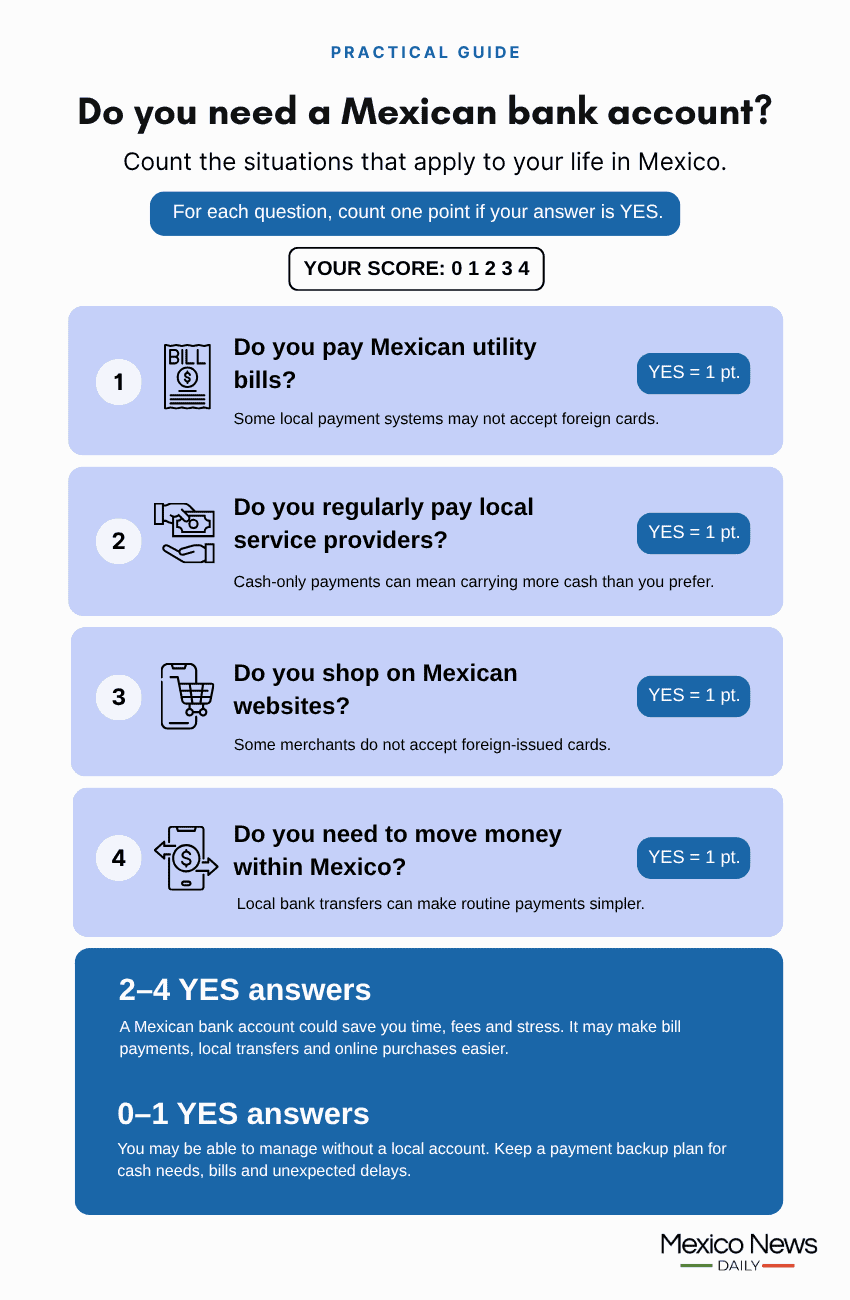
- Couldn’t pay utility bills online because government websites don’t accept foreign credit cards or reliably accept e-payments from international money transfer services. (If traveling abroad when the bill comes due, your service may be cut off.)
- Stuck paying high commissions using apps that did work in Mexico, e.g., PayPal, at 3%-plus per transaction.
- Forced to carry around more cash than I was comfortable with, so that I could make payments to local service providers (house cleaners, repairmen, etc.) who only take cash.
- Unable to make purchases on numerous Mexican websites that don’t accept foreign credit cards.
- Required to make several visits to an ATM over multiple days to pay for things that exceeded the daily withdrawal limit. (This was before I knew about money transfer services that allow users to send cash to Mexico for pickup at an Oxxo).
While not an exhaustive list, these inconveniences can add up over time.
The benefits of a Mexican bank account
This decision of whether to get a local account is a personal one, and reasonable people can disagree. However, many daily activities become easier when you have a Mexican bank account.
Here are some of the biggest benefits:
- Paying bills online instead of in person is convenient and saves time.
- Flexibility to make payments even when traveling outside of Mexico.
- Improved safety and reduced stress when carrying less cash.
- Moving money into Mexico from abroad at the lowest commissions.
- Able to access ACH (bank-to-bank) transfers within Mexico at no cost.
- Making purchases on Mexican websites that don’t accept foreign cards.
- Building a credit profile in Mexico (your credit score from abroad doesn’t count).
- Accessing other financial products in Mexico, such as credit cards and peso-based investments that earn you interest.
Is your money safe in a Mexican bank?
Once you are convinced that a local bank account could simplify day-to-day living, you may still be wondering whether your money is safe in a Mexican bank?
If you know anything about Mexico’s checkered banking history, this is not a paranoid question. Fortunately, bank safety has improved significantly since the Tequila Crisis of 1994.

Back then, widespread insolvency across the banking sector, stemming from a sharp peso devaluation and interest rates of more than 50%, led to the worst economic slump in Mexico since the 1930s. Many families lost life savings and their homes.
Beyond the financial shock, the crisis left lasting scars on the collective psyche of the Mexican people. To this day, many Mexicans who lived through it still harbor a deep distrust of traditional banks, unlike the respondents to our recent “Mexico and My Money” survey, where 7 in 10 expressed confidence in the sector.
The Bank Savings Protection Law, passed in 1999, paved the way for funds deposited in a Mexican bank to be insured up to 400,000 UDIs (Unidad de Inversión), an investment unit adjusted for inflation that is linked to the peso exchange rate.
Currently, 1 UDI is valued at 8.812 pesos and deposit insurance protects up to 3.524 million pesos per depositor, per bank. This equates to approximately US $207,412 and CA $288,702.
Why isn’t the peso at 37 to the US dollar? A perspective from our CEO
The public agency in charge of administering the law is Protección al Ahorro Bancario (IPAB). Their mandate is to rescue depositors up to the covered amount when a Mexican bank fails.
IPAB insurance covers deposits in ordinary savings and checking accounts, payroll accounts, and “term” deposits such as bank CDs.
In addition, regulators have deemed Mexico’s largest banks “too big to fail” (TBTF) due to the systemic risk their failure would pose to the banking system. The TBTF banks in Mexico are BBVA, Santander, Banamex, Banorte, HSBC and Scotiabank. All but Banorte are foreign-owned.
In the event of corporate malfeasance or an external shock, these very large banks would be bailed out. As for smaller, regional banks, depositors are still covered by IPAB, but recovering your funds from them in the event of failure may not be as expeditious.
Furthermore, IPAB insurance applies only to traditional banking institutions listed on this government website. Deposits at fintech companies, which have been springing up in Mexico lately like mushrooms after a summer rain, are not covered by IPAB.
Fintech deposits are covered by a separate regulatory framework, with insurance capped at only 25,000 UDIs. This equates to 220,300 pesos, which is about US $13,000 or CA $18,000. This threshold is 94% lower than insurance coverage at traditional banks.
Funds kept at crypto exchanges and brokerage houses inside Mexico are also uninsured. Caveat emptor.
Depositors beware of scams
While I don’t mean to scare you, depositors at Mexican banks covered by IPAB insurance have also lost millions stemming from bank employees’ nefarious activities. In the Banco Monex case of 2018, about US $8 million in deposits across 158 Monex accounts disappeared over several months.
A large number of depositors were American retirees living in San Miguel de Allende, who relied on a well-connected bank employee to take care of their financial needs. But the employee was making unauthorized transfers of clients’ money to a network of shadow accounts, all while reassuring depositors that everything was in order.
When the scandal broke, the affected Monex clients had difficulty recovering their money, as the employee had moved some of their funds into uninsured brokerage accounts. Following protracted negotiations, a portion of the stolen money was recovered, but some lost their life savings.
Some San Miguel retirees won’t back down in fight over millions in stolen savings
The main takeaway from this disaster is that if you bank at an IPAB-covered institution with serious flaws in its security protocols, you can still lose money, and the regulators won’t be of much help.
The more recent failure of CiBanco and the government intervention at Intercam in 2025 went much more smoothly for depositors, with most receiving their money back in full with minimal delay.
Although the sector is far more secure today than in decades past, there are still plenty of complaints from banking customers about scams being run by bank insiders. These cases, which include personal loan fraud, ATM PIN traps, and unwanted insurance policies, have continued to erode the Mexican people’s trust in traditional banks, as demonstrated by a recent Banxico survey.
Practical tips to keep your money safe in Mexico
- Only bank at institutions covered by IPAB insurance, which you have verified yourself.
- Do not share sensitive account information, e.g. PINs or passwords, or your mobile with bank employees, for any reason.
- Check your bank statement every month to verify the transactions and charges. Take immediate action, in-person at a bank branch, if you see any suspicious charges or products on your statement.
- Don’t put all of your financial eggs in one basket. Have a Plan B in the event that you are cut off from deposited funds in Mexico, to ensure that your basic expenses can still be covered.
From tipping to moving money into Mexico from abroad, check out more from MND’s “Mexico and My Money” archive.
MND writer Dawn Stoner is reporting from Guadalajara.