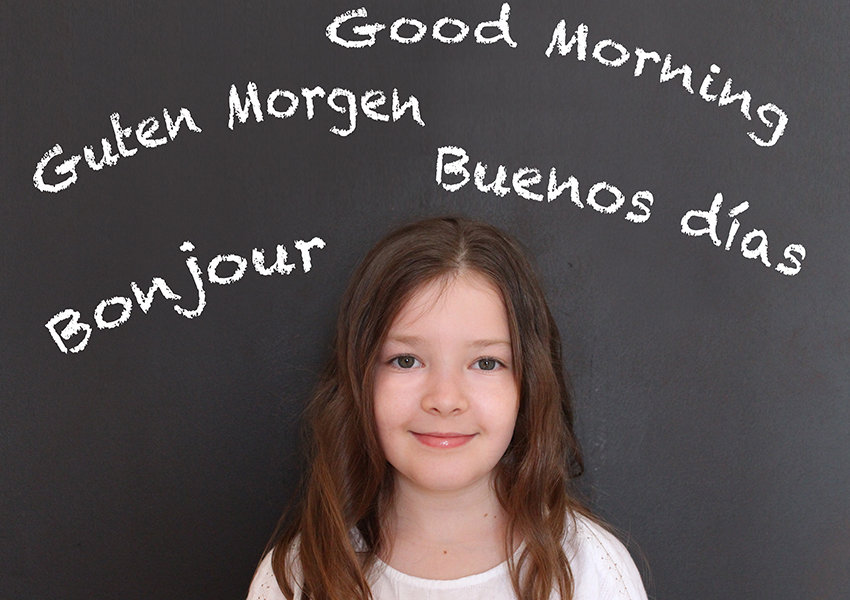
It wasn’t until my daughter reached kindergarten that she realized that the ability to speak English was something other people thought was cool.
“Bye, Mommy! Have a good day, Mommy! I’ll see you in the afternoon, Mommy!” she’d shout for all to hear as she walked toward her classroom. She seemed to relish the head turns from the parents and the open-mouthed stares of her classmates. I mean, it’s not every day that being different makes you cooler (as opposed to simply weirder).
At home, it has always been natural for her to use one language with me and another language with her father and anyone else who happened to be around. Her “mother tongue” has mostly been exactly that: the language she speaks with her mother. The rest of her world, except when we travel to the United States or have visitors from there, is in Spanish.
Today, we’re going to take some time away from all the sad news of the day and the types of articles that earn me angry comments on Facebook and focus instead on a question I get quite a lot: how did you teach your kid English?
I, of course, haven’t sat down to “teach” her as I would kids in a classroom; that’s not how native language acquisition works.
But before I came to Mexico, I’d always figured that being a foreigner in a foreign country and having kids there would pretty much do it; not so, I’ve found! However, it’s not as complicated as it seems if you just follow a few simple rules:
Only speak to your child in your native language — especially if you’re the foreigner.

This is by far the most important item on the list. In fact, you could do only this and you and your kids would probably be golden.
This seems simple, but I’ve observed many native English-speaking parents in Mexico — mostly fathers, for some reason — speak to their children primarily in (not very good) Spanish. I have some theories on why men especially do this, but that could be an entirely different article. For now, we’ll just stick with the do this, not this instructions.
Anyway! Insisting on this point (and you must insist for this to work) means that if they want to talk to you, they’ll have to do it in your language. All the time. Or at least … 99% of the time?
It’s possible, even likely, that you’ll meet some resistance from your child at some point. After all, speaking in one language with everybody instead of two with different sets of people is easier.
In my daughter’s case, she tried to insist for about two days when she was two years old that I speak in Spanish, since she obviously knew I spoke it. She’d ask me for things in Spanish and get mad when I responded, “You have to speak to Mommy in English, sweetie.”
She eventually did, and all has been well since then. In fact, on the off occasion that I say something in Spanish to her, she looks at me strangely and says, “Why are you speaking Spanish?”
One last note here: don’t feel guilty about insisting your kids speak to you in your language. Being a permanent foreigner and second-language speaker in nearly every aspect of your life is hard. You deserve to have at least one person in your immediate family with whom you can speak in your own language.
Watch movies, listen to music, and read books in the foreign language on a regular basis.
As many a foreign-language course client will tell you, media won’t do the entire job for you. However, just like in one’s native language, hearing different dialects and accents of a language in different formats is enriching and entertaining and can help with grammar, vocabulary, idiomatic expressions, collocations, pronunciation — all those things that people spend years in English-language classes to learn.
When my little one was younger, I would simply turn on shows and movies for her in English and choose books in English to read to her. Now that she’s older, she prefers a mix, and I mostly oblige since it’s simply a matter of preference: Hercules is better in Spanish (apparently), and Sing is best in English.
Most of the children’s books we have are in English, but if she wants one in Spanish, I’ll read it to her and let her marvel at her mother’s foreign accent in a language in which her own pronunciation is flawless.
Visit your native country with your child whenever you can so that they are forced to use the language with people besides you.
My daughter was 1 1/2 the first time we visited the United States. For the first day, she was very shy about speaking English with anyone but me; after all, she’d never really done it before!
In the end, she was motivated by pie; my mom had made one, and my daughter wanted a piece of it. When I refused to ask for some on her behalf, she finally got up the nerve to do it herself. The rest is history!
What if you can’t travel back frequently to your native country with your child — say, if there’s a global pandemic, for instance? The next best thing is having other native speakers of the foreign language speak with your child as much as possible — I mean, if you like them and want to spend time with them, of course.
Don’t be alarmed if your child takes longer than others to start speaking.
When babies realize there is more than one language being spoken by the important people around them, they pay close attention. And in most bilingual households, they pay close attention for a considerably longer time than kids in monolingual homes do.
In my case, my daughter surprised me and started speaking in phrases and sentences in both languages at about the same rate as her Spanish-speaking peers did. I was not expecting it, and aside from the belief, as all parents have, that my child is obviously a genius, I figured that she just really, really, wanted to start communicating.
Is my daughter’s English as good as that of a 7-year-old child who has grown up in the United States? Honestly, I don’t know; I don’t know any other gringo kids, here or at home, to compare her to. Those of you out there with experience raising bilingual kids, what have you noticed? I’d be curious to hear other people’s stories.
She doesn’t have an accent in either language, though, and when she says something in English that’s adorably wrong and that has very obviously been translated from either Spanish grammar or slang vocabulary, I say, “Oh, in English you say [insert English translation here]. Can you say that for me?”
She repeats the phrase, and then it’s learned.
Really, that’s all it takes.
Sarah DeVries is a writer and translator based in Xalapa, Veracruz. She can be reached through her website, sdevrieswritingandtranslating.com and her Patreon page.