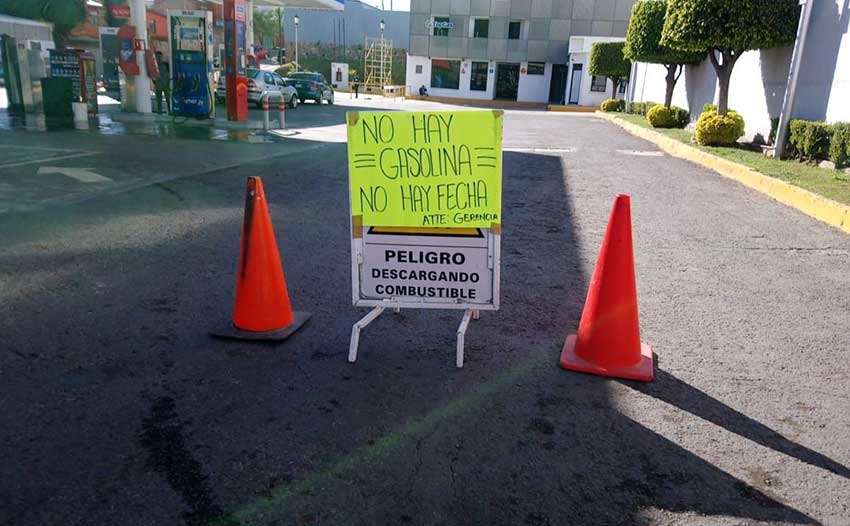
Almost three weeks after gasoline shortages began affecting Guanajuato, 70% of gas stations in the state have no fuel, according to authorities.
Gas station closures have been reported in most parts of the state including the cities of Guanajuato, León and Irapuato as well as rural municipalities.
Mauricio Usabiaga, Secretary for Sustainable Economic Development, said the shortages have affected at least 50% of Guanajuato’s economy.
“The [economic] impact due to the lack of gasoline in Guanajuato has been severe, especially in cities like León and Irapuato, which represent more than 85% of the state’s wealth,” he said.
“Now we’re trying to raise awareness of the situation with the federal government . . . in order to receive support, we’re also looking for options such as attracting investment for a [new fuel] storage center . . . Business people are looking for legal, economic and social certainty” Usabiaga added.
Paulo Bañuelos Rosales, a lawmaker for Guanajuato’s ruling National Action Party (PAN), said that if shortages persist, agriculture could be among the sectors that are hardest hit.
The industry has already recorded losses of more than 200 million pesos (US $10.5 million), according to the state Agricultural Development Secretariat.

Bañuelos said that farmers in municipalities such as Abasolo, Cuerámaro and Pueblo Nuevo are becoming increasingly angry about the situation and have threatened to protest.
“They’ve been telling me that they were going to block the highways but I told them that was not something that would help us to solve the problem,” he said.
The lawmaker said the fuel shortages have meant that many farmers have been unable to harvest their crops.
“We’re talking about 15% or 20% of more than 130,000 producers [who are affected]. It’s mainly those who grow vegetables . . . The corn is still a little bit pale and you can keep it on the plant but you can’t do that with onions and bell peppers. Of course, they get marked and they no longer meet the quality to be exported . . . It’s having a very big impact on the agricultural sector,” Bañuelos said.
Meanwhile, in Jalisco, where 85% of gas stations in Guadalajara and 80% in the rest of the state remained closed yesterday, Governor Enrique Alfaro took to Twitter to question why the shortage crisis was worse there than in other parts of Mexico.
“It’s not controversial to say that the size of the fuel shortage problem . . . in Jalisco is very different to the rest of the country. It’s worrying that here it’s been going on almost 19 days while in other places, such as Mexico City, they only had three days of crisis,” he wrote in the first of several tweets on the subject.
Alfaro also took aim at the state oil company and the federal government, charging that they had let Jalisco down despite the state government doing everything that was asked of it.
“We helped to reinforce security for the tanker trucks and guaranteed their entry to the city, we’re collaborating with the protection and surveillance of pipelines, we strengthened the patrolling of distribution centers and operations to combat fuel thieves,” he wrote.
“However, as we have said from the beginning, Pemex and other federal agencies haven’t shared precise information that is useful to take the necessary decisions . . . so that the citizens suffer the negative effects as little as possible . . . It’s very concerning that the metropolitan area of Guadalajara is receiving just 40% of the daily fuel it requires,” the governor continued.
“We’ve complied with all the requests that have been made to us but if the federal government doesn’t assume its responsibility and generate certainty for the residents of Jalisco, we will take preventative measures on a larger scale to contain the impact of this unprecedented crisis on Jalisco and the country.”
Source: El Financiero (sp), Milenio (sp)