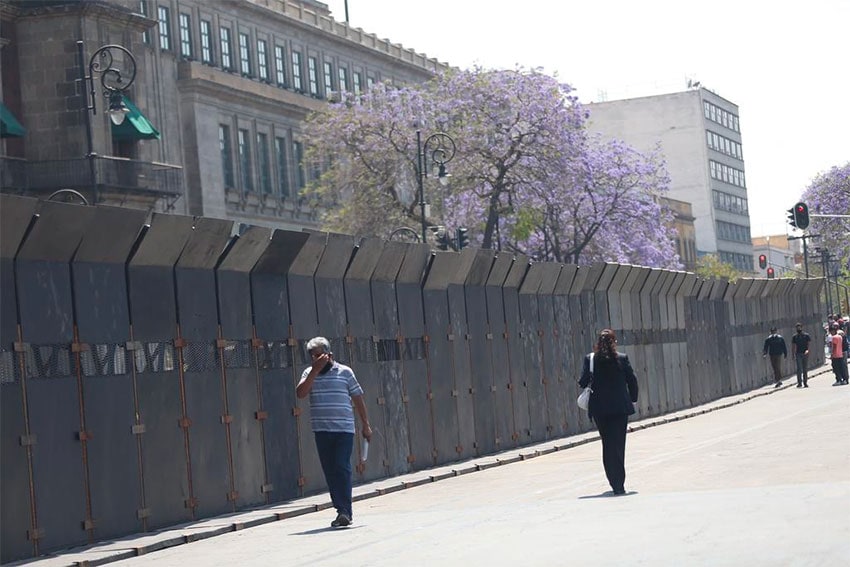
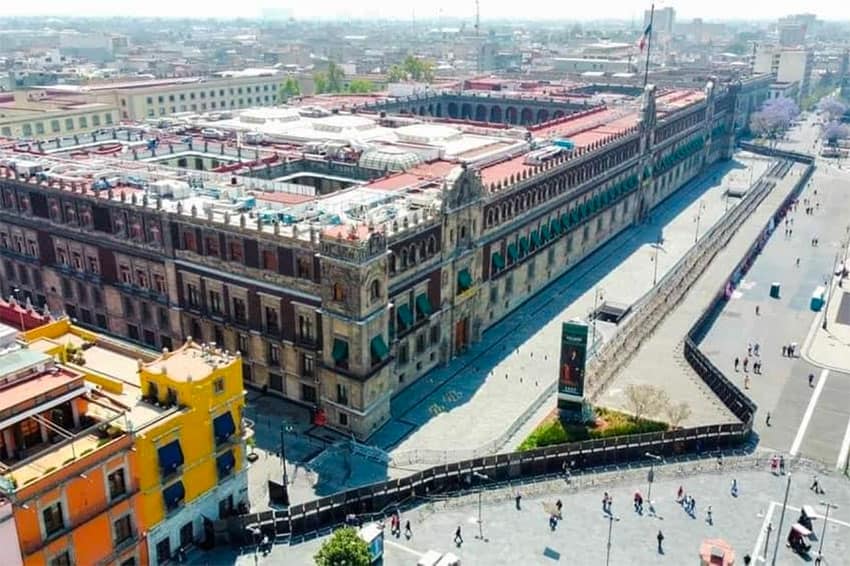
The erection of three-meter-high metal barriers around the National Palace in Mexico City in anticipation of Monday’s International Women’s Day march has stoked more anger against the government for what appears to be indifference over gender-based violence.
Critics dubbed the barrier, which went up early Friday, “a macho wall of shame” and said it showed not only the government’s fear of the women due to march on Monday but its belief that erecting protective walls was more important than the reason for marching.
The annual march is held in protest against gender-based violence in Mexico, where at least 11 women are murdered every day.
Last year’s event was the biggest ever held, drawing an estimated 80,000 participants, most of whom marched peacefully to the zócalo. But a small number of protesters threw Molotov cocktails and committed acts of vandalism. Thirteen people were hospitalized for injuries or burns and another 52 were hurt.
President López Obrador defended the barriers on the weekend, saying it was not because of fear that they were installed but rather to avoid “provocation” and prevent confrontation and damage to historic monuments. His office issued a statement calling the barriers “a wall of peace.”
🔴 ¡Histórico! Palacio Nacional amanece blindado con muros de metal desde la calle de Moneda hasta la calle de Corregidora ante la marcha del #8M2021
📹: Gerardo Galicia / @heraldodemexico pic.twitter.com/3Rb6gcGZ2j
— El Heraldo de México (@heraldodemexico) March 5, 2021

Other women’s protest marches in the city have seen varying levels of violence and vandalism, which the president has blamed on politically-motivated individuals having infiltrated the ranks of protesters.
But his administration has been widely criticized for an indifferent attitude toward the marches and the issues behind them. Since Friday, the critics have rallied.
The National Feminist Collective (Conafem) said the government has taken more action to protect the palace than it has to protect women from rape.
“They are frightened because we are no longer frightened. This barrier is a wall of shame and of fear, fear of the women without fear,” Conafem tweeted Friday morning.
“In Mexico if a woman has an abortion she goes to prison. If a man rapes a woman he can become governor. In Mexico misogynistic chauvinists are in positions of power. In Mexico we as women are not safe.”
The reference to rapists becoming governor refers to another controversy that the government has been unable to contain. The Morena party chose Félix Salgado Macedonio, accused of sexually assaulting five women, as its candidate for governor of Guerrero.
López Obrador has refused to intervene, claiming that the accusations against Salgado are, like women’s protest marches, politically motivated.
In statements on social media accounts Conafem proclaimed that the barriers were a reflection of the president’s misogyny, declaring him to be “part of the systemic femicide” in Mexico.
Mexico is second in Latin America for crimes against women after Brazil, according to the Economic Commission for Latin American and the Caribbean.
“Women have reason to shout, to leave a mark, to burn everything! Mr. President, we are going to burn everything!”
It said protecting historic sites with barriers sends a message that the monuments come first, women’s demands are not legitimate and that the women are wrong.
“It is an outrage[that] so few people support us in our cries for justice,” said Becky Bois, a survivor of an attempted femicide in 2015 who will participate in the march on Monday. “It is clear that they are trying to erase the footsteps of the women who fight for justice.”
Theatrical producer Jimena Sealtiel said women themselves could use some walls for protection.
“If only we could put up walls to guarantee our freedom to walk in the streets … if only we could erect walls around our bodies and our daughters. If only the government’s efficiency at protecting monuments were the same for protecting women … it would be a different country.”
Source: Reforma (sp), El Economista (sp), El Universal (sp)