The federal government will attempt to convince all political parties to support its plan to change the constitution to overhaul the energy sector, President López Obrador said Monday.
The president sent a constitutional bill to Congress last Friday that seeks to guarantee 54% electricity market participation for the state-owned Federal Electricity Commission (CFE) – an increase of 16% compared to the share it says it currently holds – and get rid of two independent regulators: the National Hydrocarbons Commission and the Energy Regulatory Commission.
If approved, the law would partially reverse the 2013 energy reform, which opened up the electricity and oil markets to foreign and private companies.
Speaking at his regular news conference, López Obrador rejected warnings that the initiative contravenes the new North American free trade agreement, the USMCA, which took effect last year. If that were the case, the United States government would already have protested, financial markets would have reacted and the value of the peso would have dropped, he said.
Asked whether the government would seek the support of the Institutional Revolutionary Party (PRI) to get the bill through Congress (constitutional reforms require two-thirds support), the president responded:
“We’re going to seek to convince everyone. To the priistas [PRI lawmakers] we just have to say: ‘Listen, did you already forget that the president Adolfo López Mateos, who was from the PRI, nationalized the electricity industry?’ And why did he do it? Because the country had to be electrified.”
López Obrador said it would be “interesting” if opposition parities such as the PRI and the National Action Party (PAN) chose to defend foreign energy companies such as Spanish firm Iberdrola – a favorite punching bag of the president – rather than support the CFE.

He also said that lawmakers who vote against the bill will be named and shamed at his morning press conferences.
“… It’s not a threat nor a warning [but] I say to the lawmakers there will not be anonymity, we all have to show our faces because [this issue] concerns the interests of the people,” the president said.
The aim of the bill, he said, is to guarantee low electricity prices for residential and business customers. “How are we going to industrialize the country with expensive electricity?” López Obrador asked.
The PAN, the Democratic Revolution Party and the Citizens Movement party have all rejected the president’s proposal, while the PRI has indicated it is willing to discuss it, even though it spearheaded the 2013 reform.

If the PRI were to support the bill, its alliance with the PAN would come to an end, the latter party’s leader in the lower house told a press conference on Tuesday.
Accompanied by other PAN lawmakers, Deputy Jorge Romero also said that if the electricity reform passes Congress – in which the ruling Morena party no longer has a supermajority as a result of elections in June – and is ratified by a majority of state legislatures, the National Action Party will challenge the law at the Supreme Court.
He reiterated that the PAN is vehemently opposed to the proposed reform because it poses a threat to free competition, a principle the court sought to protect in rescinding key elements of a federal energy policy earlier this year.
Contradicting the president’s claim, Romero said that giving the CFE greater control of the market will increase electricity generation costs, resulting in high prices for consumers.
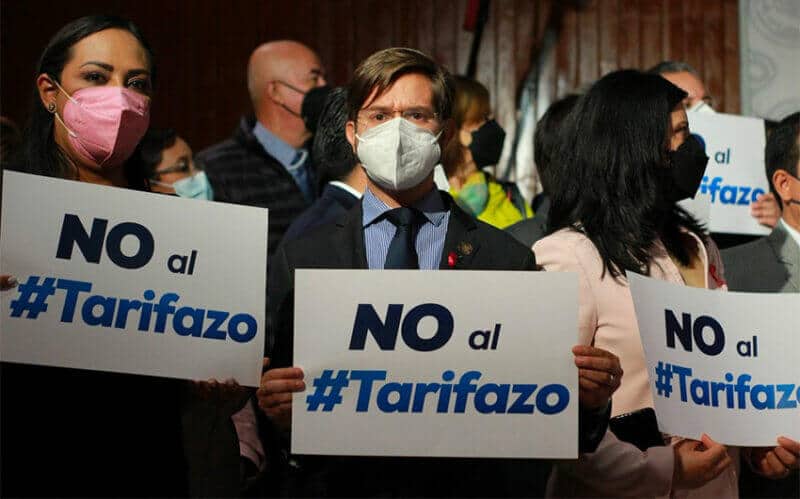
PAN lawmakers held up placards in the Chamber of Deputies on Tuesday, and at Romero’s press conference, to express their opposition to what they believe would be a tarifazo, or steep increase to electricity prices.
The PAN has an ally in the Mexican Institute for Competitiveness (IMCO), a think tank, which warned that the approval of the reform “would represent a historic setback for the construction of a more competitive Mexico.”
IMCO said the proposal, if approved, would create a situation in which the CFE is both an electricity generator and a regulator of the same market.
“In other words the company would have the authority to establish rates and grant permits as well as decide which power plants can inject their electricity into the grid and when,” it said.
The think tank said electricity prices would increase and greater damage would be inflicted on the environment, as the CFE is heavily reliant on fossil fuels and renewable companies’ participation in the market would be limited.
It said that strengthening the CFE – a stated aim of the president – requires recognition that the company “doesn’t have the resources to be the sole player in all links of the electricity value chain – generation, transmission, distribution and commercialization.”
The company should instead “prioritize those segments that generate greater profitability, such as its legal monopolies in electricity transmission and distribution and its fuel buying and selling business,” IMCO said.
“Instead of strengthening the company, the initiative weakens it by forcing it to carry out activities in which it loses money.”
Energy analysts have said the reform would hinder investment in Mexico’s energy sector, which would have a knock-on effect on economic growth.
With reports from El Universal and Milenio