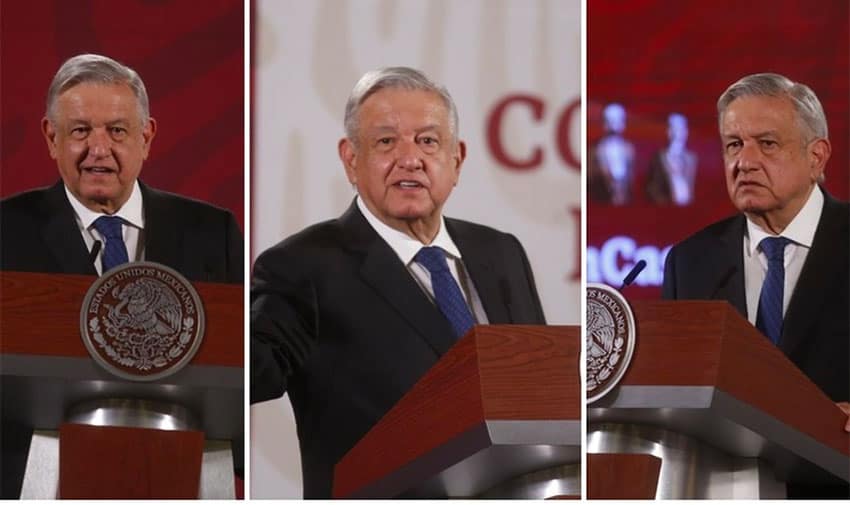
There can be no denying that President López Obrador has a penchant for lengthy political discourse: every weekday morning he appears before reporters at the National Palace in Mexico City to respond to questions during a press briefing that lasts up to two and a half hours.
But how valuable are the daily press briefings when, as the newspaper The Guardian notes in a report published on Monday, the president’s “verbose responses” often don’t provide an actual answer to the question he was asked?
Not valuable at all, says Javier Garza, a journalist in Torreón, Coahuila. He told The Guardian that when AMLO, as the president is commonly known, first began his weekday press briefings shortly after he was sworn in as president in December 2018, they were “a useful and novel method of presidential communication.”
However, the news conferences later became “a predictable spectacle without any value,” Garza said, although he acknowledged that reporters at least have the chance to pose a question to the president, an opportunity that only presented itself very rarely during the governments of many past presidents including AMLO’s predecessor, Enrique Peña Nieto.
“The president has not tried to flee,” Garza said.
But it’s not only long-winded, often evasive answers, that punctuate the president’s 7:00 a.m. pressers: López Obrador is also known for bending the truth.
Verificado, a fact-checking initiative, said in December that more than half of the statements AMLO made in his first year in office were false or misleading. His lies and half-truths extended across a range of government matters including migration, crime, the economy, welfare and education.

More recently, the coronavirus crisis has been subjected to the president’s “looseness with the truth” treatment, with López Obrador claiming at one recent press conference that Mexico’s epidemic curve had “flattened” even as statistics from his own Health Ministry showed that cases continued to steadily rise.
Verbal attacks on past presidents as well as political opponents or those perceived to be – the newspaper Reforma is a favorite target – are also often entwined in AMLO’s wordy responses as are staunch defenses of his government’s policies, actions and plans.
The president’s potshots, impassioned pleas – AMLO often asks criminals to think of their mothers before committing crimes – loquacious lecturing and remarks made in self-defense all add to the theatrics of his daily press briefing on their own, while put together they help him to achieve his overarching aim: to dominate the daily news cycle.
López Obrador is more concerned about dominating the news cycle than the quality of the message he sends, says Federico Estévez, political science professor at the Autonomous Technological Institute of Mexico.
“It works just like it works for [United States President Donald] Trump,” he told The Guardian.
“It doesn’t matter what the quality of the communication is, it dominates the [news] cycle. That’s all it’s about. That’s all it’s supposed to be about,” Estévez said.
The president’s pugnacity in going after both media that covers him less than favorably and his political opponents has riled many Mexicans – including the press freedom advocacy organization Article 19 – but according to a historian at the Iberoamerican University, López Obrador’s tendency to pick fights only endears him more to his ardent followers.
“This is the charm for his followers,” Ilán Semo said. “They believe in him like they would a preacher.”
Source: The Guardian (en)