A federal auditor has defended the methodology used to calculate the cost of canceling the previous government’s international airport project at Texcoco, México state, saying that it was consistent and internationally recognized.
The Federal Auditor’s Office (ASF) said in late February that canceling the new Mexico City airport project will cost almost 332 billion pesos (US $15.8 billion), an estimate more than three times higher than that of the federal government.
However, after President López Obrador rejected the estimate and called for the auditor’s office to explain how it reached the figure, the ASF said that there were “inconsistencies” in its calculation and that the audit was undergoing “exhaustive revision.”
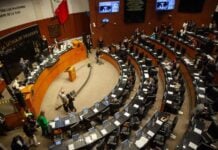
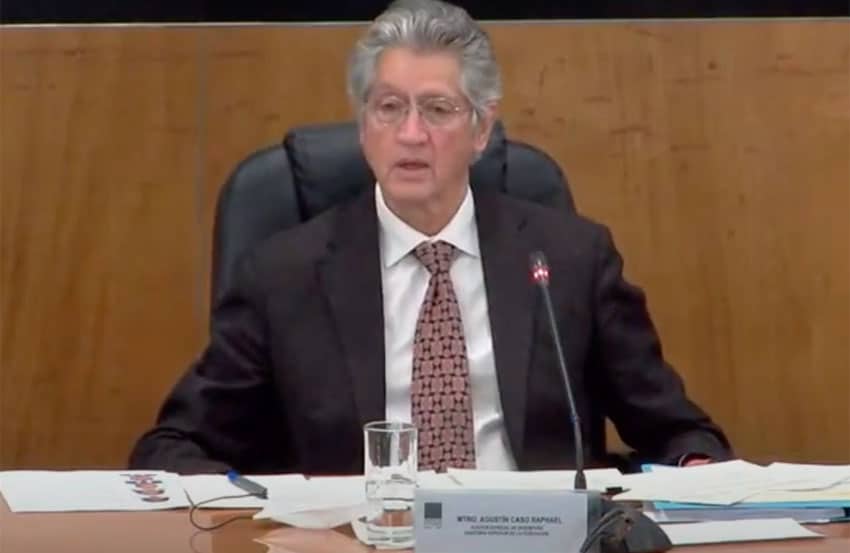
In an appearance before an audit supervision committee of the lower house of Congress on Tuesday, ASF special performance auditor Agustín Caso – temporarily removed from the role as the revision takes place – denied that there was deceit or political motivation in the airport audit results.
(López Obrador canceled the partially-built US $15-billion project after a legally questionable public consultation held a month before he took office in late 2018.)
“The Federal Auditor’s Office adhered to due process and the [correct] methodology. …. There is no bad faith, there is no error,” Caso said.
The auditor said that if the ASF had acted in bad faith or inflated the cost of canceling the airport for political purposes – to damage the government, in other words – it would be a “serious issue” because the auditor’s office has a responsibility to “contribute to the good performance” of the government.

While denying that there were errors in the audit, Caso told deputies that he hadn’t come before them to defend the ASF figure and the validity of the audit process to such an extent as to completely repudiate other opinions.
“There are different perspectives and legal processes that air differences,” he acknowledged.
Caso pointed out that the Ministry of Communications and Transportation didn’t raise any objections to the audit result. He declined to respond to questions about the “inconsistencies” in the audit to which the ASF admitted because an investigation into them is currently taking place.
The federal government faced numerous legal challenges over its decision to cancel the Texcoco airport project and several injunctions were granted against the Santa Lucía airport, which is currently under construction at an Air Force base north of Mexico City.
The injunctions stalled work on the government’s cheaper alternative but they were ultimately unable to stop it. A new military base at the Santa Lucía facility was officially opened last month and the site’s commercial airport is expected to open in March 2022.
Source: Reforma (sp)