



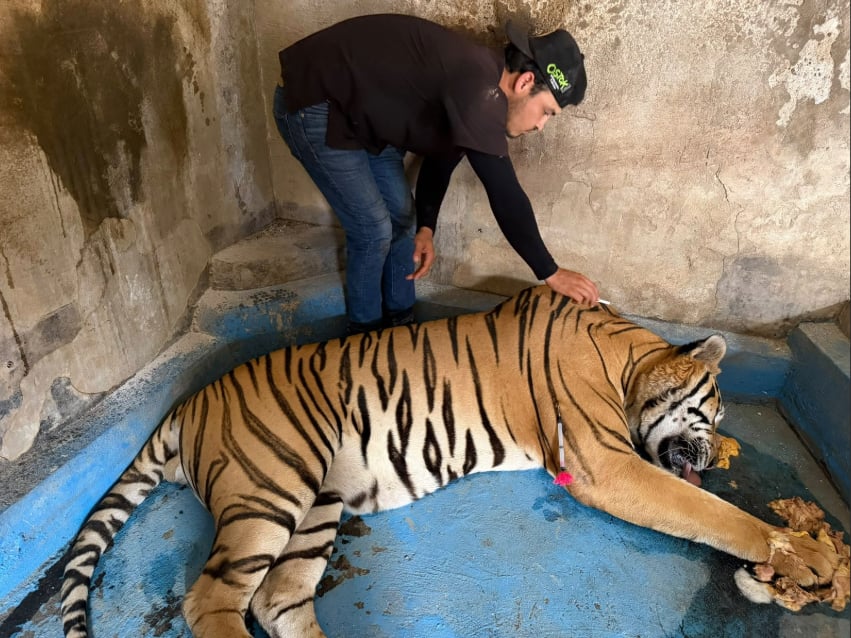
Authorities in Mazatlán found four Bengal tigers in a gated lot behind a former nightclub this week, marking the latest big-cat seizure in a country where wildlife trafficking persists.
Federal officers also seized four pavorreales (peacocks), five vehicles, a trailer and the property in the Francisco I. Madero neighborhood, an area that includes a zona de tolerancia (red-light district). It’s about six to eight kilometers inland from Mazatlán’s beachfront hotel zone.
View this post on Instagram
The operation began Monday when National Guard members in the state of Sinaloa received a citizen complaint about constant roars. After officers confirmed the roars as well as bird sounds, the area was secured and a federal prosecutor obtained a judicial warrant.
According to reports, the animals went to the Ostok Sanctuary, north of Mazatlán, at the request of the Federal Attorney for Environmental Protection (Profepa). Ostok used to have another site near Culiacán, the capital of Sinaloa, but it shut down last year and its roughly 700 animals were relocated because of nearby cartel violence.

This week’s transfer occurred Tuesday after the sanctuary’s team sedated the tigers: a white cub about 5 months old, a yellow cub about 7 months old and an adult pair.
All the animals were reportedly in good health.
Ostok Sanctuary President Ernesto Zazueta said the animals were found in “a place that they apparently used for experiments with animals or some kind of handling, because there was a wall full of photographs,” the news source EFE reported.
Prosecutors are investigating a possible crime against biodiversity, the newspaper El Debate Sinaloa reported. No reports mention arrests, and the tigers’ legal fate is undecided.
It was not Sinaloa’s first such case. In April 2025, Ostok rescued two Bengal tigers, a white tigress and a yellow tiger from an abandoned lot in the Golden Triangle, a mountainous region known for organized crime.
Wildlife trafficking is ‘out of control’ in Mexico
Throughout the country, animal trafficking remains widespread. A 2022 Center for Biological Diversity study concluded that “Wildlife trafficking in Mexico is out of control.”
Seizures include not only Bengal tigers, but many other animals, as well. Just this week, Profepa reported rescuing 70 turtles and a chameleon being moved illegally in Chihuahua state, 88.9 Noticias reported.
In Tlaxcala state, Profepa reported that police seized six wild birds and arrested two people for illegal possession of wildlife at a livestock market. The birds were two yellow-headed parrots, whose sale is prohibited, and four American kestrels; the vendors did not have documents proving the birds’ legal origin.
Profepa reported 1,119 Facebook and Instagram posts for possible illegal wildlife sales from May 2025 to June 2026, the agency said in a news release.
Titled “Profepa strengthens actions to detect and combat the illegal sale of wildlife on social media,” the release noted that Profepa worked with Meta — the platforms’ parent company — and that 640 of the posts, or 57%, were removed or resolved.
With reports from Ríodoce, El Debate Sinaloa and EFE