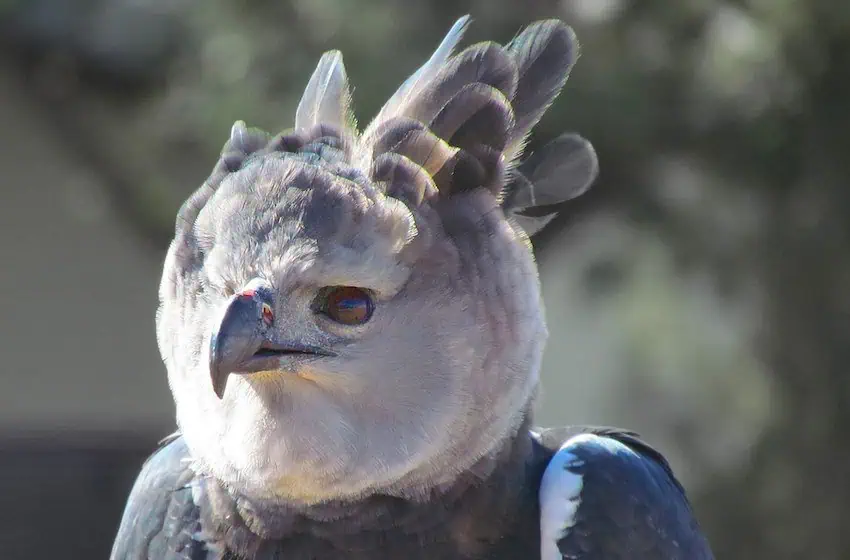
The harpy eagle — a striking, almost mythical-looking species thought extinct in Mexico — has been documented in the Lacandon Jungle of Chiapas, marking a landmark moment for conservationists.
The discovery of the elusive eagle, announced this month at the Chiapas Birding and Photo Festival, follows nearly a decade of community-led monitoring in the region.
🦅 | El águila arpía, una de las aves rapaces más grandes y majestuosas del mundo, resalta por su belleza natural. pic.twitter.com/1MiPohSZ9j
— UHN Plus (@UHN_Plus) January 25, 2024
“For many years, the scientific community considered it an extinct species in Mexico,” said Alan Monroy-Ojeda, a conservationist with a Ph.D. in tropical ecology. “Now, we can announce to the world that harpy eagles still exist here.”
He also said the sighting will be backed by a forthcoming article in a scientific publication, but didn’t say which.
Listed as endangered under Mexican law, the harpy eagle is one of the world’s largest birds of prey, with females typically being larger than males. Though both have a wingspan that can reach 2.2 meters (7 feet), females generally weigh 6 to 9 kilograms (13 to 20 pounds), with males generally 4 to 6 kilograms.

Both sexes are skilled hunters whose diets are dominated by arboreal mammals like monkeys and sloths.
The harpy breeds only once every two to three years, which is unusual among birds and contributes to its rarity, and females manage to conceive only one baby per nesting effort.
Its global population number is estimated to be 20,000 to 50,000, but that range is not very precise. Their biggest numbers are in South America, especially Brazil, while their populations in Central America are extremely small or nearly extirpated, with no reliable numbers available.
The harpy eagle’s reappearance in Chiapas — a southeastern Mexican state historically part of its range — comes after a 2011 photograph by an Indigenous guide near the Mexico-Guatemala border reignited search efforts.
Monroy-Ojeda credited the monitors from Siyaj Chan, a group of Indigenous community members who live near the Chiapas-Guatemala border. Its participants conduct regular field visits and wildlife monitoring, and have received training and equipment.

Monroy-Ojeda is the scientific director for Dimensión Natural, a Mexican organization dedicated to studying, documenting, and protecting priority species and their habitats — especially neotropical birds of prey in the Lacandon Jungle.
He warned that the harpy eagle (Harpia harpyja) population remains critically small, citing deforestation and habitat fragmentation as existential threats. He and others are scouting for the best areas to implement a reintroduction strategy to strengthen the conservation of the bird.
“The challenge of conserving this eagle is everyone’s,” he said, acknowledging collaborations with Mexico’s National Commission of Natural Protected Areas (CONANP), Natura y Ecosistemas Mexicanos (a 20-year-old nonprofit dedicated to protecting biodiversity in the Lacandon Rainforest in Chiapas) and local communities.
Efraín Orantes Abadía, a conservationist who witnessed the eagle, recalled his encounter: “It flew next to us, giving incredible shots. Today, there’s hope we can save this majestic bird.”
The Lacandon Jungle, a biodiversity hotspot sometimes affected by cartel violence, has also been a refuge for other rare species, including a black-and-white hawk-eagle whose first Mexican nest was documented in 2023.
Both species face pressures from logging and agricultural expansion, though community-led ecotourism and habitat protection initiatives aim to counter these threats.
Also, both are linked to superstitions and popular beliefs in Indigenous cultures.
The harpy eagle, for example, was sometimes considered a witch or a supernatural being, which led to its persecution and hunting.
Its return offers a fragile victory.
“Immediate action is urgent,” Monroy-Ojeda stressed. “Mexico’s forests — and the life they sustain — are disappearing daily.”
With reports from Aristegui Noticias, Mongabay.com and Por Esto!