In order to ensure that the Jalisco New Generation Cartel (CJNG) maintained the ability to traffic drugs through Tijuana and into the United States, a group of cartel enforcers employed “rampant violence,” according to the U.S. government.
The United States Attorney’s Office for the Southern District of California issued a statement Monday advising that a superseding indictment and arrest warrants were recently unsealed in a federal court against alleged Mexican drug cartel enforcement leaders in connection with their violent support of heroin and methamphetamine trafficking.
Members of the cartel enforcers group, known as Los Cabos, are charged with conspiracy to distribute and import controlled substances.
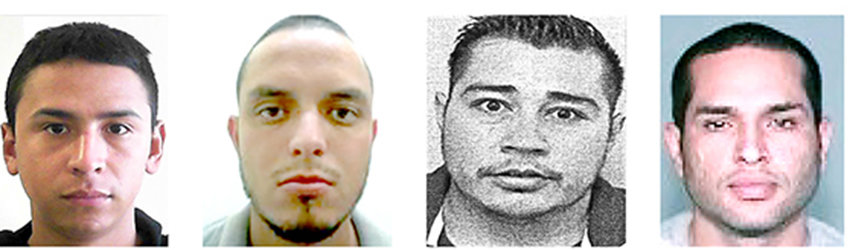
Among the accused are Edgar Herrera Pardo, also known as Caiman; Carlos Lorenzo Hinojosa Guerrero, aka Cabo 96; Édgar Pérez Villa, aka Cabo 89; and Israel Alejandro Vázquez-Vázquez, aka Cabo 50.
According to court filings filed by the U.S. government, the four men were leaders of Los Cabos. The group operated in Baja California to secure control of the region for the CJNG, generally considered Mexico’s most powerful and violent criminal organization.
“Los Cabos allegedly employed rampant violence to ensure that [the] CJNG maintained the ability to traffic drugs through Tijuana, Mexico, and into the United States through San Diego,” the U.S. Attorney’s Office said.
“Indeed, in one approximately 6.5-month period of judicially-authorized interceptions of a group chat operated by leaders of Los Cabos, these individuals planned over 150 murders, the majority of which took place in Tijuana, according to the filings.”

The U.S. government alleges that the cartel enforcers’ “bloody reign of terror” included the murder in Tijuana in November 2018 of two teenaged United States citizens from Chula Vista, California.
“The government also alleges that Los Cabos targeted law enforcement in Tijuana, killing at least three police officers,” the Attorney’s Office said.
“Los Cabos allegedly engaged in this violence in support of CJNG, one of the most dangerous transnational criminal organizations in the world. The cartel has its hands in trafficking multiple deadly substances. It is responsible for moving tons of cocaine, methamphetamine and fentanyl-laced heroin into the United States,” it said.
“CJNG is also a prolific methamphetamine producer and chemical importer, using precursors procured from China and India. CJNG is one of the most powerful Mexican cartels operating within the United States,” the Attorney’s Office said, adding that the organization is “the most well-armed cartel in Mexico” and “has contributed to a catastrophic trail of human and physical destruction.”
Acting U.S. Attorney Randy S. Grossman said that authorities are determined to hold cartel operatives to account.
“For too long, powerful cartels have visited unspeakable violence on Tijuana, a city that is right next door to San Diego,” he said.
“We will continue our campaign to end the cartels’ reign of terror and stop the flow of drugs across the border by prosecuting the highest-ranking leaders and enforcers.”
Grossman praised U.S authorities, including Drug Enforcement Administration (DEA) agents, for their work on the Los Cabos case and thanked Mexico’s federal Attorney General’s Office for assisting.
DEA Special Agent in Charge John W. Callery said that cartels such as the CJNG “not only perpetrate violence and murders that affect our neighbors south of the border, but their drugs cause death and destruction in our own communities.”
If arrested and convicted, the Los Cabos members face up to life imprisonment and a US $10 million fine for drug importation offenses and the same penalties for narcotic distribution crimes. There is a mandatory minimum sentence of 10 years’ imprisonment for both crimes.
The CJNG’s leader, Nemesio Oseguera “El Mencho” Cervantes, is also a wanted man in the United States, where authorities are offering a $10 million reward for information leading to his arrest.
Mexico News Daily