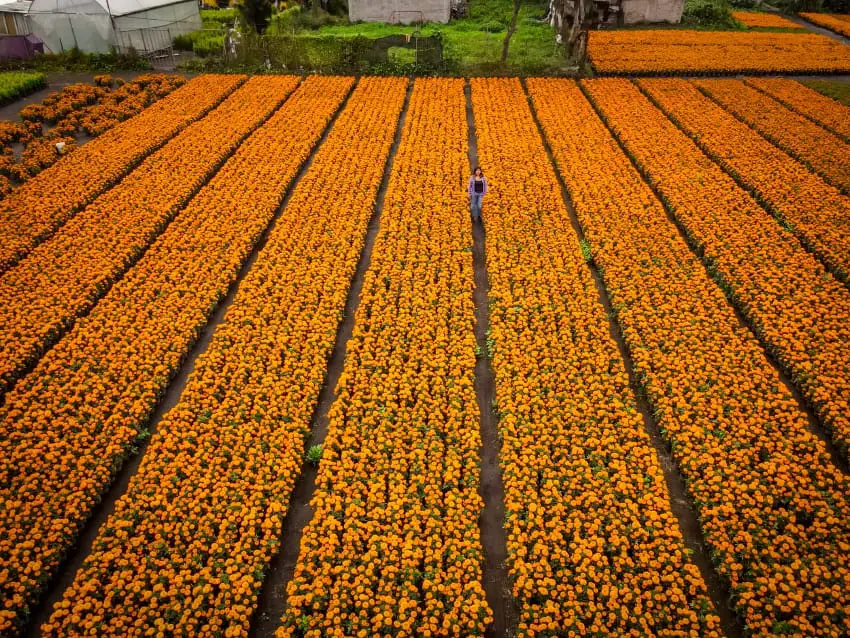
Cempasúchil flowers are not only used for decorating altars

This year’s celebration of Day of the Dead will see many families return to cemeteries that had been closed during the pandemic, bearing food, drinks and of course, flowers.

The cempasúchil (marigold) – which is native to Mexico and grown in various states – is the most ubiquitous of the traditional flowers used to decorate ofrendas and tombs, and has been a symbol of the cycles of life and death since ancient times. 

The Ministry of Agriculture has announced that 27 million plants were harvested this season, equivalent to 20,245 tonnes.

Since 2016, domestic producers have found a new opportunity for additional income by selling leftover flowers to food processing companies. Each season, there is about 30% leftover unsold from the harvest. Major companies like Barcel and Sabritas use the bright carotenoid pigments in the flowers as a colorant in  their food products (cheetos, anyone?) and are seeking to increase the country’s supply of this raw material.

To secure good quality flowers, companies advance 25% of the total payment to growers to buy quality seeds. Then they start planting  in August, when they sow about 35 hectares in greenhouses to ensure they bloom by October. This agreement is known as “contract farming.” 

Today, 90 growers from the areas of Atlixco and Huaquechula sell the flower both as a seasonal ornamental piece for the Day of the Dead, and as a food component after the season ends.

According to industry representative Eduardo Robelo Estrada, quoted in the newspaper El Economista, the objective is to cultivate 65 hectares in the next three years to supply larger companies that export to the U.S.

With reports from El Economista and Excelsior


Have something to say? Paid Subscribers get all access to make & read comments.
Manzanillo, Colima, México, 13 de marzo de 2026. La doctora Claudia Sheinbaum Pardo, presidenta Constitucional de los Estados Unidos Mexicanos en conferencia de prensa matutina, “Conferencia del Pueblo” desde Colima. La acompañan Indira Vizcaíno Silva, gobernadora Constitucional del Estado de Colima; Omar García Harfuch, secretario de Seguridad y Protección Ciudadana (SSPC); Raymundo Pedro Morales Ángeles, secretario de Marina (Semar); Bulmaro Juárez Pérez, divulgador de lenguas originarias, presentador de la sección “Suave Patria”; Ricardo Trevilla Trejo, secretario de la Defensa Nacional (Sedena); Jesús Antonio Esteva Medina, secretario de Infraestructura, Comunicaciones y Transportes; Bryant Alejandro García Ramírez, fiscal general del Estado de Colima; Fabián Ricardo Gómez Calcáneo; Rocío Bárcena Molina, subsecretaria de Desarrollo Democrático, Participación Social y Asuntos Religiosos de la Secretaría de Gobernación; Efraín Morales López, director general de la Comisión Nacional del Agua (Conagua); Marcela Figueroa Franco, secretaria ejecutiva del Sistema Nacional de Seguridad Pública (SESNSP) y Guillermo Briseño Lobera, comandante de la Guardia Nacional (GN). Foto: Saúl López / Presidencia

Mexico’s week in review: Congress deals Sheinbaum her first legislative defeat

1
The week of March 9 in Mexico was marked by standoffs between allies in Congress and adversaries at the airport. Here's what you missed.
A soldier displays seized handguns

The US and Mexico, growing together and growing apart: A perspective from our CEO

1
From a historic drop in homicides to opposite bets on electric vehicles, Mexico News Daily's CEO breaks down where the U.S. and Mexico are converging — and where they're not.
Veracruz Gov.

Veracruz governor blames private vessel for 200-kilometer Gulf Coast oil spill

1
The spill, which has spread to over 200 kilometers of Mexico's Gulf Coast beaches, has been traced to a private oil tanker off the coast of Tabasco.
BETA Version - Powered by Perplexity