Citizens’ aggression against military seen as organized crime tactic

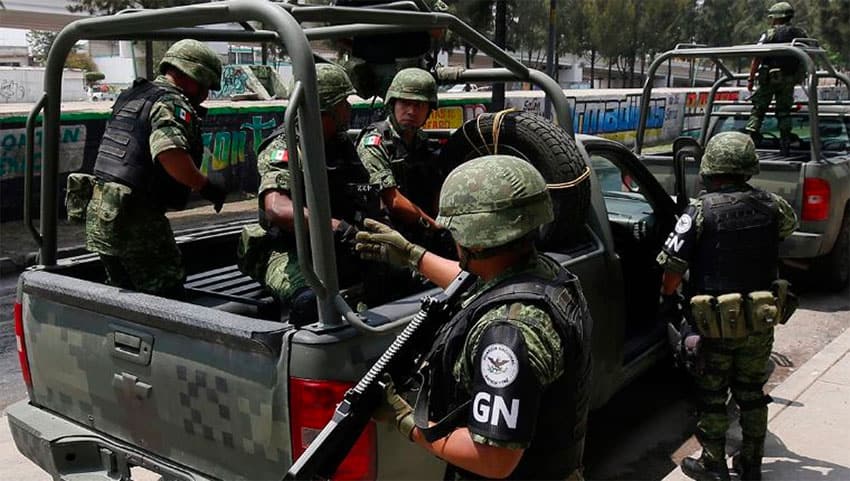
Recent acts of aggression by citizens towards soldiers could have been ordered by organized crime groups, according to retired military generals.

Clashes between residents of states such as Michoacán, Guerrero and Querétaro and the Mexican army have become increasingly common in recent months.

Examples include an attack on September 7 by residents of the Queretaro municipality of San Juan del Río, who threw stones at soldiers after they arrived at a location where a train was being looted, and two incidents in Michoacán late last month in which military personnel were assailed with firearms, shovels and brooms.

According to Benito Medina Herrera, a former army general who is now a federal lawmaker for the Institutional Revolutionary Party, it is possible that at least some of the acts of aggression towards soldiers were ordered by criminal groups.

He said that in some parts of the country, gangs order women and children to confront the army when their interests are threatened because they know that soldiers won’t retaliate against them.

“. . . They take advantage of those circumstances in order to be able to confront the armed forces . . .” Medina said.

“In other places, I believe there are families . . . that are involved in organized crime or crime in general and they go out to defend [their interests] . . .” he added.

José Francisco Gallardo, a retired general who is now a professor at the National Autonomous University, agreed with Medina that citizens’ aggression towards soldiers could be linked to organized crime.

He described attacks on the army as “demeaning” for soldiers and charged that they don’t have sufficient training to deal with them.

Gallardo also said that there is a lot of discontent among soldiers because they are forced to carry out public security tasks. He claimed that there have been almost 1,000 desertions since the new government took office in December.

While Federal Police are unhappy about being transferred into the National Guard, soldiers are angry about having to do the work of a policeman, Gallardo said.

Source: El Economista (sp) 

Have something to say? Paid Subscribers get all access to make & read comments.
Manzanillo, Colima, México, 13 de marzo de 2026. La doctora Claudia Sheinbaum Pardo, presidenta Constitucional de los Estados Unidos Mexicanos en conferencia de prensa matutina, “Conferencia del Pueblo” desde Colima. La acompañan Indira Vizcaíno Silva, gobernadora Constitucional del Estado de Colima; Omar García Harfuch, secretario de Seguridad y Protección Ciudadana (SSPC); Raymundo Pedro Morales Ángeles, secretario de Marina (Semar); Bulmaro Juárez Pérez, divulgador de lenguas originarias, presentador de la sección “Suave Patria”; Ricardo Trevilla Trejo, secretario de la Defensa Nacional (Sedena); Jesús Antonio Esteva Medina, secretario de Infraestructura, Comunicaciones y Transportes; Bryant Alejandro García Ramírez, fiscal general del Estado de Colima; Fabián Ricardo Gómez Calcáneo; Rocío Bárcena Molina, subsecretaria de Desarrollo Democrático, Participación Social y Asuntos Religiosos de la Secretaría de Gobernación; Efraín Morales López, director general de la Comisión Nacional del Agua (Conagua); Marcela Figueroa Franco, secretaria ejecutiva del Sistema Nacional de Seguridad Pública (SESNSP) y Guillermo Briseño Lobera, comandante de la Guardia Nacional (GN). Foto: Saúl López / Presidencia

Mexico’s week in review: Congress deals Sheinbaum her first legislative defeat

0
The week of March 9 in Mexico was marked by standoffs between allies in Congress and adversaries at the airport. Here's what you missed.
A soldier displays seized handguns

The US and Mexico, growing together and growing apart: A perspective from our CEO

1
From a historic drop in homicides to opposite bets on electric vehicles, Mexico News Daily's CEO breaks down where the U.S. and Mexico are converging — and where they're not.
Veracruz Gov.

Veracruz governor blames private vessel for 200-kilometer Gulf Coast oil spill

1
The spill, which has spread to over 200 kilometers of Mexico's Gulf Coast beaches, has been traced to a private oil tanker off the coast of Tabasco.
BETA Version - Powered by Perplexity