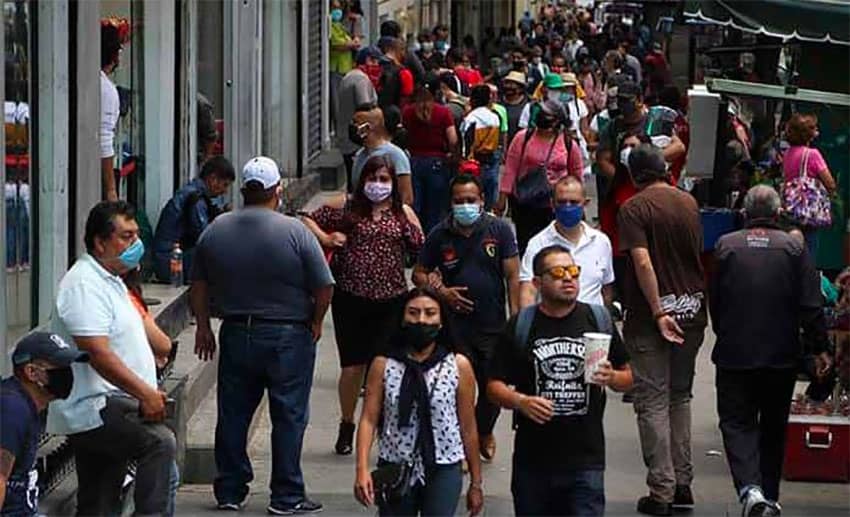
The Mexico City government has announced a new scheme aimed at limiting foot traffic in the historic center amid the coronavirus pandemic.
Authorities are asking residents to go to the capital’s downtown area on certain days depending on the first letter of their first surname.
Under the scheme, people whose surnames begin with the letters A to L should only travel to the historic center on Mondays, Wednesdays and Fridays. People whose surnames begin with the letters M to Z should only go to the downtown area on Tuesdays, Thursdays and Saturdays.
Mexico City Interior Minister Rosa Icela Rodríguez stressed that the initiative is voluntary but appealed to residents’ “goodwill” to help make it a success.
She also said that people should only go to the city’s downtown for reasons such as work and essential shopping, “not for pleasure.”
The announcement of the new surname-based initiative comes after hordes of shoppers descended on the historic center last week after the transition to “orange light” coronavirus restrictions allowed the reopening of more businesses, some of which failed to comply with health rules.
The government responded by shutting down the capital’s central core over the weekend as new reopening measures were drawn up.

The authorities announced Sunday that several streets in the historic center will be pedestrian-only in order to provide more space for citizens so that they can maintain a healthy distance from each other.
The zócalo, Allende and Merced subway stations will be closed while the coronavirus risk level remains high, said Transport Minister Andrés Lajous, explaining that the aim was to reduce the number of people traveling to the downtown area.
Only 50% of nonessential businesses will be permitted to operate on any given day – those with even number addresses will be allowed to open while those with odd numbers are closed and vice versa.
Health screening stations will be set up at different points in the downtown area, where city officials will conduct temperature checks and encourage people to wear face masks. The use of face masks is supposedly mandatory in the capital but large numbers of people flout the rule, which has generally not been enforced.
Rodríguez said that starting Monday businesses that don’t comply with restrictions on their permitted opening days, the number of people that can enter at any given time and the directive for both employees and customers to use face masks will no longer be given warnings but rather forcibly closed for two weeks.
Entire streets where 30% or more businesses are flouting the health rules will be closed for an undisclosed period.
Mexico City is one of 17 states that was allocated an “orange light” Friday on the federal government’s color-coded “stoplight” map, used to indicate the risk of coronavirus infection, while the other 15 states will face “red light” restrictions at least until the end of this week.
The capital, however, still has the largest active outbreak in Mexico, with 4,058 people testing positive after developing coronavirus symptoms in the past 14 days, according to official data.
Mexico City also has the highest accumulated Covid-19 case tally and death toll in the country, with 52,210 of the former and 6,963 of the latter.
Source: El Universal (sp)