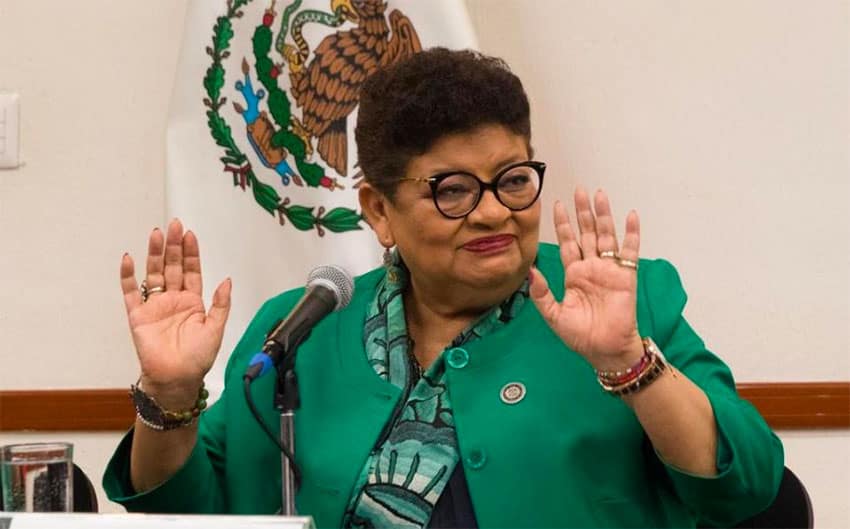
Mexico City Attorney General Ernestina Godoy will continue to head up the justice system as the city switches over to the new fiscalía general (FGJ), which began operations on Friday.
Godoy, who will hold the office for four years, said the new public prosecutor’s office will transform the way the city seeks justice and “will put reparation of damages first.”
“It’s an autonomous institution of the state that belongs to all of us. [The former Attorney General’s Office] that was left behind was anchored to old practices and stuck in the past,” she said at an inaugural ceremony outside Mexico City’s Interactive Museum of Economy.
“The creation of the FGJ represents a unique opportunity to build a true institution at the service of justice, which acts with the perspective of gender and investigates with professionalism and scientific rigor.”
She emphasized that violence against women will continue to be a priority for the new office and that her decisions as public prosecutor will not be subject to political calculations or media judgments.
Among her objectives are attending to complaints within 15 minutes, improving digital reporting of crimes, creating a DNA database and forming a group of professionals to work alongside the prosecutor’s office, investigative police and experts, among other goals.
She will also hire more forensic experts and increase training for her office’s agents and the investigative police, as well as create a system that allows victims of home burglaries to make reports from their homes, attended by officers.

Godoy said her goal is to create a climate in which citizens are more likely to report crimes, saying it was the best tool for combating impunity, adding that the new office will get rid of the disincentives people have for not reporting.
“The challenge ahead of us is enormous and demands an unbreakable commitment to justice and honesty of all who work here,” she said.
“For the majority of people, going to the public prosecutor’s office is a problem, not the solution,” she said after listing off over a dozen reasons people are afraid to report crimes.
Among them: opacity, corruption, inefficiency, poor treatment, enormous wait times, negligence, leaks, fabricated guilty verdicts, revictimization, omissions, deficient investigations, torture practices, complicity with crime, lack of personnel, technological delays, violations of due process, nepotism and clandestine prisons.
She also promised to execute all the arrest warrants in her office that have gone unresolved for years.
Creation of the fiscalía general is part of a process that began several years ago to strengthen the justice system with a public prosecutor’s office that was autonomous and independent of the executive branch of the government.
The federal Attorney General’s Office became the Fiscalía General de la República last year but criticism followed the appointment of someone close to President López Obrador to be the chief prosecutor. Naming Alejandro Gertz Manero to the position would affect its impartiality, critics said.
Critics spoke again following Godoys’ appointment as Mexico City’s chief prosecutor in December, citing her role as an activist in a political party. She is a former federal deputy and one of the founders of the ruling Morena party.
Gertz and Godoy have each been described by critics as a fiscal carnal, meaning they are government-friendly.
Source: Milenio (sp)