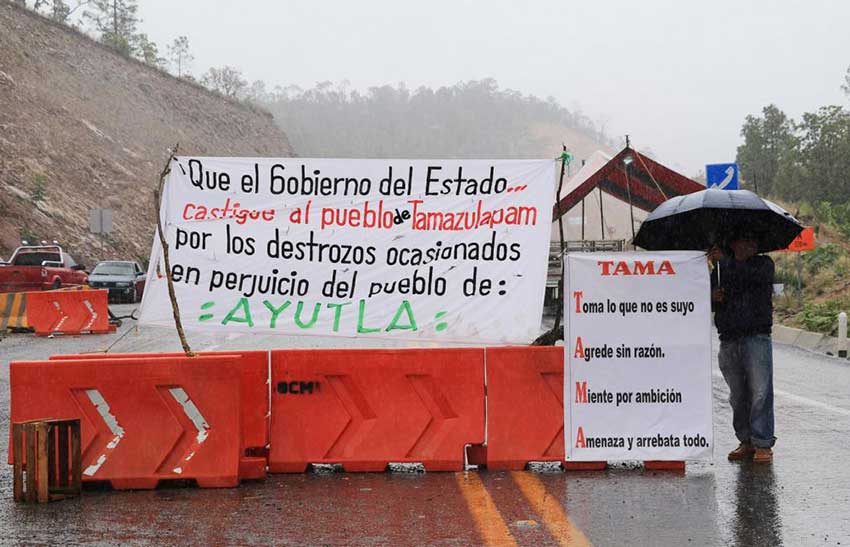
Land disputes in Oaxaca are common but a current conflict between residents of two municipalities is over access to drinking water.
A year and a half ago, authorities in San Pedro y San Pablo Ayutla, a municipality in the state’s Mixe region about 100 kilometers southeast of Oaxaca city, connected to the water supply of the neighboring municipality of Tamazulápam del Espíritu Santo when their own supply ran dry.
However, before doing so they failed to ask for permission, according to reports, triggering a conflict between comuneros (community landowners) in the two municipalities.
On May 17, 2017, a violent clash broke out between the two opposing groups, with both guns and sticks used in an ugly confrontation.
One person died, two people were kidnapped, dozens were injured and scores of houses were destroyed.
Tamazulápam councilor Román Rodríguez told the newspaper Milenio that an attempt by Ayutla residents to direct all the water to that municipality led to the violence.
“On that occasion, they blocked the passage [of water] to our pipes and dynamited our catchment system, they wanted all the water for themselves,” he said.

Ayutla Mayor Yolanda Pacheco described the clash as “a horrible encounter.”
Ever since, water supply to Ayutla has been cut off, forcing residents to find an alternative source or look to the sky for relief.
Since this year’s rainy season began three months ago, Ayutla resident Hermelinda Hernández and her children go out with buckets whenever the heavens open to collect rainwater for their everyday needs.
Hernández’s neighbors, one of whom is her brother, do the same.
But things are more difficult when there is no rain.
“Before the rainy season, we had to go to a well that’s four kilometers down the mountain and fill our five-liter containers . . .” said Bernardo Hernández.
“The problem isn’t going down but rather having to walk [back up] for 40 minutes in the forest with the container on your shoulders or with a rope around your forehead,” he explained.
The Ayutla mayor said the lack of clean water is taking a heavy toll on the municipality’s residents.
“In Ayutla alone there are 5,686 citizens and those who have been affected the most are the elderly. There are already people who are sick and the outbreaks of gastrointestinal infections are becoming more frequent. Our children bathe every third day and us adults, once a week,” Pacheco said.
State authorities say they have tried to solve the problem by holding 17 meetings aimed at reaching an agreement between the two municipalities so that together they can install a new water capture and storage system to supply both.
However, a resolution has not yet been reached.
Residents of both municipalities are instead insisting that the National Water Commission (Conagua) and the state government install the new system in order to avoid further confrontations in the future.
Lack of a reliable water supply and water scarcity are major problems in several parts of Mexico.
Almost nine million Mexicans don’t have access to drinking water, according to Conagua, while a further 13 million rely on deliveries from water tankers or obtain their water from contaminated wells.
One solution is to install specially designed rainwater harvesting systems, which Mexico City organization Isla Urbana is doing in some of the capital’s most marginalized neighborhoods.
Source: Milenio (sp)