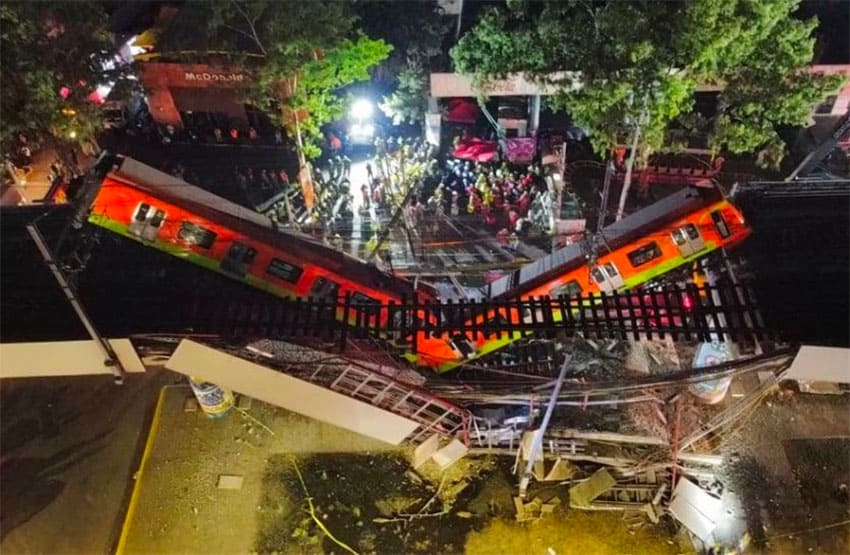
The collapse of an elevated section of the Metro in Mexico City last month that killed 26 was caused by a series of faults during construction, according to the preliminary results of an independent inquiry.
The findings could deal a blow to foreign minister and presidential hopeful Marcelo Ebrard, who was the capital’s mayor when the line was built, and Carlos Slim, Mexico’s richest man, whose Carso Infrastructure and Construction company built the infrastructure.
Slim, one of the closest businesspeople to President López Obrador, is also building part of the president’s flagship Maya Train in the Yucatán peninsula.
According to the report from Norwegian group DNV, made public at a news conference on Wednesday, the accident was caused by “structural faults associated with deficiencies in the construction process.”
They included missing studs, the use of a type of concrete inconsistent with the original design, among other discrepancies, and poorly executed soldering.
A Carso spokesman had no immediate comment. Arturo Elías, Slim’s son-in-law and spokesperson, said he would not comment until the inquiry was complete. In a statement, Ebrard defended the design and execution of the line, saying all decisions had been taken “based on efficiency and technical aptitude” by experts and officials.
Mexico City Mayor Claudia Sheinbaum stressed that the findings regarding the “terrible tragedy” were preliminary. DNV expects to publish two more sets of findings, on July 14 and August 30.

She said an expert commission would present a rehabilitation blueprint in one month. It would be up to the city’s attorney general to determine responsibility for the accident, she added.
López Obrador has lamented the accident but said “the poor, hardworking, good people” in the area where the line collapsed “understand that these things unfortunately happen.”
On Wednesday, before the release of the preliminary findings, he expressed support for Sheinbaum, who is widely considered his favorite candidate to succeed him as president.
The elevated section of the Metro’s Line 12, dubbed the “Golden Line,” collapsed without warning on to a busy road about five meters below late at night on May 3 in a southeastern suburb of the capital.
The line on one of the world’s busiest metro services has been plagued by problems, including the premature wearing of train wheels and rails, since it opened in 2012.
It was inaugurated by Ebrard in the final months of his term as mayor. Criticism of its design and construction emerged soon after Ebrard left office, and the state auditor’s office alleged there had been cost overruns, irregularities and shoddy work.
The line was partially closed in 2014-2015 to repair what the authorities described at the time as structural faults. Four stations were also shut after an earthquake struck the capital in 2017.
DNV’s preliminary findings appeared to back up an investigation by the New York Times, which found that steel studs essential to the strength of the elevated section had been badly welded, prompting the collapse. López Obrador and Sheinbaum have questioned the impartiality of that and other reports.
In a 15-page document, Ebrard refuted some of the Times’ allegations, saying “the questions … in some cases, are based on false premises or appear to suggest conclusions or assume an adversarial posture.”
© 2021 The Financial Times Ltd. All rights reserved. Please do not copy and paste FT articles and redistribute by email or post to the web.